

Top staffing MSP providers are companies that manage contingent workforce programs, IT staffing vendors, and talent supply chains for enterprises across the United States. They operate as centralized workforce partners, using Vendor Management Systems (VMS), data analytics, and compliance frameworks to optimize hiring, reduce costs, and improve talent quality.
In the U.S., the top 10 staffing MSP providers oversee billions in contingent labor annually and serve Fortune 1000 enterprises, federal contractors, healthcare systems, and technology firms. Businesses searching for a list of MSP companies or the top 10 MSP providers in USA typically evaluate scale, compliance capabilities, technology integration, and geographic reach.
Platforms like DiscoverMSPs provide verified data, rankings, and database access for identifying these providers efficiently.

What Are Top Staffing MSP Providers?
Top staffing MSP providers are specialized managed service providers that oversee an organization’s contingent workforce and staffing supply chain. They manage vendor selection, contract compliance, workforce analytics, and hiring optimization using structured technology systems like VMS platforms across U.S. enterprises.
Summary
- Manage contingent workforce programs
- Centralize vendor relationships
- Optimize staffing costs and compliance
- Integrate with HR and procurement systems
- Provide data-driven workforce reporting
Concise Explanation:
In the U.S. enterprise environment, staffing MSP providers act as strategic workforce managers, consolidating multiple staffing vendors into a unified program that ensures compliance, cost control, and scalable talent acquisition.
Key Entities Related to Top Staffing MSP Providers
Industry Entities
- Managed Service Providers (MSPs)
- Managed Security Service Providers (MSSPs)
- IT Staffing Firms
- RPO (Recruitment Process Outsourcing) Providers
- Workforce Solutions Companies
Technologies
- Vendor Management Systems (VMS)
- Applicant Tracking Systems (ATS)
- HRIS Platforms
- AI-driven talent analytics
- Cloud-based compliance tracking tools
Regulatory Authorities (USA)
- U.S. Department of Labor (DOL)
- IRS Worker Classification Guidelines
- Equal Employment Opportunity Commission (EEOC)
- Federal Acquisition Regulation (FAR)
Market Leaders (Staffing MSP Segment)
- Allegis Global Solutions
- Randstad Sourceright
- KellyOCG
- ManpowerGroup Solutions
- Pontoon Solutions
Frameworks & Standards
- ISO 9001 (Quality Management)
- SOC 2 Compliance
- GDPR (for global operations)
- U.S. labor classification compliance
How Top Staffing MSP Providers Work
Step 1 – Workforce Assessment
- Evaluate contingent labor spend
- Identify vendor fragmentation
- Audit compliance gaps
Step 2 – Vendor Consolidation
- Centralize staffing suppliers
- Negotiate rate cards
- Standardize SLAs
Step 3 – Technology Integration
- Deploy VMS platform
- Integrate HRIS & ATS
- Enable analytics dashboards
Step 4 – Continuous Optimization
- Monitor KPIs
- Track time-to-fill
- Reduce maverick spend
Types of Staffing MSP Models
Pure-Play Staffing MSP
Focused solely on workforce management.
Hybrid MSP + RPO
Combines contingent workforce with permanent hiring.
IT-Specialized MSP
Targets technology and cybersecurity roles.
Industry-Specific MSP
Healthcare, manufacturing, federal staffing.
Benefits of Top 10 MSP Providers in USA
- 10–25% reduction in contingent labor costs
- Improved worker classification compliance
- Reduced vendor redundancy
- Enhanced workforce visibility
- Standardized contract governance
Risks & Limitations
- Over-centralization risks
- Vendor resistance
- Implementation complexity
- Technology integration challenges
- Data privacy concerns
Cost Breakdown (USA Enterprise Estimates)
| Component | Estimated Cost Range |
| MSP Management Fee | 1–4% of contingent spend |
| VMS Licensing | $50,000–$250,000 annually |
| Implementation Costs | $75,000–$500,000 |
| Compliance Audits | Variable |
Industry Use Cases
- Fortune 500 IT transformation projects
- Healthcare staffing consolidation
- Federal contractor workforce compliance
- Enterprise cloud migration staffing
MSP vs Traditional Staffing
| Criteria | Staffing MSP | Traditional Staffing Agency |
| Vendor Management | Centralized | Individual contracts |
| Compliance | Standardized | Varies |
| Cost Efficiency | Optimized | Less structured |
| Technology Use | VMS-driven | Limited |
Trends 2026–2030
- AI-powered talent matching
- Increased worker classification scrutiny
- ESG-driven workforce transparency
- Expansion of gig economy integration
- Cybersecurity workforce MSP growth
Buying Guide – Selecting Top Staffing MSP Providers
Evaluate:
- U.S. compliance expertise
- VMS integration capability
- Industry specialization
- Scalability
- Reporting transparency
- Verified provider database access (via DiscoverMSPs)
Common Mistakes
- Selecting based on price alone
- Ignoring technology capabilities
- Failing to audit compliance record
- Overlooking data security standards
Market Insights & Industry Statistics (USA)
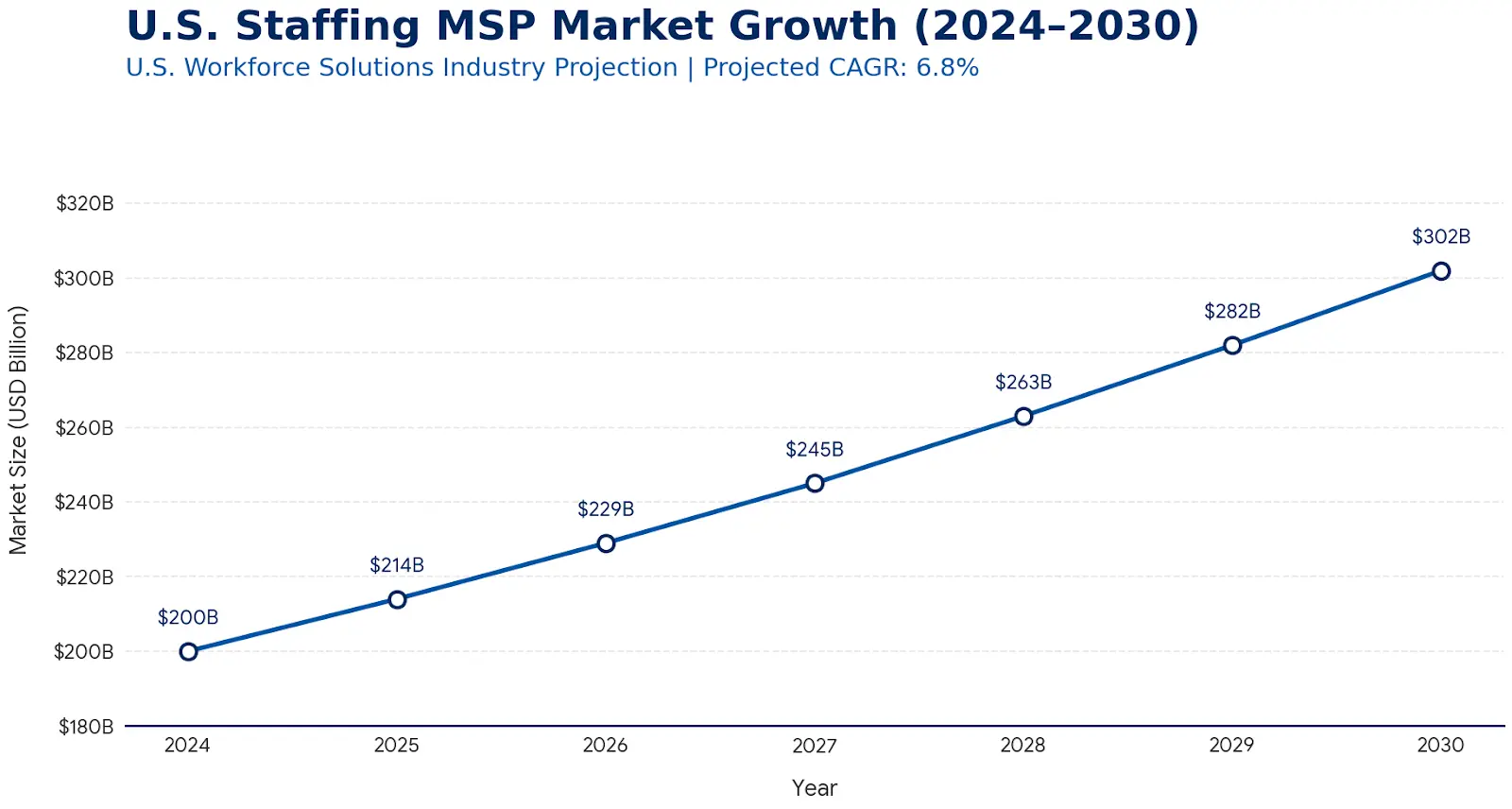
- The U.S. staffing industry exceeds $200 billion annually.
- Contingent workforce comprises ~35% of total U.S. workforce.
- MSP adoption among Fortune 1000 exceeds 65%.
- Workforce solutions market CAGR projected at 6–8% through 2030.
- IT staffing demand is expected to grow due to AI and cybersecurity talent gaps.
Demand drivers include:
- Digital transformation
- Cloud migration
- Regulatory compliance
- Federal infrastructure programs
Real-World Example 1 – Fortune 500 IT Enterprise
Implemented an MSP model and reduced vendor count from 120 to 35, cutting contingent labor spend by 18% within 18 months.
Real-World Example 2 – Healthcare Network
Standardized compliance across 12 states, eliminating misclassification risk and improving time-to-fill by 22%.
Real-World Example 3 – Federal Contractor
Integrated VMS platform aligned with FAR requirements, reducing audit risks and improving reporting transparency.
Frequently Asked Questions
1. What are the top staffing MSP providers in the USA?
Top staffing MSP providers include enterprise workforce management companies that centralize vendor relationships and optimize contingent labor programs across U.S. industries.
2. What is the difference between an MSP and a staffing agency?
An MSP manages multiple staffing vendors under one program, while a staffing agency supplies talent directly.
3. Are staffing MSPs worth it in 2026?
Yes, staffing MSPs are worth it in 2026 due to increasing compliance complexity and demand for workforce analytics.
4. How do I find a verified list of MSP companies?
You can access a verified list of MSP companies via platforms like DiscoverMSPs that provide curated, data-backed provider databases.
5. What industries use top 10 MSP providers in USA?
Technology, healthcare, federal contracting, manufacturing, and financial services heavily rely on MSP models.
6. How much do MSP services cost?
MSP management fees typically range from 1–4% of contingent workforce spend.
7. Do MSP providers manage cybersecurity staffing?
Yes, many top MSP providers manage IT and cybersecurity workforce programs.
8. What technology do staffing MSPs use?
They use Vendor Management Systems (VMS), ATS platforms, HRIS integration tools, and AI analytics.
9. Can small businesses use MSP providers?
While MSPs traditionally serve enterprises, mid-market companies increasingly adopt scaled-down MSP models.
Expert Insight
Enterprises selecting top staffing MSP providers should prioritize compliance infrastructure over short-term cost reduction. Worker misclassification penalties in the U.S. are increasing, and AI-driven workforce analytics will define competitive advantage by 2028.
Best practices:
- Conduct multi-year cost-benefit analysis
- Verify SOC 2 or ISO certifications
- Audit historical compliance record
- Evaluate AI and analytics maturity
- Leverage verified MSP intelligence platforms
Strategically, organizations that treat MSP partnerships as workforce strategy not procurement tools gain sustainable cost and performance advantages.
CONCLUSION
Top staffing MSP providers play a critical role in managing the modern U.S. contingent workforce. They centralize vendor ecosystems, enhance compliance, and deliver cost efficiency through structured technology platforms.
As workforce complexity increases toward 2030, enterprises will rely more heavily on data-driven MSP models. Accessing a verified list of MSP companies and comparing the top 10 MSP providers in the USA through trusted intelligence platforms like DiscoverMSPs enables smarter, risk-mitigated decisions.
Forward-looking organizations should evaluate MSP partnerships now to remain competitive in a rapidly evolving labor market.