

New Jersey has one of the highest concentrations of regulated businesses per square mile of any US state. The Route 1 pharmaceutical corridor, the Newark and Jersey City financial services cluster, and healthcare networks spanning Bergen County to Atlantic City all operate under compliance frameworks that extend directly into their IT management requirements. For any NJ business evaluating a managed service provider in 2026, the selection decision is not primarily a technology choice. It is a compliance risk decision. The wrong managed service provider in New Jersey does not simply underdeliver on IT. It creates regulatory exposure, audit vulnerabilities, and operational gaps that cost materially more to resolve than the managed services contract was worth. This guide covers how to approach the NJ MSP market, what to expect from a well-structured managed services engagement, and how to evaluate providers before committing to a multi-year contract.
What a Managed Service Provider in NJ Should Actually Deliver
The managed services model exists to replace the unpredictable, reactive break-fix IT approach with proactive management under a fixed monthly contract. In practice, the quality gap between managed service providers in NJ is wide, and the marketing language used by providers across that quality spectrum is largely identical. Understanding what a genuinely capable MSP delivers, and how to verify it before signing, is the most valuable work in any NJ MSP evaluation.
Proactive monitoring versus reactive support
The core value proposition of any managed service provider is proactive monitoring that identifies and resolves issues before they cause disruption. An MSP who deploys remote monitoring and management tools across your environment and reviews alerts actively is fundamentally different from one who installs RMM software and responds to tickets when clients call. The distinction is not always visible in the sales process, which is why reference calls with current NJ clients about actual incident response experience are more informative than any capability presentation. Ask every reference you speak with: when was the last significant IT problem you experienced, and how many hours passed between the issue starting and your MSP resolving it? The answers will tell you more about operational quality than any certification the provider holds.
According to CompTIA’s managed services market research, businesses that move from reactive break-fix IT to proactive managed services reduce average IT costs by 25 to 45% while achieving significantly higher network uptime. The improvement is real, but it requires an MSP who is actually running a proactive monitoring operation rather than one who markets the model without the operational infrastructure to deliver it.
Strategic IT advisory as a standard service component
The best managed service providers in NJ do not limit their value to operational IT management. They function as a strategic IT partner, bringing technology roadmap recommendations, annual security assessments, compliance gap analyses, and budget planning input that help clients make better IT investment decisions over time. For small and mid-market NJ businesses without internal IT leadership, this strategic advisory function is often the most commercially valuable component of the managed services engagement. An MSP who calls only when something is broken and never initiates a strategic conversation is delivering commodity infrastructure management, not the advisory partnership that the managed services model at its best provides. The DiscoverMSPs verified MSP database covers NJ providers with firmographic and service scope data that helps businesses identify which providers have built genuine advisory practices versus commodity helpdesk operations.
The NJ Business Landscape and Why It Shapes MSP Selection
New Jersey’s business landscape is genuinely diverse, and the managed service provider that is right for a 50-person pharmaceutical company in Parsippany looks very different from the right choice for a 200-person professional services firm in Princeton or a manufacturing business in the Meadowlands. Understanding which segments of the NJ market a prospective MSP has built their practice around is essential before any SLA conversation.
Northern NJ: the tri-state business corridor
Northern New Jersey, spanning Bergen, Essex, Hudson, Morris, and Union counties, is one of the most commercially dense regions in the United States. Businesses here operate in direct competition with their Manhattan counterparts while leveraging NJ’s lower cost base. The IT demands are comparable to New York City: financial services compliance, professional services security requirements, and the operational pace that comes with proximity to the largest business market in the country. Managed service providers serving northern NJ effectively need genuine on-site response capability across the Hudson River as well as within NJ, making geographic coverage verification particularly important for tri-state businesses. DiscoverMSPs’ managed IT services USA directory covers northern NJ providers with geographic coverage data that identifies tri-state operations before you invest in an evaluation conversation.
Central NJ: pharma, logistics, and the Route 1 corridor
Central New Jersey along and near Route 1 is the heart of the US pharmaceutical industry. Middlesex, Somerset, and Mercer counties host a concentration of life sciences businesses that makes FDA compliance expertise a baseline requirement rather than a differentiator for any managed service provider serious about this market. The logistics and distribution businesses spread across Route 9 and the New Jersey Turnpike corridor have different requirements, focused on operational uptime, supply chain system management, and the EDI infrastructure that ties their operations to retail and e-commerce partners. A single managed service provider who tries to serve both segments with equal depth is unusual. More commonly, effective NJ MSPs in central New Jersey have made a deliberate practice focus decision and built their team’s expertise accordingly.
Southern NJ and the Shore region
Southern New Jersey and the Shore region present a different MSP market: smaller average business size, strong healthcare and legal sector presence, and a geographic footprint that many northern-NJ-based providers do not cover adequately. Businesses in Burlington, Camden, Gloucester, Atlantic, and Ocean counties benefit from evaluating providers who specifically operate in their geography rather than northern NJ providers who list statewide coverage in their marketing without the technical staff distribution to support it. Compliance-focused IT providers in the DiscoverMSPs directory include southern NJ MSPs with specific healthcare and legal sector experience in the region.
Looking for verified managed service provider contacts across New Jersey? Request a free sample from DiscoverMSPs segmented by NJ county, vertical focus, and company size.
What to Look for in an NJ MSP Contract Before You Sign
The managed services contract is where the quality of an NJ MSP relationship is either protected or exposed. A well-structured contract creates mutual accountability. A poorly structured one gives the provider flexibility to underdeliver while the client has limited recourse. Three contract elements deserve particular attention in any NJ MSP evaluation.
SLA specificity and enforcement provisions
The Service Level Agreement must specify response time commitments for different incident severity levels, resolution time targets by severity, network uptime guarantees, and on-site response times for your specific NJ location rather than a generic statewide commitment. Critically, the SLA must include service credit or financial penalty provisions for SLA breaches that create a genuine consequence for non-performance. An SLA with no enforcement mechanism is a marketing document rather than a contractual commitment. Ask every prospective NJ MSP how many service credits they have paid in the past 12 months. A provider who has never paid a service credit either has never breached their SLA which is possible or has no functional enforcement mechanism, which is more common.
Data ownership and offboarding terms
Any managed service provider in NJ who manages your infrastructure, cloud environments, or backup systems will accumulate access credentials, configuration documentation, and potentially copies of your data during the engagement. The contract must specify clearly that all of this belongs to you, that it will be returned in a specified format within a defined period at contract end, and that the MSP has no right to retain it after the engagement concludes. Offboarding terms that do not address data return and credential transfer create leverage for the outgoing provider that does not serve the client’s interests and has caused costly transitions for businesses who did not address it before signing.
Compliance liability and indemnification
For NJ businesses in regulated industries, the managed services contract must address liability allocation for compliance failures that are directly attributable to the MSP’s service delivery. If the MSP’s failure to apply a patch within the agreed maintenance window results in a HIPAA breach, or if their access control misconfiguration creates an FDA audit finding, the contract should specify that the MSP bears appropriate liability for the consequences of their operational failures. Many NJ MSP contracts contain blanket liability limitations that effectively insulate the provider from the compliance consequences of their errors. Reviewing contract indemnification terms with legal counsel before signing is worthwhile for any regulated NJ business entering a multi-year managed services engagement. DiscoverMSPs’ technographic data can identify which NJ MSPs serve regulated industry clients at scale, which is a reasonable indicator that their contract terms have been stress-tested by sophisticated buyers.
How Technology Vendors Reach NJ Managed Service Providers
For software vendors, cybersecurity companies, cloud platform providers, and hardware distributors selling to the NJ managed services market, reaching MSP decision-makers requires contact data that reflects the actual decision-making structure at providers of different sizes operating across different NJ geographies.
NJ MSPs range from large regional operators with 100-plus technicians serving mid-market and enterprise clients to 10-person specialist boutiques serving a single industry in a single county. The technology procurement decision at a large northern NJ MSP typically sits with a VP of Technology or Director of Operations, while at a smaller central NJ provider it often sits with the founder or managing director directly. Generic outreach to “New Jersey IT companies” mixes these segments indiscriminately and produces poor results at both ends of the size range. Technographic data from DiscoverMSPs for the NJ MSP market covers RMM and PSA platform deployments, security stack components, cloud partnerships, and vertical focus, allowing technology vendors to build displacement campaigns targeting NJ MSPs on competitive platforms and expansion campaigns targeting existing technology relationships. Endpoint security vendors use this data to identify NJ MSPs still deploying first-generation antivirus who represent the most receptive audience for next-generation EDR conversations. Backup and disaster recovery vendors use it to identify NJ MSPs whose current backup stack creates competitive displacement opportunity across the state’s dense SMB base. The specificity of the data is what converts outreach investment into qualified meetings rather than generic activity against an NJ IT company list that includes everyone from enterprise MSPs to one-person break-fix shops.
Frequently Asked Questions
1.What is a managed service provider in New Jersey?
A managed service provider in NJ is a third-party IT company that proactively manages your technology infrastructure, cybersecurity, cloud environments, and helpdesk support under a fixed monthly contract. New Jersey MSPs replace unpredictable break-fix IT costs with proactive monitoring and strategic advisory, particularly important in NJ’s regulated pharmaceutical, healthcare, and financial services industries.
2.How much does a managed service provider cost in New Jersey?
NJ managed service provider costs typically range from $100 to $250 per user per month for fully managed services. Server management ranges from $150 to $400 per server monthly. Specialist providers serving pharmaceutical or healthcare clients charge premium rates reflecting compliance expertise requirements. Always confirm exactly what the quoted price includes before comparing proposals from different NJ providers.
3.What services do New Jersey managed service providers include?
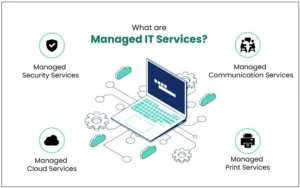
NJ MSPs typically include network monitoring, cloud infrastructure management, cybersecurity including endpoint protection and patch management, helpdesk support with defined SLA response times, backup and disaster recovery, and compliance management. Many NJ providers also offer vCISO services, Microsoft 365 administration, and technology procurement advisory as standard service components.
4.How do I choose the right managed service provider in NJ?
Start with your compliance requirements, verify documented experience in your specific NJ industry, confirm on-site response capability for your location, request SOC 2 Type II documentation and SLA terms, and conduct reference calls with current NJ clients in a comparable industry. This sequence eliminates providers who cannot meet your baseline requirements before any time is invested in detailed evaluation.
5.What is the difference between an MSP and break-fix IT in New Jersey?
An NJ MSP manages your IT proactively under a fixed monthly contract, monitoring systems continuously and resolving issues before they cause disruption. Break-fix IT responds after problems occur, billing by the hour with no ongoing monitoring. For NJ regulated businesses where downtime has direct compliance and revenue consequences, the proactive MSP model consistently delivers lower total IT cost.
6.What certifications should I look for in a New Jersey MSP?
Microsoft Gold or Silver Partner status, CompTIA Managed Services accreditation, and SOC 2 Type II for general IT quality. Computer system validation experience documentation for pharmaceutical clients. HIPAA programme capability and BAA readiness for healthcare. FINRA and SEC compliance client experience for financial services. Providers who cannot produce current certification documentation promptly are not operationally embedded in these frameworks.
7.How many managed service providers are there in New Jersey?
New Jersey has hundreds of managed service providers ranging from large regional operators to specialist boutique firms focused on specific industries or geographies. The DiscoverMSPs database covers verified NJ MSPs with firmographic, technographic, and contact data allowing businesses and vendors to segment the market before investing time in direct evaluation conversations.
8.Can a New Jersey MSP support cloud-only businesses?
Yes. Modern NJ MSPs fully support cloud-native businesses with no on-premises infrastructure. Cloud-focused services cover Microsoft 365, Azure and AWS management, identity and access management, cloud security posture monitoring, and SaaS application management. For NJ businesses already fully in the cloud, an MSP with strong cloud platform partnerships delivers more value than one whose practice is built primarily around on-premises infrastructure.
9.What should an NJ managed service provider SLA include?
Response time commitments by incident severity, resolution time targets, network uptime guarantees at 99.9% or above, on-site response time for your specific NJ location, escalation procedures, security incident notification timelines, and service credit provisions for SLA breaches. An SLA with no enforcement mechanism is marketing language rather than a contractual commitment.
10.How do vendors find managed service providers in NJ to partner with?
Technology vendors find NJ managed service providers most effectively through verified B2B contact databases segmented by geography, company size, technology stack, and vertical focus. DiscoverMSPs maintains verified NJ MSP data with monthly refresh cycles at 95% accuracy, enabling targeted channel partnership and technology sales campaigns that reach the specific decision-makers responsible for vendor selection at providers across the state.
The Right NJ MSP Partnership Pays for Itself Many Times Over
A well-chosen managed service provider in New Jersey does three things that break-fix IT and generic IT support never reliably deliver: it reduces unplanned downtime that costs NJ businesses far more per hour than the monthly managed services fee, it builds and maintains the compliance posture that New Jersey’s regulated industries require as a baseline operating condition, and it provides the strategic technology advisory input that helps businesses make better IT investment decisions year over year.
The evaluation process that produces these outcomes is not complicated, but it requires doing the work: defining compliance requirements before approaching providers, verifying industry-specific experience rather than accepting general IT capability claims, reviewing SLA and contract terms with the scrutiny that a multi-year commitment deserves, and speaking to current clients about actual incident performance rather than theoretical SLA commitments.
For technology vendors targeting the NJ managed services market, the DiscoverMSPs verified database provides the contact intelligence, technographic segmentation, and geographic coverage data that makes NJ MSP outreach campaigns produce qualified pipeline rather than generic activity. Request a free sample of NJ MSP data to validate accuracy before committing campaign budget to the state’s competitive managed services market.