
Finding the right technology hardware or software is rarely the real challenge for modern procurement teams. A corporate credit card and an internet connection can secure thousands of software licences or a pallet of server hardware within minutes. The true friction begins the morning after the purchase order is approved. Businesses routinely find themselves holding expensive, sophisticated technology tools that nobody knows how to configure, integrate with legacy infrastructure, or secure against modern digital vulnerabilities.
Working with the tech channel takes more than a standard supplier list. The market is full of box-shifters and brokers who clear stock but give no tech support. For buyers, IT directors and vendors building channel ties, a capable value added reseller is the difference between a working rollout and costly shelfware. The hard part is cutting through the noise. You want partners with proven engineering skills, not just a sales certificate.
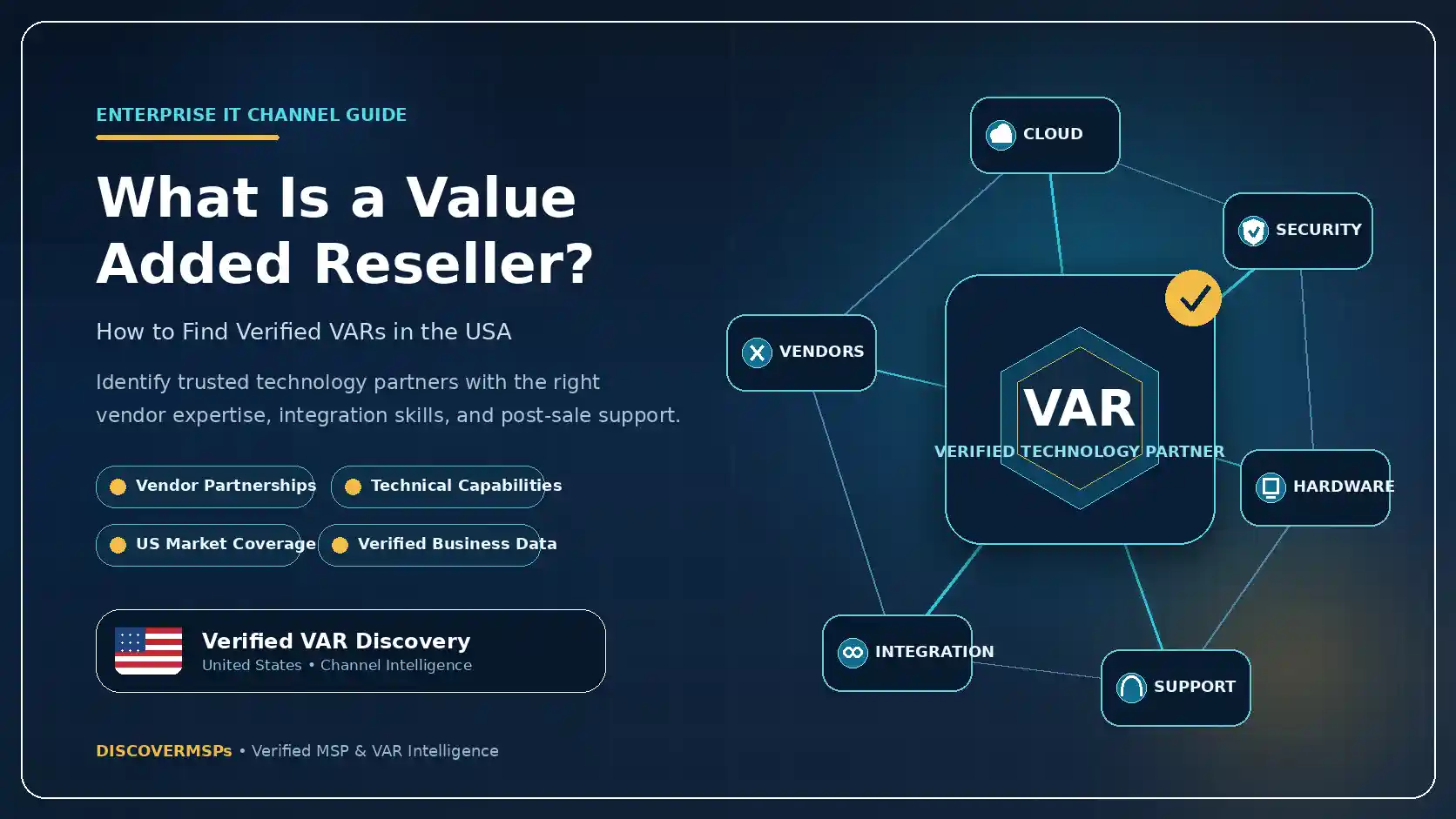
A value added reseller is not just a middleman between a tech maker and the buyer. It acts as an outside engineering and advice team. It takes tech products from other firms and builds a working solution around them. It adds advice, setup, links between vendors, hands-on rollout, staff training and long-term support. So the tech a firm buys really delivers what it promised.
When firms want to sort out how they buy tech, a platform like DiscoverMSPs makes it easier to find capable, reliable IT channel partners around the world.
What is a value added reseller?
To understand what is a value added reseller, it helps to look at the operational reality of enterprise IT. Very few enterprise systems work perfectly right out of the box. A value added reseller establishes commercial partnerships with primary technology vendors and distributors, purchases their hardware, software, or cloud assets, and packages them alongside their own specialized services.
What turns a plain reseller into a VAR is the extra work: solution design, rollout, custom API links, training after the sale and ongoing support. For more on how these channel ties work, TechTarget’s value-added reseller definition explains how these firms link big tech makers with local business buyers. In the end, the customer gets far more than a licence key or a box. They get a working system that fits how they run.
Value added reseller definition and meaning in simple business terms
Strip away the channel jargon, and the practical value added reseller definition centers on risk reduction. The technical value added reseller meaning is not about selling products at a discount; it is about building a functional ecosystem around those products so the buyer achieves a measurable return on investment.
A value added reseller usually:
- Works closely with top tech vendors, global distributors or large software firms, so it knows the products well.
- Adds advice, setup or complex rollout work to the product sale.
- Helps customers review what they already run, so they buy the right mix and not too much.
- Supports user adoption and provides tier-one or tier-two technical support long after the initial purchase.
- Focuses on set tech areas, such as cloud moves, security, telecom, SaaS, servers, unified comms or managed IT.
- Adds real value by cutting rollout risk, confusion and wasted spend.
Many tools are now sold straight to buyers online. Yet value added resellers still matter. Anyone can buy a firewall online. But setting it up right to protect health or finance data takes skilled engineers. VARs do well because buyers care most about fit, a proper rollout and one firm to hold to account.
Why value added resellers still matter in the USA
The United States is one of the largest and most complex tech markets in the world. It is also split into many parts. US VARs act as local experts for mid-size firms, health networks, banks, factories and local government. Rules and setups differ a lot from state to state. So buyers lean on local experts to keep their systems compliant and running.
To find reputable verified VARs in the USA, you need to know their local strengths and tech focus. The right partner makes sure global tech products fit the strict needs of American firms.
Next, we need to separate a real VAR from a basic reseller, because that difference decides whether a partnership becomes useful or expensive noise.
Value added reseller vs basic reseller: what is the real difference?
The enterprise technology market is heavily populated by basic transactional resellers. These organisations exist solely to move inventory. A basic reseller might sell a product, process a licence renewal, ship a mobile device or facilitate a software subscription. Their relationship with the buyer ends the moment the transaction clears. They offer convenience, but they do not solve complex infrastructure problems.
A value added reseller steps into the picture when a simple transaction is not enough. The true value added reseller meaning centres on the professional services wrapped around the core product sale. The best value added resellers act as trusted advisors who ensure the purchased technology integrates smoothly into the client’s existing operations. Instead of simply processing orders, they design, deploy and support the solution, taking full accountability for the technical outcome rather than just the delivery.
Consider how this plays out across different technology categories. A cybersecurity VAR does not just sell anti-virus software; they help choose, deploy and configure an endpoint security platform tailored to a company’s specific compliance needs. A cloud VAR will map out architecture, design migration pathways and provide ongoing cost control support. A telecom VAR will advise on complex unified communications, contact centre deployments or voice solutions. Similarly, a hardware VAR will bundle procurement with physical installation, network integration and long-term hardware support.
To put it clearly, a reseller becomes a true VAR when it can show:
- Technical understanding of the product
- Clear implementation support
- Vendor or distributor relationships
- Customer-specific configuration
- Industry or regional experience
- Post-sale help
- A reason for the buyer to trust the recommendation
Value added reseller vs MSP: where the models overlap
When mapping the channel ecosystem, procurement teams often confuse VARs with Managed Service Providers. The confusion is understandable because the boundaries between these two business models have blurred significantly in recent years. However, their primary commercial engines remain distinct, and understanding this nuance will help you align your expectations before signing a contract.
Traditionally, a VAR focuses on selling and implementing technology through project-based work. Their revenue relies heavily on product margins, deployment services and integration projects. An MSP, on the other hand, usually focuses on ongoing management and recurring support. An MSP steps in to monitor networks, manage cloud infrastructure and run remote helpdesks on a fixed monthly retainer.
Today, many successful technology firms do both. A provider might act as a VAR to sell and install a new server cluster, and then transition into an MSP role to monitor and patch those servers month after month. Platforms like DiscoverMSPs work across this entire IT channel ecosystem to help buyers and vendors navigate these overlapping identities. Whether a team is searching for an MSP database to outsource IT helpdesk tasks, exploring SaaS resellers and ISVs to expand software distribution, or seeking specialised UCaaS providers to overhaul business communications, understanding these service models is crucial to making the right choice.
Why finding value added resellers in the USA is harder than it looks
Sourcing a reliable VAR in the USA presents unique challenges. The market is incredibly dense, highly regionalised and constantly shifting due to mergers and acquisitions. A technology vendor looking to build a national channel program, or an enterprise buyer searching for a local integration partner, will quickly discover that standard research methods fall short.
Relying on generic Google search results, old industry directories or scraped B2B databases often leads to frustrating dead ends. These broad searches frequently surface inactive companies, miscategorised businesses, outdated contact details or resellers that simply do not serve the buyer’s target market. For instance, a firm might be listed under a broad IT category, but their actual capability is limited to consumer hardware repair rather than enterprise cloud architecture.
If you are looking for a list of value added reseller companies in usa, it is vital to recognise the hallmarks of poor data. A weak VAR list usually has these problems:
- Company names without service context
- Old websites or inactive providers
- No state or region clarity
- No vendor partnership information
- No role-level decision-maker data
- No way to filter by revenue, staff size or tech focus
- No compliance explanation
- No sample before purchase
What makes a USA VAR worth shortlisting?
Building a functional partner shortlist requires verified intelligence. A name and a phone number hold zero commercial value if the company lacks the engineering capacity to handle your specific project or the vendor relationships to secure fair pricing.
A strong USA VAR shortlist should show:
- Location and market coverage to ensure they can service your physical offices or target regions
- Tech focus, to check they specialise in exactly what you need
- Vendor partnerships, to confirm their tier and tech certificates with major vendors
- Customer segment fit so you know they understand businesses of your size
- Industry focus, so they know your rules and compliance load
- Access to leaders, so you can talk to the boss or tech director directly
- Evidence of active operations to filter out shell companies or dormant businesses
- Accurate, fresh data, so every contact and skill listed is current
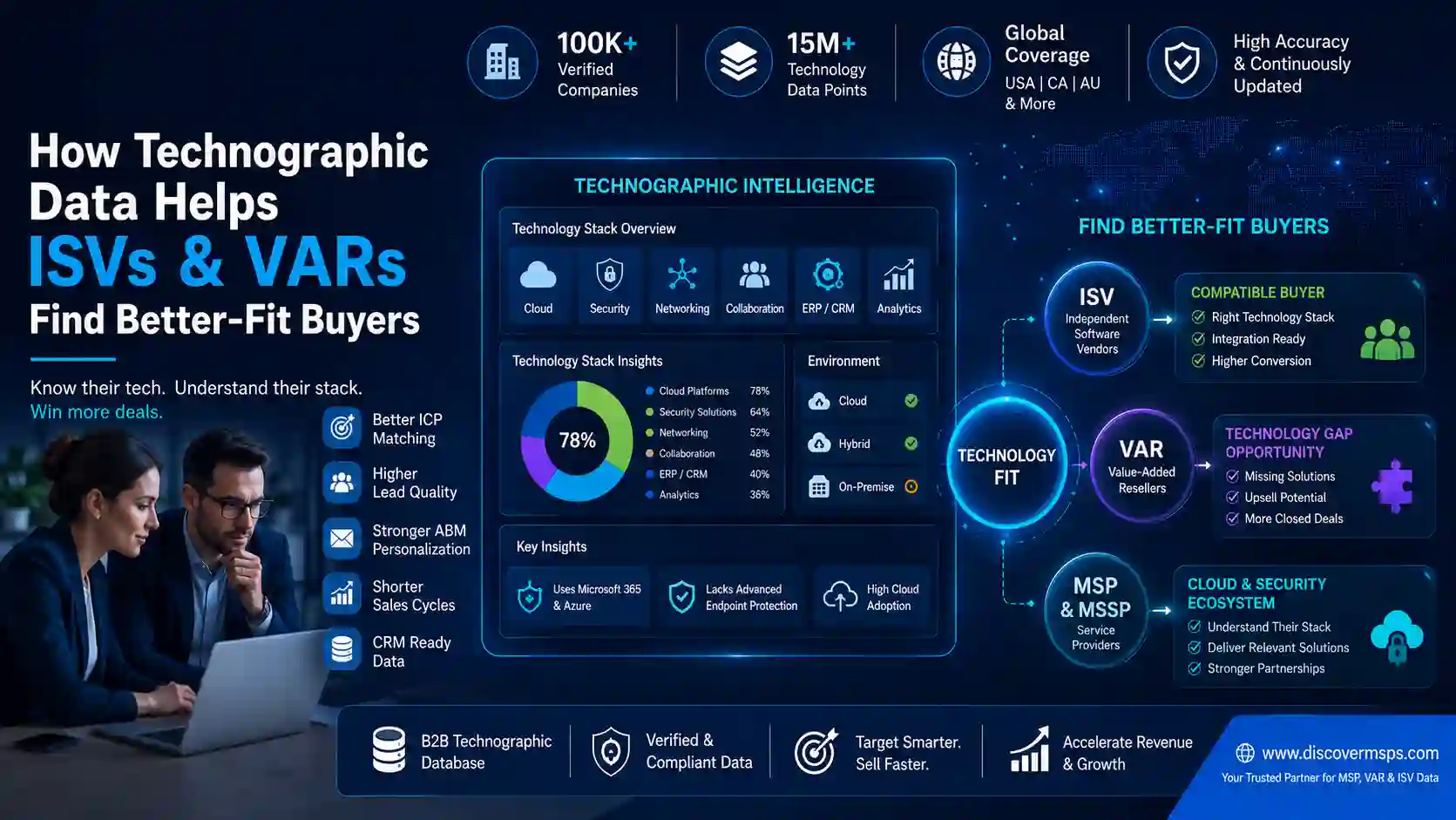
Teams that need verified value added resellers often start with DiscoverMSPs. You can filter providers by location, revenue, staff size, vendor partners, solutions and tech skills. That takes the guesswork out of finding channel partners.
Once you understand what separates a useful VAR list from a weak one, the next step is knowing exactly how to build a shortlist without wasting weeks on manual research.
How to find the right value added reseller list without wasting weeks
Finding technology partners manually is entirely possible. If you have the patience to sit through endless search pages, you can assemble a spreadsheet of regional IT firms. Search engines will readily show you local vendor partner directories, old industry articles, local IT service companies and paid listing sites. The process is not difficult, but it is incredibly slow and highly inefficient for modern channel teams.
The problem is not getting search results. The problem is knowing which of those results represent active, relevant and capable businesses that are actually worth contacting. When a software vendor or a corporate IT buyer types a query into a search bar, they are presented with a mix of dormant websites, mislabelled consumer repair shops and broad technology brokers. Sifting through that noise to find a verified list of value added reseller companies in USA drains hundreds of hours from your sales or procurement teams.
To make this process viable at scale, you need a structured approach. Instead of building a database one row at a time, savvy channel managers and IT directors seek out curated intelligence platforms. However, even when sourcing pre-built data, you must apply strict commercial filters to ensure the contact list translates into actual business pipeline.
A practical VAR list checklist
When evaluating a data source for your channel outreach, apply this framework:
- Start with the country, especially if your first priority is the USA, because regional compliance matters.
- Filter by tech category, not just company name, so the fit is real.
- Check vendor partnerships to verify they hold the right certifications.
- Check whether the reseller serves your buyer segment, such as mid-market or enterprise.
- Look for firmographic details such as employee size, revenue band and location.
- Confirm whether the company is active and operational.
- Check which roles have contacts, so you reach the right person directly.
- Ask for a sample before buying or planning outreach.
- Avoid static lists that do not explain verification or refresh cycles.
How can you make sure DiscoverMSPs provides the right VAR data?
Any data provider can make bold claims on its website. Your job as a buyer is to check them before you spend. DiscoverMSPs keeps a dedicated value added resellers database page with regional breakdowns, built around full reseller profiles. It does more than hand over names and emails. Its data covers company details, regional reach, service focus, vendor partners, solutions and tech skills.
This level of detail is crucial. For context on how strictly these categories are defined at a federal level, you can review the Federal Register description of IT value added resellers, which outlines the specific economic criteria that separate VARs from standard retailers. A serious buyer should still test the commercial fit before making a purchase. The right approach is to request a data sample, compare it against your target market, and check whether the included fields match your partnership goals.
Before trusting any VAR data source, ask:
- Does the data match my exact country and market?
- Does it separate VARs from MSPs, ISVs and general IT firms?
- Does it show technology focus or vendor alignment?
- Does it include usable business context?
- Can I review a sample first?
- Is there a clear contact route if I have questions?
- Are privacy and compliance pages visible?
The easiest way to answer these questions is to request a free data sample and run it past your sales or technical team.
Why trust a newer specialist source over older generic databases?
There is a common misconception in B2B data procurement that older, massive generic databases are inherently superior. While legacy platforms certainly offer scale, scale is completely useless if the VAR category is mixed with unrelated IT companies, consumer repair shops and obsolete contact records. You do not need a million rows of dirty data; you need a few thousand rows of highly targeted, verified intelligence.
A specialist platform becomes worth considering when it is focused on a specific niche, transparent about its methods, verifiable and easier to test through samples. Buyers should judge DiscoverMSPs the same way they should judge any data provider. Look at the category fit, sample quality, data freshness, operational transparency and compliance handling. Most importantly, check whether their team can answer practical questions about the technology channel. You can learn more About DiscoverMSPs and their approach to IT channel intelligence by reviewing their methodology.
The next concern is privacy. If a business is buying verified VAR data, it should understand how data handling, compliance pages and customer questions are managed before starting outreach.
How should privacy be handled when buying VAR data?
Any firm that buys B2B reseller data must check the provider's privacy and compliance papers first. Do this before you use the data for outreach, partner recruitment or sales. Buying data is now a legal choice, not just a budget one. Loading unchecked contacts into a marketing tool can lead to heavy fines, a blocked domain and real harm to your brand.
For data platforms, openness is the bare minimum. DiscoverMSPs publishes a clear Privacy Policy and a detailed GDPR Compliance Policy. Read both before you buy, especially if you plan outreach in the USA, UK, Canada, Australia, Europe or other markets. Each country has its own rules for business email, so a one-size approach is risky.
Before purchasing VAR data, ask:
- What specific categories of business data are included in the directory?
- Is the data strictly intended for business professionals rather than consumer accounts?
- How are data opt-outs, updates or correction requests handled by the provider?
- What compliance frameworks are referenced to ensure data integrity?
- How is the final data delivered to prevent unauthorized interception?
- How often is the channel data reviewed, validated or refreshed?
- Who can answer specific privacy or compliance questions before purchase?
- What steps should my own sales or marketing team take to maintain compliance during outreach?
How does a buyer know whether a VAR list is suitable for outreach?
Successful channel outreach begins long before the first cold email is drafted or the first phone call is placed. The foundation of any campaign relies entirely on data alignment. The data must be explicitly relevant to the buyer’s Ideal Customer Profile (ICP). If a software vendor manufactures cybersecurity applications, it requires a list of partners with clear security relevance. If a vendor creates unified communications platforms, it must connect with telecom and enterprise voice partners. If a vendor builds infrastructure, it needs cloud-capable resellers.
The goal is not to amass the largest possible file or buy thousands of unqualified records just to show high volume. The point is to build a clean, relevant and legally defendable shortlist. When utilizing a specialised VAR database, you can filter out transactional box-shifters and focus entirely on engineering teams that maintain the active vendor certifications, technical capabilities and client profiles required for your specific product ecosystem.
USA first, then global VAR markets
The United States is the main focus for tech vendors, but mature tech markets exist worldwide. Treat the USA as the top priority, because its size and complex local setup need the strictest checks. But channel programmes rarely stay in one country. Vendors often need clear reseller data across several mature regions to grow.
United States
The US market needs data that covers every state and huge vendor networks. A useful US directory must track VARs in cloud moves, top-tier security, complex telecom, modern SaaS and full managed IT, across all fifty states.
United Kingdom
The UK channel values governance, strict data rules under UK GDPR and deep sector skills. A good directory must cover providers who serve the public sector, London finance, legal hubs and professional firms in England, Scotland, Wales and Northern Ireland.
Australia
In Australia, distance, time zones and spread-out support all matter. Good channel work depends on finding capable partners in Sydney, Melbourne, Brisbane and Perth. It also needs regional firms that look after branch offices far from the cities.
Canada
Canada has its own provincial rules, some bilingual needs and strict privacy under PIPEDA. A useful database must track mid-size and large tech providers in Toronto, Vancouver, Montréal and Calgary.
Global Markets
Beyond North America and the Commonwealth, Germany, Singapore, the Netherlands and India are key entry points for global tech vendors. Good reseller, MSP and partner coverage there needs local insight. That means knowing local compliance rules and which languages each partner supports.
How to compare VARs across countries without mixing the wrong data
Running a channel plan across regions takes discipline. When you search for partners across borders, keep each region's data apart. Mixing them skews your campaign results and leads to compliance mistakes.
- Keep each country list apart, to avoid mixing up rules across borders.
- Compare providers by service category rather than using broad, generic IT labels.
- Check vendor partnerships, to be sure local tech certificates exist.
- Check regional coverage, to confirm the firm can legally support that territory.
- Compare business size and target market to ensure they fit your specific ICP.
- Check each region's privacy rules before you send anything.
- Ask for a localized sample file before scaling your outreach program.
- Document the exact reason why each value added reseller was included in your shortlist.
Need country data, a sample file or help mapping fields to your campaign? Contact DiscoverMSPs to speak with our data specialists.
The final step is turning all of this into a simple decision process, then answering the questions buyers usually ask before they trust a VAR directory.
A simple way to choose the right value added reseller
The best VAR is not always the biggest name on a vendor directory. A giant multinational reseller might have a massive marketing budget, but a specialised regional VAR often possesses the deep, vendor-specific engineering talent required for complex integrations. The right partner is the one that intrinsically understands the technology you are deploying, the specific customer environment you operate in, and the regional market dynamics.
It all comes down to alignment. You need an organisation that understands the post-sale expectations of your business. Whether you are a software developer looking to expand your channel reach or an IT director attempting to solve a difficult infrastructure problem, the ideal partner matches your operational scale and your technical ambition.
Final VAR selection checklist
- Decide the exact tech category first
- Choose the country and region
- Decide whether you need sales reach, implementation support or both
- Check vendor partnerships
- Review industry experience
- Confirm whether the VAR serves your target customer size
- Look for active decision-maker contacts
- Ask for a sample if using a database
- Compare 5 to 10 strong-fit VARs instead of hundreds of weak names
- Keep privacy and compliance requirements visible from the start
Where DiscoverMSPs fits into the VAR search
Finding that perfect alignment takes time, which is why structured data is so valuable. DiscoverMSPs can help teams that need a focused way to explore value added resellers without wasting weeks on manual research. This is particularly useful when channel managers want a verified list of value added reseller companies in USA and other major global markets.
The platform is built to provide actionable firmographic intelligence rather than just basic contact scraping. If you want to test the data quality for your own outreach campaigns, you can easily request a free data sample. For those who want to understand the wider IT channel data ecosystem, taking a moment to read About DiscoverMSPs or exploring the broader MSP database provides excellent context on how the modern technology supply chain is mapped and categorised.
Final thoughts
A value added reseller can be a serious growth partner when the match is right. For vendors, the right VAR acts as an extension of the internal sales and engineering teams, opening new markets and helping customers adopt complex technology with far less friction. For corporate buyers, the right VAR can significantly reduce operational confusion, deployment risk and the heavy internal implementation burden.
Success in the enterprise technology channel is rarely about finding the cheapest hardware or the quickest software licence. It is about finding the right people to make that technology work. Start your search with verified, country-specific data rather than scattered search results, and you will build partnerships that actually deliver commercial value.
Frequently Asked Questions
How accurate is DiscoverMSPs’ data?
How often is DiscoverMSPs’ data refreshed?
1. What is a value added reseller?
When people ask what is a value added reseller, they are looking for a practical explanation of a common channel term. A value added reseller is a business that purchases technology products from vendors or distributors, adds its own professional services, and resells the combined solution to end users. The value comes from their ability to design, integrate, secure and support the technology, ensuring the buyer receives a fully functional system rather than just an isolated product.
2. What is the value added reseller definition in simple terms?
The value added reseller definition is straightforward. It describes a technology company that takes third-party hardware, software or cloud infrastructure and wraps it in highly specialised services before selling it to a business customer. These services usually include pre-sale consultation, custom network configuration, complex software integration, user training or ongoing technical support. By doing this, the reseller solves a complete business problem for the client instead of simply acting as a basic retail middleman.
3. What is the value added reseller meaning for technology vendors?
For software and hardware developers, the value added reseller meaning centres on scalable market growth. Vendors cannot realistically hire enough direct sales and engineering staff to reach every potential customer in every regional market. VARs provide that essential local reach. They act as an outsourced, highly capable extension of the vendor. They bring deep local trust, dedicated implementation capacity and the engineering skills required to ensure the customer actually adopts and uses the technology successfully.
4. How can I find a list of value added reseller companies in USA?
You can manually build a list by searching through vendor partner directories, local business registries and industry publications, but this takes a massive amount of time. A more efficient approach is to use a specialised, verified B2B database. By accessing a structured list of value added reseller companies in USA, you can filter potential partners by state, technology focus, vendor certifications and employee size to find exact matches for your campaign.
5. How do I know if a VAR database is trustworthy?
A trustworthy database should always be transparent about its data collection and verification methods. You should check if the provider allows you to request a data sample before purchasing. Look for granular country filters, accurate firmographic details and clear technology or vendor focus categories. Furthermore, a reliable provider will display detailed privacy pages, outline their compliance frameworks and provide a direct contact route so you can ask specific questions about data freshness and market fit.
6. Can DiscoverMSPs help with VARs beyond the USA?
Yes. DiscoverMSPs helps you explore VARs and channel partners by country and tech focus across many regions. The USA is a major focus, but the platform also covers mature markets such as the UK, Canada, Australia and Germany. So vendors and buyers can find verified, capable partners wherever they are growing.
Final VAR Selection Checklist: How to Choose the Right Value Added Reseller
An eight-step structured selection checklist for technology vendors, channel managers and IT procurement teams to identify, evaluate and shortlist the right value added reseller in the USA and global markets.
Define the exact technology category first
Specify the precise technology domain you need the VAR to specialise in before opening any database or directory. A cybersecurity VAR, a cloud migration specialist and a hardware integrator require entirely different technical capabilities and vendor relationships. Clarity at this stage eliminates a large proportion of irrelevant results immediately.
Choose the country and region
Identify your primary geographic market, starting with the USA if that is your top priority, then map the specific states or metro areas where the VAR must operate. Regional compliance expectations, tax structures and local vendor ecosystems vary significantly, making geographic precision essential before contacting any candidate.
Decide whether you need sales reach, implementation support or both
Determine the commercial objective clearly before approaching a VAR. Some VARs specialise in transactional channel volume, while others focus on complex multi-month implementation projects. Mixing these two profiles in your shortlist creates confusion and wastes evaluation time for both parties.
Check vendor partnerships and certifications
Verify that the VAR holds active certifications from the primary technology vendors relevant to your solution. Vendor tier status directly determines pricing access, technical support priority and co-selling eligibility. A VAR without the right certifications cannot access the resources needed to serve your customers well.
Review industry experience and target customer size
Confirm that the VAR has documented experience serving businesses in your specific industry and of a comparable size to your target customer. A partner with deep healthcare vertical experience operates very differently from a general IT integrator, even if their product catalogue looks identical on the surface.
Look for active decision-maker contacts
Ensure your VAR data includes direct access to leadership and technical decision-makers rather than generic company email addresses. Reaching the right person, such as a VP of Sales, Director of Technology or Channel Manager, dramatically reduces the time required to qualify a partnership opportunity.
Ask for a data sample before purchasing
Request a targeted sample file filtered to your exact ICP before committing any budget to a VAR database. Review the field structure, contact accuracy and firmographic depth against known companies in your target market to verify the quality before scaling your outreach or partner recruitment programme.
Keep privacy and compliance requirements visible from the start
Confirm that the data provider's compliance documentation covers the regional privacy laws applicable to your outreach markets, including GDPR, CCPA, PIPEDA and applicable Australian privacy regulations. Non-compliant outreach using unverified contact data can result in heavy penalties, domain blacklisting and reputational damage that far outweighs the cost of a properly sourced dataset.

 ChatGPT
 Claude
 Google AI Mode