
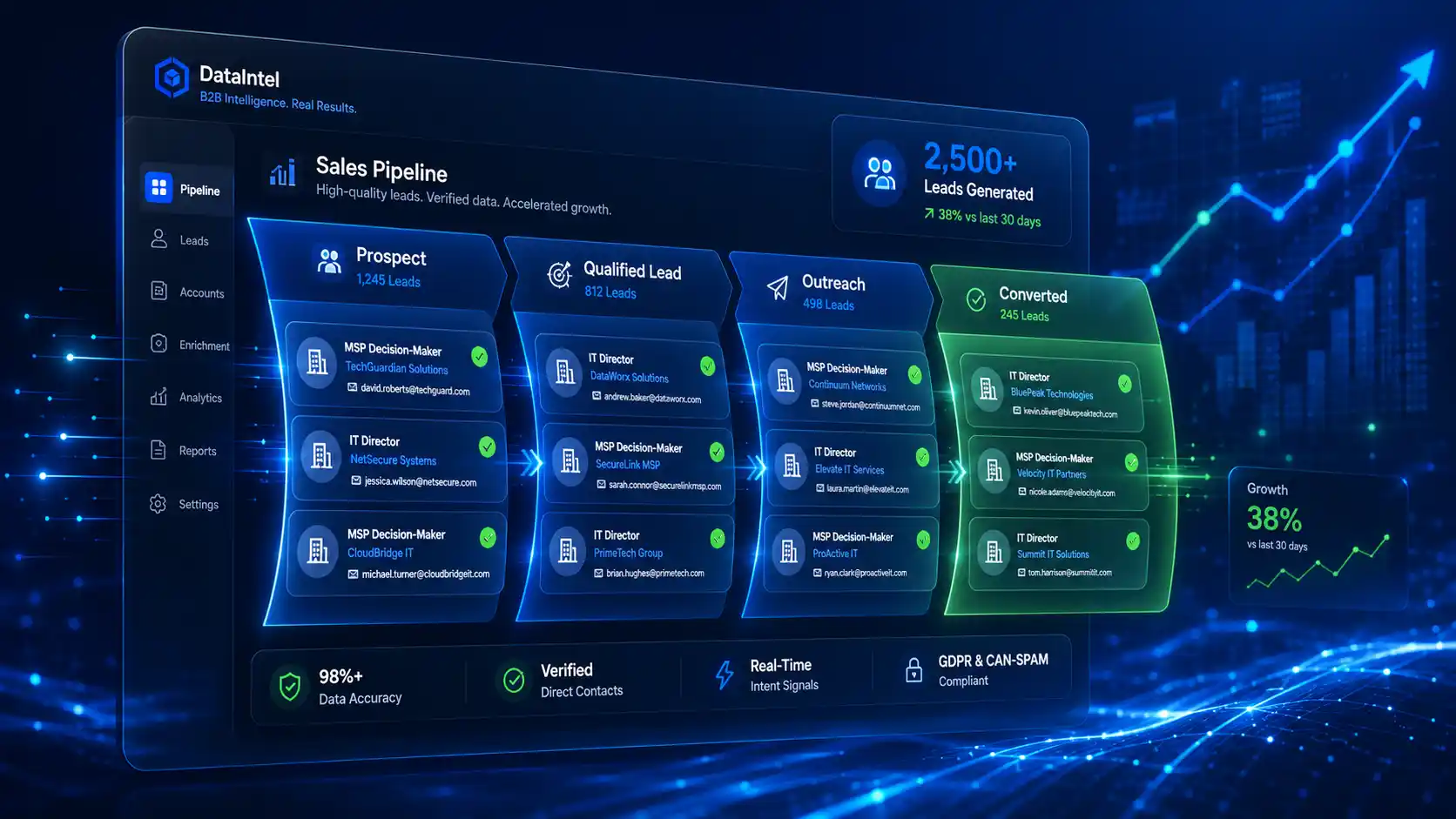
What is MSP lead generation? MSP lead generation is the work a managed service provider does to find businesses that might become customers and start conversations with them. A "lead" is a company or person who has shown some sign of interest or fit. Lead generation covers everything from asking existing clients for introductions to running outbound campaigns.
If you run an MSP and are asking "how do I find customers for my MSP?", the honest answer is that no single tactic does it. The providers who grow steadily tend to pick a small number of channels, do them consistently and measure what comes back. This guide explains what MSP lead generation involves, the main channels, how to build a prospect list, how to run outreach that gets replies, and how to avoid common mistakes.
What makes MSP lead generation different?
- The sale is a relationship. Customers hand over responsibility for their systems, so trust matters more than a clever offer.
- The cycle can be long. Contracts often start when an existing arrangement fails, a renewal arrives or the business hits a problem.
- Local reputation counts. Many buyers ask peers before they ask search engines.
- The offer is hard to compare. Two providers can promise the same thing with very different delivery, so proof and clarity win.
What are the main ways to find customers for an MSP?
| Channel | How it works | Strength | Watch out for |
|---|---|---|---|
| Referrals | Ask happy customers and professional contacts for introductions | High trust and good fit | Slow unless you ask on a routine |
| Partnerships | Work with accountants, lawyers, telecom resellers and software vendors who meet your target customers | Warm introductions | Needs a clear arrangement both sides understand |
| Local search and reviews | Keep your business profile, website and reviews strong for local searches | Catches people already looking | Reviews take time to build |
| Educational content | Publish guides and answers for your target industry | Builds trust before the first call | Generic content gets ignored |
| Outbound email and calls | Contact a defined list of companies directly | You control volume and targeting | Poor lists and bad messages hurt your reputation |
| Events and webinars | Meet people in person or online | Face-to-face trust | Cost and follow-up effort |
| Assessments | Offer a free review of security or IT health | Gives a reason to talk | Must lead to a clear next step |
How do you decide who to target?
A tight target beats a wide one. Before you write a single message, answer these:
- Who are your best customers today? Look at who is profitable, stays and refers others.
- What do they have in common? Industry, size, location, systems and compliance needs.
- What problem do you solve best for them? Write it in their words, not yours.
- Where are they? Start within the area you can serve well.
- Who decides? Often an owner, an operations lead or a finance lead rather than "IT".
Providers that focus on one or two industries often find messaging and referrals easier, because they can speak specifically about those customers' software and rules.
How do you build a prospect list?
A prospect list is a set of companies that match your target, with a named person and verified contact details at each. Quality matters more than size. A short, accurate list gets better results and protects your sending reputation.
- Start with your own records: past enquiries, lapsed leads and event contacts.
- Add companies from local business directories and industry associations.
- Use a verified data provider when you need volume across a region or industry.
- Check each record before you use it: does the company fit, and is the person still there?
- Record where each contact came from and honor opt-outs.
Our post on how MSPs build a prospect list for lead generation covers this in more depth.
How do you write outreach that gets answered?
- Be specific about why you are writing. Mention their industry or a relevant problem.
- Keep it short. A few sentences, one idea, one clear question.
- Offer something useful. A short checklist or a free review is easier to accept than a sales call.
- Make the next step small. Ask for a short chat, not a contract.
- Follow up. Most replies come after the first message. Plan a few polite follow-ups.
- Respect opt-outs. Stop when asked, and follow the email and data rules in your market.
What should you track?
- Leads by source.
- Conversations started from each channel.
- Proposals sent and accepted.
- Time from first contact to signed agreement.
- Revenue and retention by source.
The last two matter most. A channel that brings many leads and few lasting customers is not working, however full the pipeline looks.
What mistakes should MSPs avoid?
- Trying every channel at once. Pick two or three and do them well.
- Selling tools instead of outcomes. Customers care about downtime, risk and cost, not product names.
- Buying a huge list and blasting it. It damages deliverability and reputation.
- Stopping after one follow-up. Persistence, politely, is part of the work.
- Ignoring current customers. Existing clients are the best source of referrals and expansion.
- Not tracking results. Without data you cannot tell what to keep.
When should you get outside help?
If you have the offer, the proof and the time, you can run lead generation yourself. If your team is busy delivering or you want a faster start, a specialist can build and run campaigns for you. See our B2B lead generation services for how we approach it.
Related reading
- how to find a technology reseller: another route to customers: resellers and partners.
- what is a managed service provider: what the model is, for context.
- how MSPs build a prospect list for lead generation: building a prospect list in more depth.
Where to go next
MSP lead generation comes down to choosing a clear target, using a few channels consistently and tracking what produces customers who stay. If you want help building a verified list in your region or industry, request a free 100-record sample.



 ChatGPT
 Claude
 Google AI Mode