As businesses across the USA, Australia, the UK, Canada, and other global markets continue to scale their digital operations, leadership teams are facing an increasingly complex challenge: figuring out who should manage and protect their technology infrastructure. We are operating in an era where downtime is measured in thousands of dollars per minute, and cyber threats are no longer just an IT problem; they are a board-level risk. It is no surprise that executives are closely evaluating their external partnerships to ensure they have the right support in place.
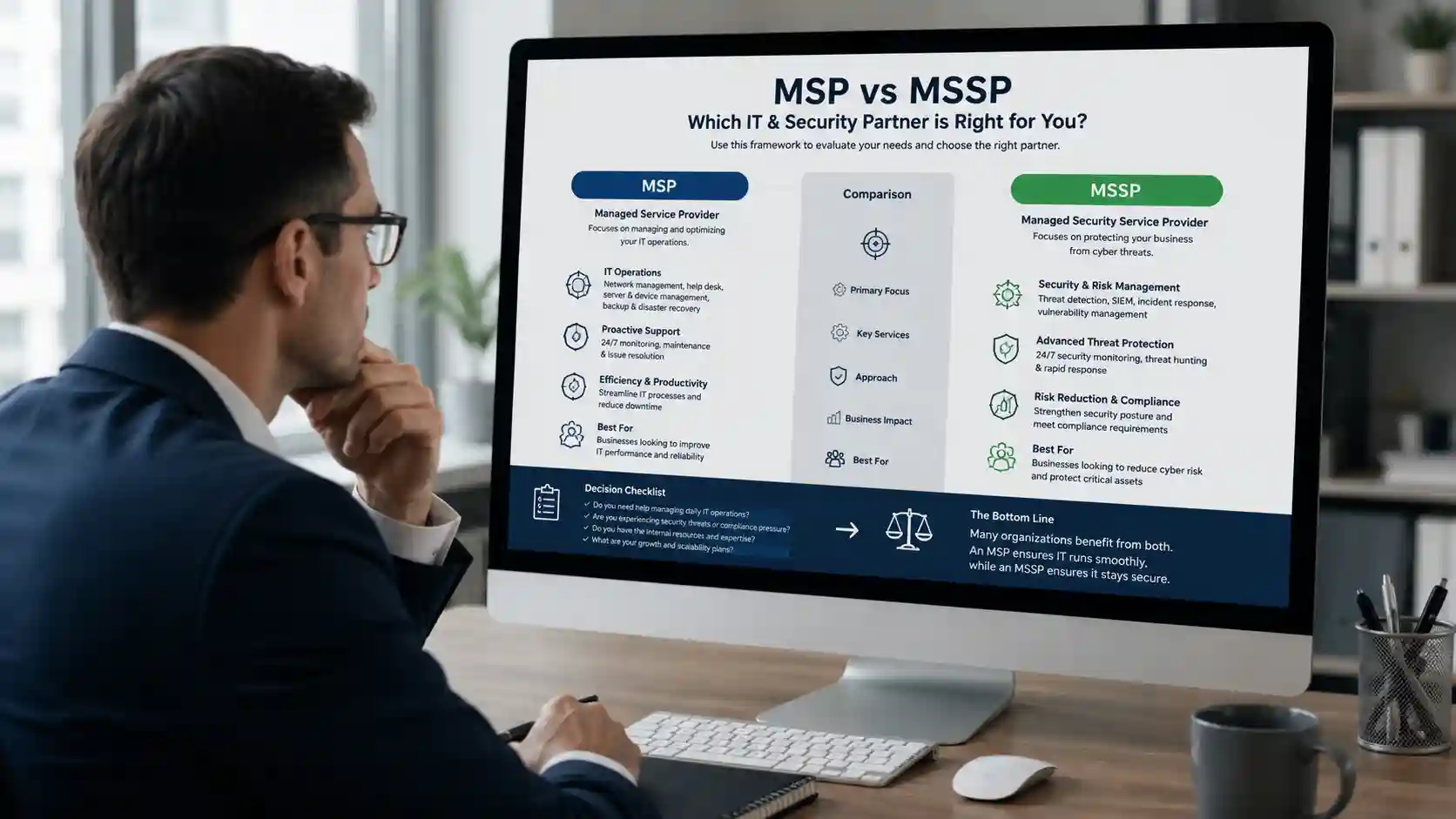
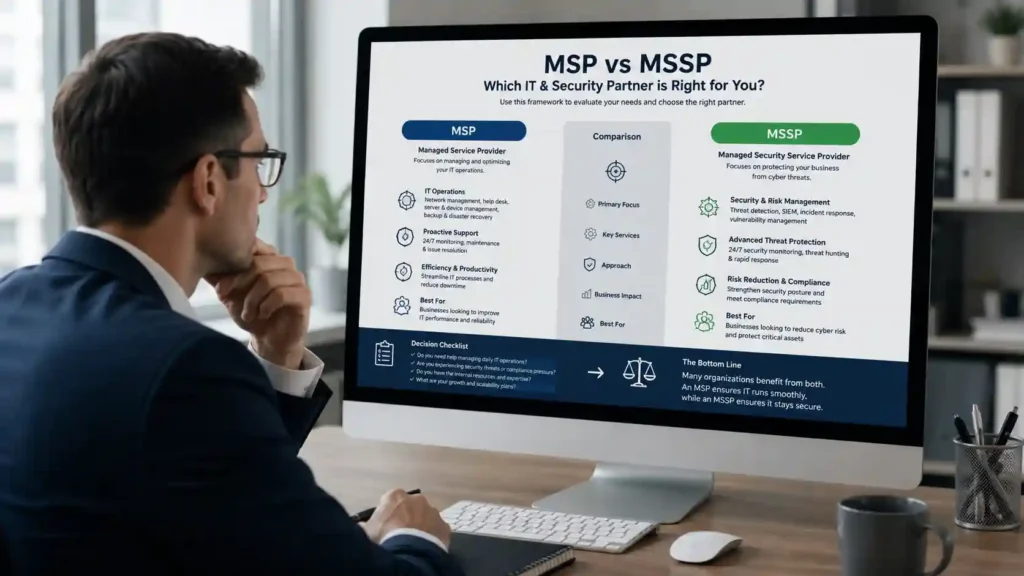
However, when searching for an outsourced technology partner, many companies find themselves stumbling over the alphabet soup of the IT channel. The most common point of confusion is deciding between a Managed Service Provider (MSP) and a Managed Security Service Provider (MSSP). It is easy to see why these two models are frequently conflated. Both involve handing over the reins of critical technology functions to an external team, and both use proactive monitoring to keep your business running smoothly. Yet, while their services occasionally overlap, they solve fundamentally different problems. In short, one focuses on operational performance and efficiency, while the other is laser-focused on risk management and threat defence.
Understanding this distinction is the first step in making a strategic decision for your organisation. If you are currently evaluating your options, DiscoverMSPs offers a practical way to compare provider data and find a partner that aligns with your specific operational and security requirements.
First, What Does a Managed Service Provider Actually Do?
Think of a Managed Service Provider as your outsourced IT department. Their primary mandate is to ensure that your business technology works seamlessly, efficiently, and predictably so that your internal teams can focus on their actual jobs rather than wrestling with system outages. An MSP takes ownership of the day-to-day management of your IT environment, functioning as the backbone of your digital infrastructure.
At a high level an MSP is responsible for system availability, user productivity and foundational IT health. You depend on them to set up new devices for employees, migrate workloads to the cloud, keep software current, and fix technical glitches before they stop your workflow. Good MSPs do the basics: basic firewalls, antivirus, regular data backups but their focus is uptime and usability, not cyber warfare.
When you explore the MSP Database, you will notice that the best providers act as strategic technology advisors, not just break-fix technicians.
So, what should a business expect from a good MSP? A robust partnership will typically deliver:
- Responsive IT helpdesk support: Providing fast, reliable troubleshooting for employees experiencing daily technical issues, from password resets to application errors.
- Proactive infrastructure monitoring: Keeping a constant watch over servers, networks, and internet connectivity to identify and resolve performance bottlenecks before they cause downtime.
- Routine system patching: Ensuring that operating systems and core business applications are regularly updated to fix known bugs and apply standard security patches.
- Comprehensive cloud management: Overseeing the architecture, migration, and daily administration of cloud environments like Microsoft 365, Google Workspace, or AWS.
- Reliable backup and disaster recovery: Managing routine data backups and testing recovery protocols so that business information can be restored quickly in the event of hardware failure or accidental deletion.
- Endpoint device support: Configuring, deploying, and maintaining company laptops, desktops, and mobile devices to ensure they perform optimally.
- Foundational compliance support: Assisting with basic data privacy controls and standard IT policies required by industry regulators.
- Strategic vendor coordination: Acting as the single point of contact for your other technology vendors, such as internet service providers and specialised software companies.
What Does a Managed Security Service Provider Do Differently?
If an MSP is your IT operations centre, a Managed Security Service Provider is your private security detail. While an MSP ensures your systems are running, an MSSP ensures they are secure against sophisticated, targeted, and persistent cyber threats.
Today’s threat landscape is deeply complex. Ransomware syndicates, state-sponsored actors, and insider threats require a level of defensive vigilance that goes far beyond standard antivirus software. This is where managed security service providers step in. Their mandate is not about fixing a broken printer or setting up a new user inbox; it is about protecting your intellectual property, financial data, and reputation from active harm.
An MSSP employs dedicated cybersecurity engineers and threat hunters who monitor your environment 24/7/365 from a Security Operations Centre (SOC). They actively look for anomalies that indicate a breach might be in progress. For example, if an employee logs in from London and then ten minutes later there is an access attempt from another continent, the MSSP’s systems will flag, isolate, and investigate the event immediately.
Organisations operating in highly regulated industries, or those aligning their defences with rigorous standards like the NIST Cybersecurity Framework, often require the specialised capabilities of an MSSP. Furthermore, following recent CISA guidance for MSPs and customers, it has become clear that managing foundational IT is no longer enough to mitigate advanced supply chain risks and sophisticated network intrusions.
An MSSP delivers deep, specialised security services, including:
- Continuous threat monitoring and MDR: Utilising Managed Detection and Response (MDR) tools to identify malicious activity and automatically isolate compromised endpoints before a threat spreads.
- 24/7 Security Operations Centre (SOC): Providing round-the-clock surveillance by human security analysts who investigate alerts and respond to incidents in real time.
- Advanced vulnerability management: Continuously scanning networks, applications, and cloud environments to identify and remediate security gaps before hackers can exploit them.
- Rapid incident response: Deploying elite forensic and response teams to contain, eradicate, and recover from a cyber attack if a breach does occur.
- Sophisticated endpoint and cloud security: Implementing Zero Trust architectures, advanced endpoint detection, and robust cloud security posture management.
- Deep compliance and risk governance: Navigating complex global privacy laws and stringent industry regulations to ensure your security controls withstand rigorous audits.
Knowing the difference between IT operations and advanced cybersecurity is only the beginning of the journey. Once you understand what each partner brings to the table, the next logical step is evaluating your own internal capabilities to determine which model fits your business strategy.
MSP vs MSSP: The Difference Is Not Just Technical
To truly understand how these two models diverge, we have to look past the technical jargon and focus on business responsibility. The division of labour comes down to a fundamental difference in corporate mandates. When you hire an MSP, you are assigning them the responsibility of ensuring operational continuity. Their performance metrics are tied to uptime, ticket resolution speeds, network availability, and how smoothly your staff can access the tools they need to do their jobs.
Conversely, an MSSP is hired to manage systemic risk and build resilience. Their performance is measured by threat detection times, vulnerability reduction, compliance adherence, and incident containment. An MSP wants to make sure data flows freely and quickly across your business; an MSSP wants to make sure that data is strictly governed, encrypted, and isolated from unauthorised eyes.
This means that deciding between them is not about choosing which technology stack sounds more impressive. It is about identifying where your current operational vulnerabilities lie. If your business is losing money because of unstable networks and slow technical support, you have an operations problem. If you are losing sleep over a potential ransomware attack or failing a regulatory audit, you have a security and risk problem.
When an MSP Is the Better Fit
For many growing organisations, operational friction is the most immediate bottleneck to growth. If your leadership team or a single internal IT manager is spending half their week setting up user permissions, troubleshooting faulty VPNs, or worrying whether the latest server update went through, your primary need is infrastructure stability.
In these scenarios, jumping straight to a high-end security partner can be a misallocation of resources. You cannot effectively secure an environment that is poorly mapped, unpatched, and structurally unstable. A traditional managed service provider delivers the baseline hygiene and operational discipline required to create a predictable IT environment. They bring order to the chaos of modern hybrid workspaces, giving you a predictable monthly budget and freeing up internal teams to focus on revenue-generating projects.
A managed service provider may be the right first step if:
- Your internal IT team is overwhelmed: Your in-house staff is buried under daily support tickets, leaving no time for strategic projects or long-term digital transformation.
- Cloud systems are becoming hard to manage: You have migrated to platforms like Microsoft 365 or AWS, but lack the internal expertise to optimise licenses, control costs, and maintain performance.
- Remote workers need stable access: Your distributed workforce frequently faces connectivity, hardware, or collaboration tool issues that stall productivity.
- Backup and recovery gaps exist: You lack a tested, automated disaster recovery plan that guarantees your business can resume operations quickly after a hardware failure.
- Patching and endpoint support are lagging: Laptops and mobile devices are not being updated systematically, creating operational vulnerabilities across the company.
- Budget predictability is a priority: You need to move from volatile, unpredictable break-fix expenses to a stable, monthly operating cost model for your IT needs.
When an MSSP Becomes the Smarter Choice
There comes a point in an organisation’s maturity where standard IT protection is no longer sufficient to satisfy clients, insurers, or regulators. If your company handles highly sensitive intellectual property, processes large volumes of financial transactions, or operates within strictly audited sectors like healthcare, finance, or government contracting, your risk profile changes dramatically.
This shift is why we are seeing a massive surge in demand for specialised top managed service providers and security experts globally. When evaluating your defensive posture, it is highly beneficial to look at region-specific landscapes. For example, businesses navigating complex federal and state compliance mandates often seek out specialized partners who understand managed IT services USA frameworks to bridge the gap between daily operations and strict security standards.
The reality of modern digital supply chains is that mid-market businesses are increasingly targeted by hackers specifically as a stepping stone into larger enterprise networks. It is no longer a matter of simply keeping a firewall active; it requires continuous vigilance. Comprehensive threat monitoring, proactive identity management, and immediate incident response readiness are the hallmarks of an MSSP. This level of oversight is particularly critical given the evolving nature of shared risk. The CISA guidance for MSPs and customers underlines this exact point, reminding organisations that securing the IT management plane itself is a joint responsibility requiring deep, specialized security oversight.
A managed security service provider is worth serious consideration if:
- You operate in highly regulated industries: Your business must comply with complex compliance standards where failure risks severe financial penalties and legal liability.
- Cyber risks are rising within your sector: Your brand has become a high-value target for phishing, ransomware, or sophisticated social engineering tactics.
- You lack internal security expertise: You do not have the budget or availability to recruit, train, and retain a dedicated, in-house cybersecurity team.
- You need 24/7 SOC or MDR support: Your operations require continuous monitoring that an internal IT team simply cannot sustain outside of standard business hours.
- Supply chain risk is a pressing concern: Enterprise clients are demanding proof of your security posture and threat detection capabilities before signing vendor agreements.
- Incident response readiness is weak: You do not have a battle-tested blueprint to contain, investigate, and remediate a breach if an incident occurs tomorrow.
What If You Need Both?
If you find yourself nodding along to both lists, you are in good company. Most mature organisations eventually reach a stage where they need both operational excellence and advanced risk management. Fortunately, you do not necessarily have to choose one over the other. The channel ecosystem has evolved significantly to accommodate this reality.
Many progressive MSPs have invested heavily in their own security capabilities, offering a hybrid model often referred to as a “co-managed” or “security-forward” MSP. Alternatively, many businesses choose to maintain a dual-vendor strategy: they partner with a trusted local MSP to handle daily user support and cloud infrastructure, while retaining an independent MSSP to act as an objective auditor and threat monitor over that entire environment. This separation of duties creates an excellent system of checks and balances.
Finding the right equilibrium depends heavily on your current internal capabilities, your growth trajectory, and your industry requirements. If you are ready to evaluate how these dynamics apply to your specific operational setup, feel free to Contact DiscoverMSPs to discuss your options with our advisory network.
In our next section, we will move beyond definitions and look closely at regional market fit. We will break down exactly how to shortlist and vet providers across the USA, Australia, UK, Canada, and global markets to ensure your chosen partner can truly deliver on their promises.
How Location Changes the MSP or MSSP Decision
It is tempting to assume that in a cloud-first era, the physical location of your technology partner no longer matters. If your servers are virtualised and your workforce is remote, does it truly make a difference where your IT firm is headquartered? The short answer is an absolute yes.
Geography fundamentally shapes the nature of a managed service provider relationship. First, there is the unavoidable reality of physical hardware. When an office network switch fails, or a new employee needs a fully configured laptop delivered and set up by Monday morning, you require localised on-site support and rapid response times.
More importantly, geography dictates compliance and legal accountability. Regional regulations, data residency laws, and local market maturity heavily influence how an IT firm operates. A partner must intrinsically understand the specific legislative landscape in which you do business, share your time zones for critical support, and communicate without friction.
Choosing a Provider in the USA
The American technology landscape is vast, highly competitive, and largely fragmented. When buyers search for the top managed service provider in USA, they quickly realise that a uniform approach does not work. Instead, businesses must compare providers by state, evaluate their specific industry focus, and heavily scrutinise their security maturity. Expectations around Service Level Agreements (SLAs), compliance with frameworks like CMMC for defense contractors, and deep cloud expertise vary wildly from coast to coast. For those navigating this complex market, filtering for verified managed IT services USA is the most efficient way to match local presence with high-end technical capability.
Choosing a Provider in the UK
In the United Kingdom, stringent data protection laws and strict financial compliance standards dictate corporate technology decisions. UK organisations operate in an environment where cyber risk is constantly monitored by regulators, making data sovereignty a top priority. Therefore, they require partners who implicitly understand local governance frameworks and can build infrastructures that meet these rigorous standards. Rather than guessing based on marketing brochures, leveraging verified provider comparison for managed IT services UK ensures you are looking at firms with the right regional footprint and operational maturity.
Choosing a Provider in Australia
Australia presents a unique geographical challenge. The sheer national spread of commercial hubs means that remote operations and robust cloud support are not just convenient; they are essential for survival. Australian businesses need a managed service provider who can maintain seamless connectivity across vast distances while ensuring strict cybersecurity readiness aligned with local frameworks like the Essential Eight. Finding reliable managed IT services Australia requires looking at service coverage capabilities and remote resolution metrics just as closely as technical skill.
Choosing a Provider in Canada
Canadian organisations require nuanced IT support that can navigate diverse province coverage and, where relevant, provide bilingual English and French support. Predictable IT management in Canada also means addressing strict data sovereignty requirements, ensuring that cloud environments and cybersecurity protocols keep sensitive intellectual property within national borders. Exploring tailored IT managed services Canada helps leaders find managed service providers who respect these regional subtleties while delivering enterprise-grade performance.
Choosing for Global or Multi-Country Operations
For companies operating across borders, the selection process becomes exponentially more complex. Global organisations should not only compare prices. They must critically compare international service coverage, the underlying service model, and the incident response process. Evaluating cross-border MSPs and MSSPs requires looking at their international certifications, security maturity, technology stack, and how they handle cross-border account ownership to ensure seamless follow-the-sun support worldwide.
How to Find the Right MSP List Without Wasting Weeks
Once you know the type of operational or security support you need and where your partner should be located, the next hurdle is actually finding them. This is where many business buyers, channel sales teams, and investors become deeply frustrated. The internet is flooded with outdated directories, pay-to-play rankings, and unverified claims.
Relying on a poor MSP list creates a ripple effect of wasted effort. It leads to bad outreach, wasted sales time, wrong-fit conversations, and incredibly weak partner targeting. A business leader can spend weeks taking introductory meetings only to discover the firm does not support their target geography, lacks the required compliance expertise, or is simply too small to handle their workload.
A better list should help users cut through the noise immediately. It must allow you to accurately filter providers by geography, company size, core service focus, industry certifications, technology stack, and overall business fit. By narrowing down the field based on factual data, you protect your time and ensure you only speak with highly qualified firms.
A useful MSP list should help you answer:
- Where is the provider located?
- Which industries do they serve?
- Do they focus on IT support, cloud, cybersecurity, compliance, or all of these?
- Can they support my target geography?
- Are they a fit for vendors, investors, or business buyers?
- Is the data current enough to support outreach or shortlist decisions?
This is precisely why DiscoverMSPs was built. It offers a cleaner, more intelligent way to explore verified provider data without the usual friction. Whether you are actively searching the MSP Database for a local IT partner to stabilise your operations, or filtering through specialized managed security service providers to elevate your threat defence, starting with accurate data fundamentally changes the buying process. You transition from hoping to find a good partner to actively selecting the right one.
Of course, building a solid shortlist is only part of the equation. As the market becomes more crowded, understanding how to verify provider claims, ensure data privacy, and establish genuine trust becomes the final, crucial step in selecting a top managed service provider. We will explore why modern verification matters, and why a newer data platform can sometimes outperform older directories, in the next section.
How Can You Trust the MSP or MSSP Data You Are Using?
If you have ever tried to run a channel partner campaign or build a vendor shortlist using a stale list of IT companies, you already know the frustration. Even the most brilliant procurement strategy or sales outreach fails completely if the provider data you rely on is old, incomplete, wrongly categorised, or mismatched to your actual market.
Trusting a data source is just as important as trusting the technology partner you eventually hire. When you are evaluating managed service providers or highly specialised managed security service providers, bad data wastes time. It leads to awkward conversations with firms that cannot support your geography, do not understand your compliance requirements, or lack the scale to handle your business. In the IT channel, data quality is not just a nice addition; it is the entire foundation of a successful partnership search.
How do I know the MSP data is relevant?
Relevance is not about having millions of rows on a spreadsheet; it is about context. To ensure the MSPs or MSSPs you are looking at are actually relevant to your needs, you must be able to apply practical, granular criteria. A reliable dataset should allow you to filter by exact geography, core service focus, and company size. Furthermore, you need visibility into their technology stack, certification filters, and specific industry focus to determine true business fit. If a list cannot tell you whether a firm specialises in cloud migrations for healthcare or advanced threat detection for finance, it is simply not relevant enough to support a serious decision.
How can I make sure DiscoverMSPs provides the right MSP data?
As an MSP and IT channel intelligence platform, DiscoverMSPs was built specifically to solve this exact problem, helping vendors and business buyers find the right partners faster. We focus on providing verified MSP records with accurate country coverage and a strict refresh cadence so that the information you receive reflects the market as it stands today.
However, you should never take any platform’s word for it blindly. The best way to ensure we provide the right data for your specific needs is to actively review sample records. Take the time to check the available data fields, compare the geographical coverage against your target regions, and ask our team about our data update schedules. Always confirm whether the dataset genuinely supports your current outreach campaign or vendor shortlist objective before you commit. You can start exploring these segments directly through the MSP Database.
Why trust a newer company when older directories already exist?
This is a perfectly reasonable question that buyers quietly ask before they invest. Older, legacy directories have been around for a long time and can still be useful for broad, general research. However, a newer, specialist platform is often significantly stronger because it has been built from the ground up around current channel data, modern verification methods, and precise segmentation.
The most critical factor in data procurement is not the age of the directory, but the accuracy, relevance, and refresh process of the records inside it. Older platforms frequently struggle with data decay, offering lists built on outdated industry codes. A newer provider focused purely on the IT channel is usually far more agile, ensuring compliance by design and a much tighter use-case fit. Ultimately, the question is whether the data helps you act faster and more confidently. If you want to understand our specific data quality values and why we built this platform, you can read more About DiscoverMSPs.
How does privacy matter when purchasing MSP or MSSP data?
Privacy is not merely a legal checkbox; it is a fundamental business requirement. Privacy matters immensely whenever buyers request samples, ask for quotes, purchase data, or require outreach support. When you source intelligence on potential partners, you must ensure that the information was gathered ethically and legally.
Before using any dataset, you should carefully review privacy policies to understand exactly how the information is collected, stored, and used. You need to check regional compliance expectations such as GDPR in Europe or the CCPA in California and confirm that the data suits lawful B2B outreach in your target region. Working with a provider that prioritises compliance protects your brand reputation and ensures your outreach efforts remain professional. We encourage all our users to review our Privacy Policy to see how seriously we take this responsibility.
A Practical Trust Checklist Before You Choose an MSP, MSSP, or Data Partner
Whether you are looking for a top managed service provider to run your daily operations or an intelligence platform to build your vendor shortlist, the vetting process requires discipline. Just as organisations use the NIST Cybersecurity Framework to ensure structured, comprehensive cybersecurity decision-making, you should apply a structured approach to verifying your partners.
Before you make a final decision, run through this practical checklist:
- Can I review a sample? Never buy unseen data or sign an IT contract without proof of capability.
- Can I filter by geography and service category? The solution must align with your specific local and technical requirements.
- Can I see company size or business profile? You need to know if the provider has the scale to support your growth.
- Is the data updated? Stale intelligence is worse than no intelligence. Ask about their refresh cadence.
- Is privacy explained clearly? Ensure their compliance standards match your own corporate governance.
- Does the provider understand MSP and MSSP markets? Look for deep channel expertise rather than broad, generic knowledge.
- Can I speak with a real person before buying? Automated platforms are efficient, but complex B2B decisions often require human context and support.
If you are currently evaluating your options and want to ensure you are starting with accurate, verified intelligence, we are always here to help. Feel free to Contact DiscoverMSPs to discuss your specific requirements with our data team.
In the final part of this guide, we will bring everything together with a clear decision framework, answer the most frequently asked questions, and help you take the final step towards securing the right technology partner.
The Simple Decision Framework: MSP, MSSP, or Both?
If you are still weighing your options, removing the technical jargon often makes the path forward clear. The decision ultimately rests on where your business currently feels the most friction and where your biggest vulnerabilities lie.
Choose a managed service provider if:
- Your daily IT operations, such as employee onboarding and helpdesk requests, are disorganised and slow.
- You need expert assistance with cloud management, ensuring your Microsoft 365 or AWS environments run smoothly.
- Your backup and disaster recovery processes are untested or non-existent.
- You require consistent routine patching for servers and endpoint devices.
- Your primary goal is achieving predictable support costs and reliable infrastructure uptime.
Choose a managed security service provider if:
- Your cyber risk profile has grown due to industry regulations, client demands, or recent security incidents.
- You need a dedicated 24/7 Security Operations Centre (SOC) or Managed Detection and Response (MDR) capabilities.
- Active threat monitoring and continuous vulnerability management are critical to your survival.
- You are facing intense compliance pressure from auditors or government frameworks.
- You need battle-tested incident response readiness to contain potential breaches immediately.
- Your organisation requires a higher level of security maturity than standard antivirus and firewalls can provide.
Choose both if:
- You lead a growing business that needs foundational IT stability alongside advanced threat protection.
- You operate in highly regulated industries, such as finance or healthcare, where security cannot be an afterthought.
- You are managing complex cloud environments that require both operational administration and strict access governance.
- You oversee multi-location operations that demand seamless connectivity and unified security policies.
- Your internal team is too small to handle either day-to-day IT support or the nuances of advanced security protection.
What to Ask Before Signing with Any MSP or MSSP
Vetting a technology partner requires asking direct, uncomfortable questions before any contracts are signed. When you sit down with a potential provider, treat the conversation like an interview for a critical executive role.
- What services are included and excluded in the standard monthly fee?
- Who owns the account and acts as our primary point of contact?
- What is the guaranteed response time for critical and non-critical issues?
- How are incidents escalated when the first-line support desk cannot solve them?
- How often are systems reviewed for performance and security gaps?
- What security tools are used within your standard technology stack?
- Can they properly support my specific country or operating region?
- Do they genuinely understand the compliance requirements of my industry?
- What proof of service quality, such as references or audit reports, can they share?
- How do they handle customer data and protect it from supply chain attacks?
Why DiscoverMSPs Helps Buyers Move Faster
Navigating the channel ecosystem can feel overwhelming, especially when relying on outdated search engines or generic business lists. This is why DiscoverMSPs was built. We provide a structured, verified environment that helps users explore managed service providers and managed security service providers by country, core service focus, company size, business profile, and true market relevance.
Rather than presenting a flat list of names, the platform allows you to identify top managed service providers based on the actual services they deliver. Whether you need an operational IT partner in London or a cybersecurity specialist in Sydney, filtering through the MSP Database ensures you are looking at accurate, actionable intelligence.
The platform is particularly useful for:
- Vendors building targeted, high-performing channel campaigns.
- Cybersecurity companies looking for capable MSSPs to deliver their solutions.
- SaaS and cloud providers seeking qualified deployment partners.
- Investors analysing the MSP or MSSP market for acquisition opportunities.
- Businesses actively compare provider options for their own IT outsourcing needs.
- Sales and marketing teams that need cleaner targeting and better outbound conversion rates.
Frequently Asked Questions
How accurate is DiscoverMSPs’ data?
1. What is the main difference between an MSP and an MSSP?
An MSP focuses primarily on operational IT, ensuring your network, helpdesk, and infrastructure run reliably. An MSSP focuses strictly on cybersecurity, managing risk, monitoring for active threats, and ensuring regulatory compliance.
2. Can one company be both an MSP and an MSSP?
Yes. Many mature managed service providers have evolved to offer comprehensive security services alongside standard IT support. However, it is crucial to verify their actual security credentials rather than just accepting marketing claims.
3.How do I find the top managed service provider in USA markets?
The American market is highly regional. To find the top managed service provider in USA locations, buyers should use verified databases to filter firms by specific state, industry expertise, and technical certifications rather than relying on broad national searches.
4. Are managed security service providers only for large enterprises?
Not anymore. The rise of sophisticated supply chain attacks and affordable cloud security tools means mid-market and even small businesses frequently employ MSSPs to protect their operations and meet strict insurance requirements.
5. What should I do before contacting providers?
Before reaching out, document your exact operational bottlenecks, map your regulatory compliance needs, determine your available budget, and build a shortlist using a verified provider database to ensure you only speak with qualified firms.
6. What is a co-managed IT model, and could it work for me?
A co-managed IT model bridges the gap between a fully in-house team and complete outsourcing. In this scenario, you keep your internal IT staff to handle daily employee requests and strategic projects, while the external provider takes over complex backend work like server maintenance, cloud governance, and advanced security monitoring. It is a highly effective model for mid-sized businesses that need to scale their capabilities without aggressively expanding their internal payroll.
7. Why does industry experience matter when choosing a provider?
Every sector has its own unique operational cadence and compliance burdens. A provider who brilliantly supports a retail business might completely fail when asked to manage the strict data privacy laws of a healthcare clinic or the heavy software demands of an engineering firm. Choosing a partner with proven experience in your specific industry means they already understand your regulatory landscape, the specialised software you use, and the unique risks your business faces daily.
Final Thoughts
Deciding between an MSP and an MSSP is rarely a simple choice of one over the other. The right decision depends entirely on your current operational needs, your active security risk, the compliance pressure you face, your geography, and your long-term growth plans. By taking the time to honestly assess your internal capabilities, you can build a partnership that protects your business while allowing your team to thrive.
We encourage you to compare your options carefully and request data samples when evaluating intelligence platforms. If you need help finding the right IT partner or targeting a specific sector of the channel market, please Contact DiscoverMSPs. We are here to ensure you move forward with clarity and confidence.