Revenue leaders, founders, and channel teams targeting the channel face a distinct problem in 2026. The managed service provider sector has grown highly sophisticated, yet the data available to target these businesses remains stubbornly generic. When looking at potential partners or vendors, technology companies often ask themselves why use a managed service provider to distribute their software or manage customer infrastructure, only to realise that finding and vetting the providers themselves is the real challenge. Relying on bloated legacy databases to uncover true managed service providers usually leads to wasted sales cycles and bounced emails.
The market has moved beyond broad categories. To build an enterprise-grade outbound programme or plan an efficient channel strategy across the USA, Australia, Canada, or globally, you need clarity. This opening section examines why standard corporate directories fall short when mapping this specific sector and looks at the foundational requirements serious buyers must evaluate this year.
Why MSP Contact Data Needs a Different Standard in 2026
The managed services market is not static. Firms continuously shift their service offerings, merge with competitors, scale their operations, or pivot from basic break-fix models into true recurring revenue operations. Traditional business directories categorise companies using broad industrial codes that fail to capture these operational nuances. A firm listed under computer facilities management might be a three-person consulting outfit or a multi-million-dollar global operator.
For a technology vendor, cloud provider, or investor, this lack of precision creates significant friction. Reaching the right desk requires knowing exactly how these organisations function internally. Buyers looking for an enterprise-grade b2b contact data provider within this niche must look for platforms that track specific operational realities:
- Geographic distribution: Knowing exactly where a provider is located and where its regional offices operate across target markets like the USA, Canada, and Australia.
- Service capabilities: Mapping the precise service catalog of the provider rather than assuming their capabilities based on a generic company description.
- Ideal customer profile matching: Identifying which accounts match your exact capacity, tiering, and technological compatibility requirements before your sales team makes initial contact.
When you understand the inner workings of these companies, your messaging shifts from a cold, generic pitch to a highly relevant business conversation.
Specialist MSP Intelligence vs. General B2B Contact Data
The core difference between specialist intelligence platforms and broad business-to-business databases lies in how the data is gathered, categorised, and maintained. General providers scrape millions of web pages to build a wide but shallow directory. They give you volume, but they lack context.
A dedicated platform like DiscoverMSPs focuses entirely on the channel ecosystem. Instead of delivering a flat list of technology professionals, a specialist platform organises information around the actual business model of the firm. It allows revenue teams to filter prospects based on their true service capabilities, which prevents your team from pitching cloud backup software to an agency that specialises solely in on-premises physical cabling.
What Serious Buyers Should Look for First
If you are tasked with evaluating a data platform to support your sales, marketing, or investment teams, you cannot rely on high-level marketing promises. You need to inspect the underlying data engineering and verification processes. Serious buyers prioritising sustainable outbound results should focus on four specific pillars:
- The depth of technology categories: Can the platform filter firms by the specific software stacks they manage, or do they just list them as IT businesses? A premium platform should offer hundreds of data fields to help you segment your market accurately.
- Verification and accuracy rates: High bounce rates damage your domain reputation and waste valuable sales development resources. Look for verified accuracy benchmarks that protect your email deliverability.
- Refresh cycles: Data in the technology sector decays rapidly as professionals change roles and firms update their services. Platforms that refresh their records every few weeks offer a clear operational advantage over those that update their records annually.
- Compliance alignment: Ensure the platform handles information in strict alignment with major international frameworks, including GDPR and CCPA, which is essential when executing campaigns across multiple jurisdictions like Canada, Europe, and the USA.
Securing access to human-verified executive contacts, such as chief executive officers, chief technology officers, and vice presidents of IT, allows your team to skip the gatekeepers and open dialogue directly with real decision-makers.
As organizations grow, their requirements shift from simple list-building to sophisticated global segmentation. In the next section, we will analyse how a dedicated data platform handles the complex regional nuances of the USA, Australia, and Canada, and explore how specific data attributes help you identify and connect with specialized security operators.
What Should a Serious MSP Contact Data Platform Include in 2026?
A modern procurement team or channel director evaluating a b2b contact data provider cannot afford to view a platform as a simple list generator. Names and email addresses are commodities. In 2026, a serious data platform must serve as an intelligence layer that explains fit, timing, regional variations, and operational focus.
If your sales development representatives are making calls based on outdated assumptions, your cost per acquisition will spike. To prevent this, an enterprise-grade platform built for the channel needs to satisfy seven critical operational requirements.
1. Verified Decision-Maker Contacts
Reaching out to a generic admin inbox or an unverified marketing manager wastes time. Channel teams need direct access to leadership. A viable platform must offer human-verified contacts for chief executive officers, chief technology officers, and vice presidents of information technology. These are the individuals who make the strategic choices regarding vendor adoption and commercial partnerships.
2. Firmographic Depth
Knowing the employee count and annual revenue of a prospect is basic practice, but true firmographic depth goes further. You need to understand how the business is structured, whether it operates out of multiple regional offices, and its financial health. This depth allows teams to tier their accounts accurately and assign appropriate sales resources.
3. MSP and MSSP Segmentation
The distinction between general IT support and specialised security operations is vast. If you are selling advanced threat detection tools, you need to target firms that actually manage security infrastructure. Understanding why use a managed security service provider from a client perspective reveals why data platforms must segment these firms clearly. DiscoverMSPs manages this division by classifying firms by country, security specialisation, business model, and organisational size, allowing teams to isolate true security operators from standard helpdesk companies.
4. Country-Level Filtering for Global Campaigns
A campaign running in the USA requires a different compliance and cultural approach than one targeting Australia or Canada. Your data platform must provide robust country-level filtering that recognizes the structural differences in these regional markets, enabling international sales teams to execute localized, targeted outbound efforts without cross-border overlap.
5. Technology Stack and Service-Focus Insights
To position a product effectively, you must know what your prospect already sells or uses. A high-calibre database tracks the software ecosystem of the provider. DiscoverMSPs is useful for this because its database is engineered entirely around structured managed service provider details, service categories, technology stack insights, and specialized firmographic data, rather than relying on automated web-scraping shortcuts.
6. Compliance and Privacy Confidence
In 2026, privacy regulations are stricter than ever. Data procurement must align with frameworks like GDPR and CCPA. A failure here can result in heavy financial penalties and severe damage to your corporate reputation. A platform must clearly state its compliance procedures and data sourcing protocols before you commit to an annual contract.
7. CRM-Ready Delivery
Data that requires days of manual formatting, cleaning, and deduplication is a liability. Serious platforms deliver structured, clean files that map directly into standard client relationship management software, ensuring your operations team can upload the data and launch campaigns within a tight, predictable timeframe.
How Do I Find the Right MSP List Without Wasting Weeks?
Finding the right segment of providers is an exercise in elimination rather than accumulation. Most companies waste weeks by downloading massive datasets, only to realize that half the listed firms do not actually fit their operational definition of a partner. According to the foundational details found on the About Us page of DiscoverMSPs, success depends on targeting providers by their actual business capabilities and location, rather than purchasing a broad, unfiltered directory of IT workers.
To shorten your evaluation process and secure a reliable list without unnecessary delays, your procurement team should follow a structured, step-by-step framework:
- Start with the market you want to enter: Clearly define your geographic focus, whether you are launching a regional pilot program in Australia or a nationwide campaign across the USA and Canada.
- Define your ideal provider type: Establish explicit criteria for whether your target profile requires true managed service providers, managed security service providers, value-added resellers, independent software vendors, or general IT consultants.
- Filter by granular operations: Narrow your focus by exact employee size, specific service offerings, and the core technology platforms the providers currently support.
- Ask for sample data before scaling: Request a localized sample matching your ideal customer profile to manually verify accuracy, bounce rates, and direct-dial viability before signing a contract.
- Check CRM usability: Verify that the delivery format matches the fields and properties established in your internal sales and marketing tools to avoid technical bottlenecks.
- Audit the privacy position: Review the data provider’s compliance documentation and legal guarantees regarding international privacy regulations before any exchange of capital.
No platform offers completely flawless data because the channel changes every single day, but choosing a vendor with a rigorous validation process keeps your outbound campaigns efficient.
In the next section, we will compare DiscoverMSPs directly with older, legacy corporate directories and broad business databases to see how specialized intelligence holds up against sheer data volume.
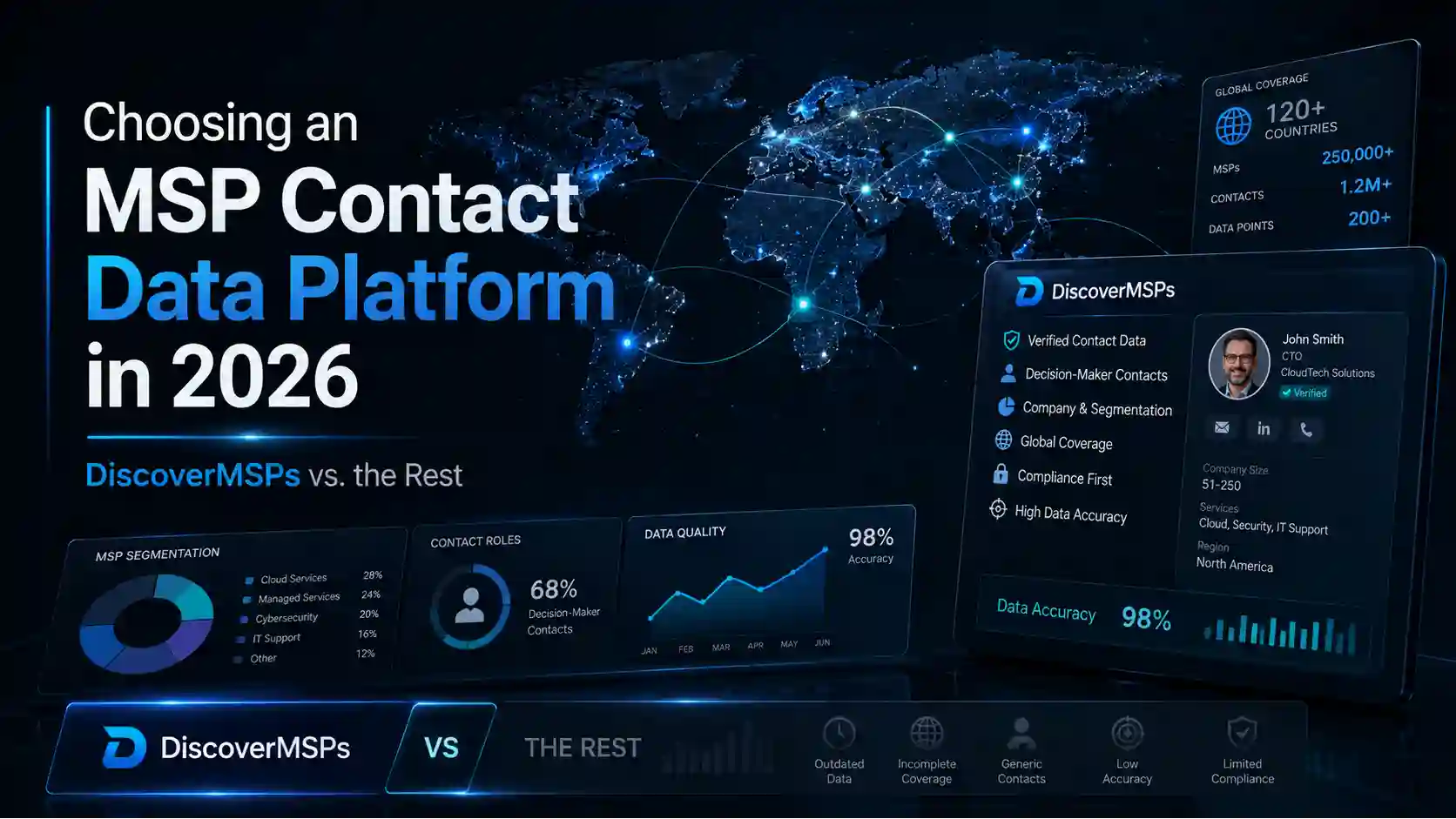
DiscoverMSPs vs. the Rest: What Actually Matters When Comparing Data Platforms?
When you scale an enterprise sales team or look for new channel partners, it is tempting to judge a data provider solely by the size of its database. Large, long-established corporate directories frequently boast tens of millions of global records. For broad, horizontal campaigns, that kind of volume is useful. However, when your revenue depends on identifying true managed service providers, raw numbers can become a distraction. Broad commercial databases often struggle when a buyer requires deep, structured IT channel intelligence.
Evaluating intelligence platforms requires looking past generic firmographics. A practical evaluation should focus on eight specific operational markers that directly impact campaign ROI.
1. Niche Relevance
General databases classify businesses using wide industrial categories. This means an independent web design shop or a retail computer repair store might be grouped under the same label as a high-growth managed service provider. DiscoverMSPs avoids this confusion by isolating true channel operators, ensuring your team does not spend time pitching complex B2B services to businesses that only handle consumer repairs.
2. MSP-Specific Segmentation
A useful platform must recognise that the channel is highly segmented. DiscoverMSPs supports specialized targeting by location, revenue, employee size, services offered, technology stack, and certifications. This means you can separate standard infrastructure management providers from firms that hold specific hybrid cloud or enterprise networking credentials.
3. Campaign Usability
Data must be organized so that marketing and sales teams can build relevant campaigns instantly. When a database provides clear insights into what a service provider actually sells, your sales representatives can tailor their messaging. DiscoverMSPs also includes dedicated MSSP targeting for security vendors and managed security service provider campaigns, allowing you to filter out businesses that lack a dedicated, around-the-clock security operations centre.
4. Contact Accuracy
Data decay is a constant problem in technology sales. General business listings often leave outdated positions active for months or years. DiscoverMSPs states that it offers a 95% accuracy benchmark, which helps lower email bounce rates, protects your domain reputation, and prevents sales development representatives from chasing contacts who have left the business.
5. Speed of Delivery
In channel management, timing is everything. Waiting weeks for a custom list to be manually cleaned can cause you to miss key sales cycles. A dedicated platform balances thorough validation with rapid delivery, ensuring that your sales operations team can access clean data quickly and keep outbound pipelines moving.
6. Privacy and Compliance Clarity
Responsible outbound communication requires strict adherence to international regulations. High-quality platforms ensure their records align with global privacy standards, including GDPR and CCPA. Incorporating reliable data protocols alongside official FTC CAN-SPAM guidance allows your team to run compliant, professional campaigns across multiple countries without creating legal or reputational risks for your business.
7. Fit for Channel Partner Recruitment
For software and hardware vendors, partner recruitment is an expensive process. If your team is using a broad directory, they will likely contact firms that do not possess the capacity or focus needed to resell your products. A specialised channel database allows recruiters to target providers who already support similar ecosystems, making the onboarding conversation far more productive.
8. Fit for Tech, SaaS, and Cybersecurity Vendors
Whether you sell telecom infrastructure, cloud monitoring systems, or SaaS products, your ideal customer profile is specific. A database that lacks clear technographic tracking will force your team to guess what software a prospect uses. Dedicated channel intelligence helps software and cybersecurity vendors identify exactly which platforms a provider currently manages, allowing for precise competitive displacement plays.
How Can I Trust DiscoverMSPs if the Company Is Newer Than Older Data Providers?
Business leaders are occasionally hesitant to work with a newer data platform when legacy providers have existed for decades. This caution is understandable, but in the data industry, age alone does not guarantee quality. A long-established directory can still contain stale, unverified contacts because maintaining massive, horizontal databases is incredibly difficult.
A newer, specialised provider can be highly valuable if its focus is narrow, transparent, and built on frequent verification cycles. Instead of trying to map every corporate entity on earth, a modern platform concentrates entirely on keeping one specific vertical accurate. Rather than relying on historical reputation, buyers should judge any provider by tangible metrics: the depth of their fields, recent verification dates, explicit compliance procedures, and clear data-replacement policies.
To protect your budget and verify platform quality before making a large commitment, you should look closely at how a vendor structures its information.
Before trusting any MSP contact data provider, ask:
- Can I see a sample before purchase? You should always be able to request a verified MSP data sample that matches your exact ideal customer profile to check its quality.
- How is the data segmented? Verify if the platform relies on automated corporate codes or if it categorises firms by actual channel models like MSP, MSSP, and VAR.
- Which regions are covered? Ensure the dataset has deep coverage in your specific target locations, such as the USA, Australia, or Canada.
- How recent is the data? Ask for the exact verification schedule and how frequently stagnant records are purged from the system.
- What fields are included? Check if the records provide direct corporate emails, executive titles, and granular technographic details, rather than generic switchboard numbers.
- Can the data be delivered in a CRM-ready format? Confirm that files are delivered as clean, structured assets that can be uploaded into your current sales tools without manual formatting.
- What privacy and compliance policies support the data? Review the provider’s official documentation regarding international data privacy laws.
- What happens if records are inaccurate? A credible provider should offer a transparent data-replacement policy for any records that bounce or prove incorrect.
Understanding how a platform validates its data gives you the confidence needed to scale your outbound strategy. In the next section, we will examine the technical details of privacy management, data security, and how modern procurement teams handle compliance verification.
Privacy, Compliance, and Buyer Confidence: What Happens After You Purchase MSP Data?
Corporate buyers are no longer assessing databases using simple volume metrics. In the current regulatory environment, the question of how many contacts are included in a dataset is secondary to operational security and risk management. Enterprise revenue teams, compliance officers, and channel directors are asking detailed questions about data origin and utilization:
- Where did this professional contact data originate, and how was it gathered?
- Can our outbound sales team deploy these records responsibly without creating security risks?
- Will poorly executed outreach campaigns cause long-term damage to our corporate domain reputation and brand equity?
- Does our sales operations infrastructure possess the capability to process, track, and honour opt-out requests instantly?
- Does the technology data provider publish clear, accessible privacy documentation and compliance updates?
A dedicated platform like DiscoverMSPs addresses these concerns directly by publishing detailed privacy and GDPR compliance documentation across its digital footprint. The platform states explicit alignment with major international frameworks, including GDPR and CCPA. However, securing data from a compliant provider does not completely absolve the buyer from operational responsibility.
Enterprise procurement teams must still thoroughly review published policies, map out their exact commercial use cases, and train their sales development representatives to execute outreach professionally. Data compliance is a shared responsibility; a high-quality database provides a stable foundation, but your internal execution determines your long-term success in the market.
How Does DiscoverMSPs Handle Privacy If I Purchase Customer Data?
Based on its published corporate policies, DiscoverMSPs outlines a structured framework regarding how it collects, uses, protects, retains, and processes professional B2B information. In its official GDPR compliance policy documentation, the company states explicitly that it does not sell personal data. The system is engineered to track and respect fundamental data privacy rights, including the right to access, rectification, erasure, restriction of processing, data portability, objection, withdrawal of consent, and the right to lodge a formal complaint with a supervisory authority.
While these built-in privacy safeguards offer reassurance, serious buyers should not treat compliance as a passive checkbox. Corporate data teams should regularly review the latest policy pages on the DiscoverMSPs platform and speak directly with their account team to establish exact contractual terms and data processing agreements that align with their internal governance standards.
Even when utilizing a highly compliant dataset, a responsible corporate buyer must establish strict internal guardrails to manage risk and protect corporate sender scores.
A responsible buyer should still do the following:
- Use business-relevant targeting only: Restrict your outbound campaigns to prospects who have a legitimate, provable business reason to learn about your technology or partner programme.
- Avoid mass-blast messaging: Ditch generic, automated mass email blasts that trigger spam filters and annoy busy channel executives.
- Personalise by region and service focus: Ensure your sales messaging accounts for structural variations across the USA, Australia, Canada, the UK, and continental Europe.
- Keep suppression lists updated: Maintain a centralized, cross-departmental suppression file to ensure opted-out contacts are never re-imported or contacted by a different team member.
- Honour opt-outs quickly: Process any unsubscribe or data removal requests immediately within your CRM to stay in alignment with global privacy expectations.
- Use clear sender details: Always provide transparent corporate identity information, including a valid physical business address and clear sender names in every message.
- Avoid misleading subject lines: Craft straightforward, honest subject lines that accurately reflect the commercial nature of the conversation.
- Train sales teams before launching outreach: Educate your sales development representatives on professional communication standards and data privacy rules before handing over a new list.
- Review regional requirements: Stay informed on specific local regulations that govern corporate outreach when engaging with contacts based in different international jurisdictions.
How Can I Make Sure DiscoverMSPs Providers the Right MSP Data?
Securing a highly accurate dataset requires providing a clear, unambiguous operational brief to your data partner. Because the channel is highly diverse, leaving your requirements open to interpretation usually results in a wider, less effective list. According to the strategic operational notes detailing the network structure on the About Us page, maximizing outbound efficiency depends entirely on aligning your data requirements with your precise engineering and regional sales goals.
To ensure your team receives a dataset that functions perfectly from day one, you should manage the procurement process using a structured onboarding checklist:
- Share your ideal customer profile clearly: Provide explicit definitions regarding target firm sizes, revenue bands, and business models.
- Mention your target regions: Outline your specific geographical parameters, whether you are running a localized campaign in Toronto or a national initiative across Australia.
- Define job titles and seniority: State precisely which executives you need to reach, such as chief executive officers, chief technology officers, or vice presidents of IT infrastructure.
- Specify service models and technology-user needs: Clarify whether you need to isolate traditional managed service providers, specialized managed security service providers, value-added resellers, or independent software vendors.
- Ask for sample records: Request a small, verified sample list tailored to your exact criteria to check file formatting and field alignment.
- Check the included fields: Ensure the data export contains all the custom properties, direct lines, and technographic markers required by your sales tools.
- Test a small campaign before scaling: Run a controlled pilot campaign with a few hundred records to verify deliverability and reply metrics before deploying a massive budget.
- Ask how replacement or correction is handled: Confirm the exact operational workflow for reporting and replacing any outdated records that bounce during your initial campaigns.
Taking the time to define these parameters before purchasing keeps your pipeline clean and your sales team focused on real opportunities. In the final section of this guide, we will translate these insights into a definitive decision framework, helping you determine whether DiscoverMSPs matches your business model or if a legacy directory fits your current scale.
Who Should Choose DiscoverMSPs, and Who May Need Another Option?
Selecting a data procurement strategy requires a clear-eyed assessment of your current commercial maturity, your team’s capability, and your precise go-to-market objectives. No single tool solves every pipeline challenge for every company. A specialized platform like DiscoverMSPs is engineered for a very specific type of B2B revenue operation, whereas a broader legacy database may suit alternative business models.
Investing in a dedicated managed service provider intelligence solution is typically the most efficient path for:
- SaaS companies expanding through channels: Software vendors who rely on downstream service providers to resell, bundle, or manage their products.
- Cybersecurity vendors targeting MSSPs: Security companies that need to filter out basic helpdesks and isolate true security operators.
- Cloud, telecom, UCaaS, and infrastructure vendors: Infrastructure providers that require highly granular technographic insights before starting competitive displacement plays.
- Channel partner recruitment teams: Professional partner managers who need to find, vet, and onboard regional partners quickly.
- International B2B sales teams: Organizations executing structured outreach across the USA, Australia, Canada, the UK, and global MSP markets.
- Investors and market researchers: Private equity firms and corporate development teams mapping out the channel to identify acquisition targets.
- Teams that prioritize relevance over raw volume: Commercial operations that require deep channel context rather than an unfiltered list of generic IT employees.
Conversely, looking at alternative options or utilizing basic list tools might be more sensible if:
- Your target list is extremely small and hyper-local, meaning you only need to identify ten or fifteen specific partners in a single town.
- Your internal sales operations team already maintains a mature, proprietary database with high accuracy and low decay rates.
- Your business sells consumer goods or services that require B2C data rather than high-end business-to-business channel contacts.
- Your primary target market is a highly obscure geographic region or niche that requires bespoke manual verification before buying any software.
- Your organization is not yet positioned to run compliant, professional, highly targeted outbound outreach.
Why Use a Managed Service Provider Contact Platform Instead of Manual Research?
When teams first begin building out a channel network, they often task junior sales development representatives with searching online directories and social platforms to find contacts manually. While this approach can work when creating a small shortlist of twenty firms, it quickly becomes slow, expensive, and inconsistent when you need to reach hundreds or thousands of verified prospects across multiple global regions.
Understanding why use a managed service provider database platform comes down to recognizing the hidden costs of manual data assembly. Relying on your sales team to act as data researchers usually pulls them away from their primary job: having high-quality conversations with decision-makers.
The challenges of manual research include:
- Manual research is significantly slower: Gathering accurate firmographics, direct lines, and executive titles takes days of manual scraping for every few dozen contacts.
- Contact freshness is hard to confirm: A corporate profile might show an executive who left the business six months ago, leading to high bounce rates.
- Segmentation becomes inconsistent: Without structured database fields, comparing the service capabilities of an operator in Canada with one in Australia is nearly impossible.
- Sales teams lose confidence: If your sales representatives spend their mornings calling disconnected switchboards, their productivity and morale drop.
- Campaign testing takes longer: Building a large enough sample size to test different value propositions takes weeks instead of hours.
- Regional outreach becomes harder: Tracking different privacy and regulatory requirements manually across borders increases your compliance risk.
- The cost of internal time remains hidden: The internal salaries spent on manual searching are often much higher than the cost of buying clean data.
Before Choosing Any MSP Contact Data Platform in 2026, Check:
- Does the provider specialize directly in MSP and MSSP intelligence, or are they a general b2b contact data provider?
- Does the database offer deep, verifiable coverage in your target territories, such as the USA, Australia, and Canada?
- Are there clear segmentation fields that allow you to filter by technology stack, revenue, and certifications?
- Can you review a small sample of records to verify field depth and contact validity before signing an annual contract?
- Does the platform support CRM-ready delivery formats that your operations team can upload instantly?
- Are there clear, published privacy and compliance policies supporting the collection and processing of the data?
- Will this intelligence actively help your sales team book meetings faster by removing guesswork?
- Does the structure of the dataset align with the specific inbound or outbound campaigns you plan to run?
- Does the platform help you truly understand the channel ecosystem, rather than simply letting you download names?
Summary of Strategic Options
| Feature/Metric | Specialist MSP Intelligence | General B2B Databases | Manual Research |
| Niche Relevance | High (Channel-focused) | Low (Broad categories) | Medium (Prone to human error) |
| Data Decay Risk | Low (Regular refresh cycles) | High (Massive volume to track) | Medium (Depends on research date) |
| Speed to Market | Rapid (CRM-ready lists) | Rapid (Mass downloads) | Very Slow (Row-by-row collection) |
| Compliance Layer | Structured (GDPR/CCPA focus) | Variable (Varies by vendor) | Low (Hard to track at scale) |
Conclusion
Securing an accurate, compliant database is no longer just about filling the top of your sales funnel; it is about protecting your corporate reputation and making your sales team efficient. The right platform should reduce guesswork, provide clear context on your ideal accounts, and give you the operational confidence needed to enter new regions.
If you are serious about scaling your partner network across the USA, Australia, Canada, or globally, you need data built around the actual business models of the channel. Review the DiscoverMSPs MSP Database or speak with the DiscoverMSPs team directly to request a verified sample that matches your exact ideal customer profile.
Frequently Asked Questions
How accurate is DiscoverMSPs’ data?
1. Why shouldn’t I just use a general B2B contact data provider for my MSP campaigns?
General directories use broad industrial category codes that group traditional software developers, local computer repair shops, and high-growth managed service providers under the same umbrella. A specialized channel database isolates actual managed service providers based on their operational business models, saving your sales team from wasting time on unqualified prospects.
2. How often does DiscoverMSPs refresh its contact data?
DiscoverMSPs uses a 45-day data verification and refresh cycle. Because roles change rapidly and technology stacks shift frequently within the IT channel ecosystem, this regular maintenance keeps records accurate and helps protect your corporate domain health.
3. What specific job titles are included in the DiscoverMSPs database?
The platform prioritises human-verified leadership and decision-making roles. You can filter and search for executive contacts including Chief Executive Officers (CEOs), Chief Technology Officers (CTOs), and Vice Presidents of IT (VP IT) who hold purchasing power and sign off on new vendor partnerships.
4. Can I target managed security service providers separately from standard IT firms?
Yes. Understanding why use a managed security service provider helps highlight the massive operational difference between general helpdesks and security operators. The platform provides dedicated MSSP targeting filters based on country, security specialisation, business model, and firm size.
5. Does the data platform support international sales compliance?
DiscoverMSPs explicitly aligns its data practices with international privacy frameworks, maintaining strict compliance with GDPR and CCPA requirements. This structured approach allows sales and marketing teams to run professional outbound campaigns across multiple global jurisdictions including the USA, Canada, and Australia.
6. What kind of technographic filtering is available for channel recruitment?
The database is structured around more than 300 data categories. This allows your team to filter prospects by their specific services offered, organizational revenue, certifications, and internal technology stacks, making competitive displacement plays highly targeted.
7. In what format is the data delivered, and can I test it first?
The data is delivered in clean, structured, CRM-ready files that upload directly into major client relationship management tools without manual cleaning. Serious buyers can contact the DiscoverMSPs team directly to request a verified data sample matching their exact ideal customer profile before committing to a larger purchase.