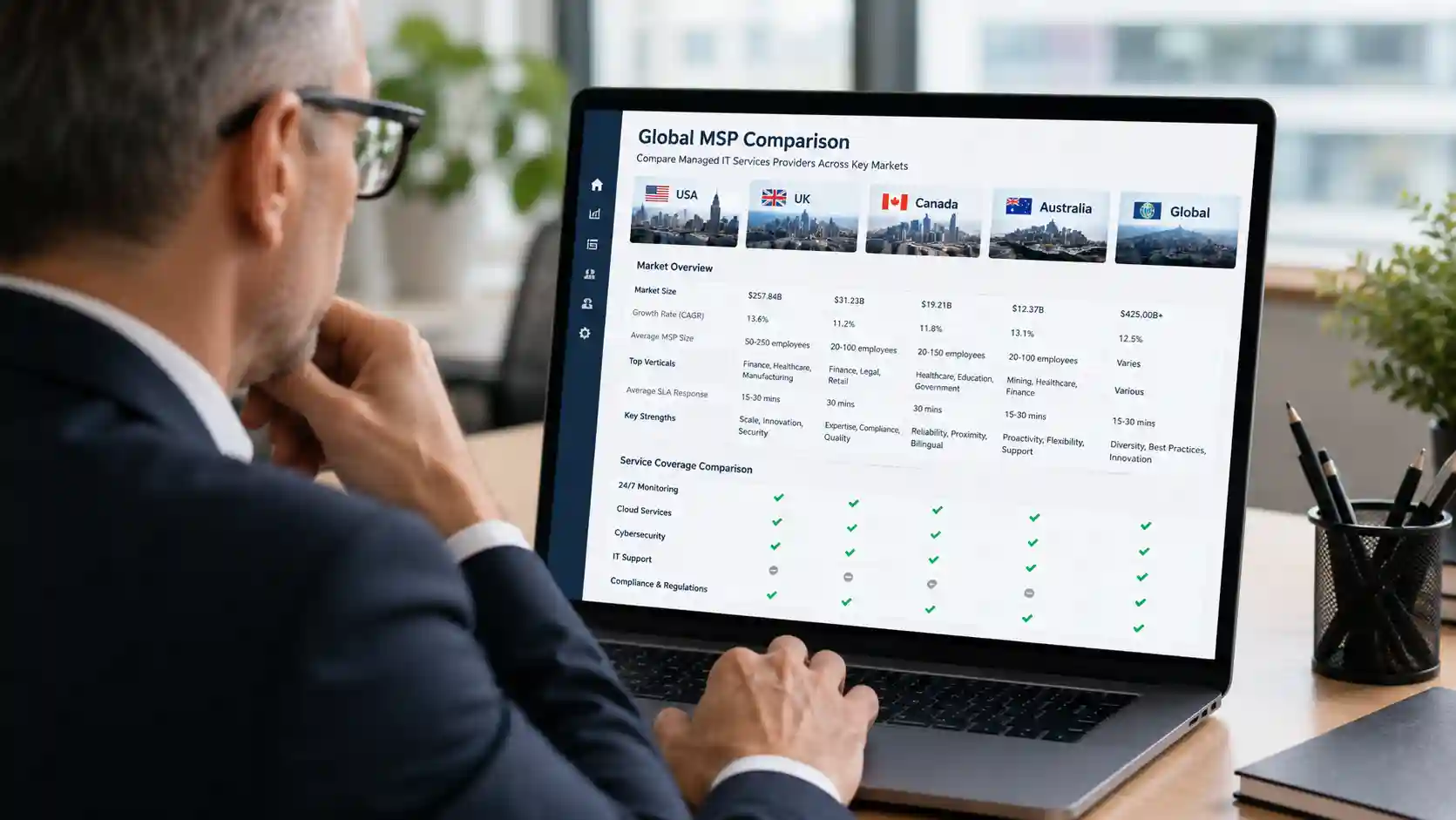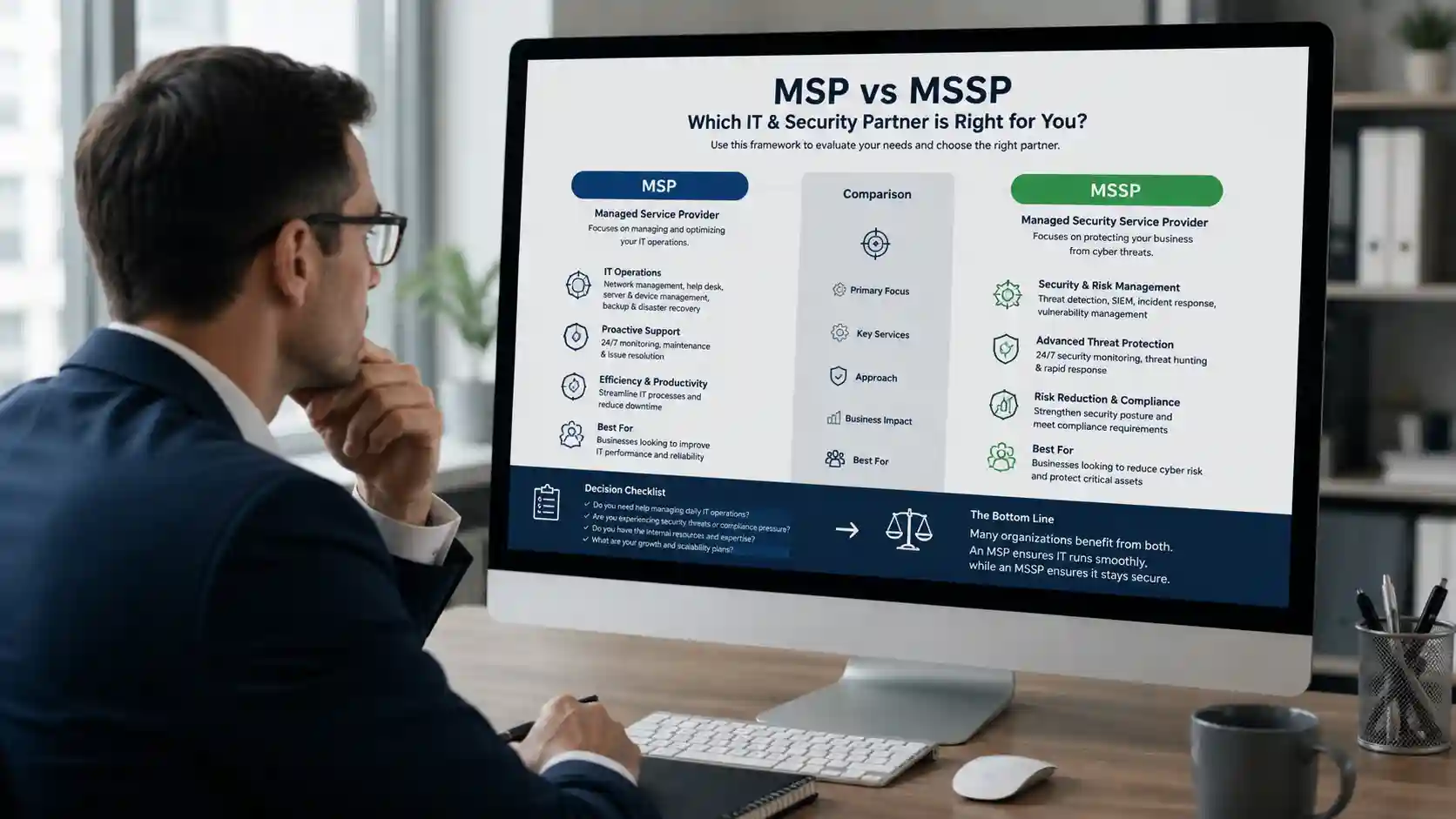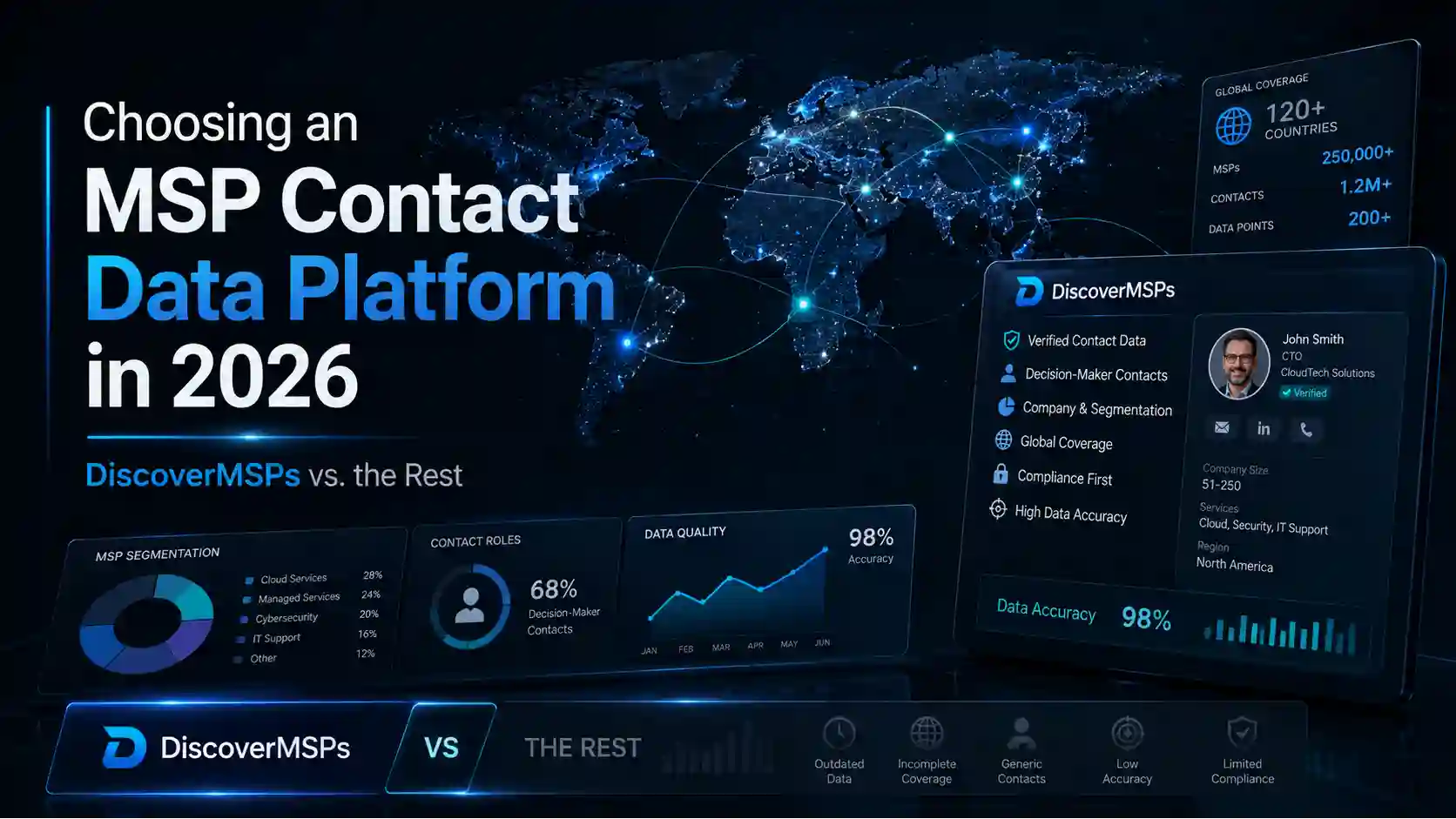
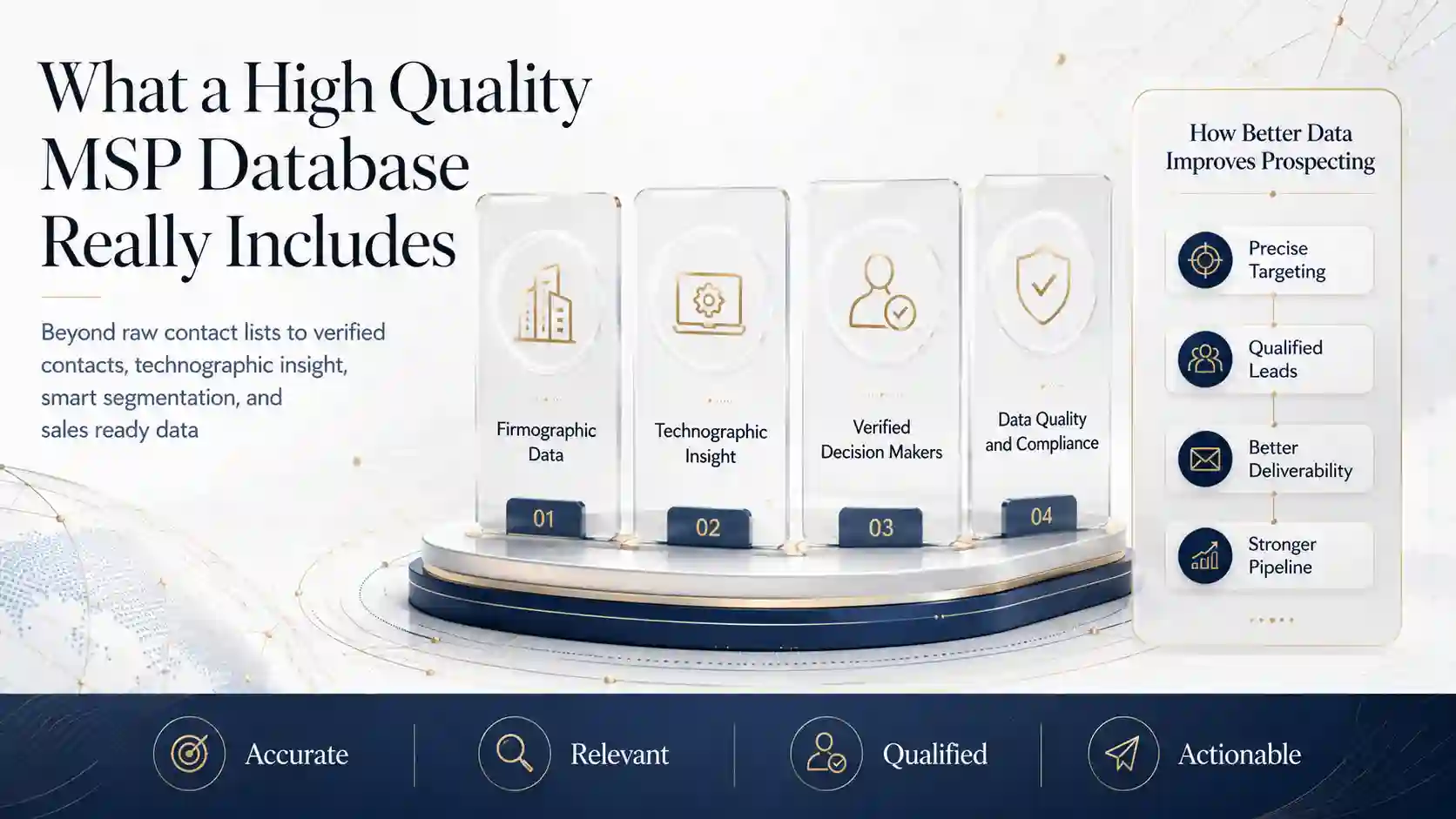
A functional MSP database differs from a standard company directory through its structural organisation, capturing the precise operational characteristics of managed service providers rather than merely listing corporate names. While general corporate registries supply basic firmographic details such as address and employee count, technology-focused sales and channel teams require granular visibility into service delivery models, vendor partnerships, and specific technical specialisations. Without this depth, outreach efforts dissolve into generic volume campaigns that generate high bounce rates and low conversion metrics.
What Is an MSP Database?
An MSP database is a specialised market intelligence repository cataloguing managed IT service providers, managed security service providers, and cloud integration firms, structured specifically for B2B sales, channel recruitment, and market analysis.
Unlike broad commercial directories that sweep up millions of retail, manufacturing, and professional services firms, a dedicated database focuses exclusively on technology service providers. It maps their core operational profiles, covering everything from remote monitoring and management toolsets to cloud migration capabilities and security operations center offerings. This specialisation transforms abstract total addressable market figures into actionable prospect lists, allowing software vendors, cybersecurity firms, and IT staffing providers to identify partners whose technical stack and service maturity align with their commercial offerings.
MSP Database Versus an Ordinary Company List
Raw list volume remains one of the most persistent traps in commercial research. Possessing fifty thousand company names holds little value if sixty percent of those entities have pivoted away from managed services, dissolved, or operate as break-fix repair shops rather than scalable managed service providers.
An ordinary company list provides a blunt instrument. It relies on SIC codes or broad industry classifications that often misclassify software developers, hardware retailers, and internal IT departments as external service providers.
A specialist intelligence platform applies rigorous filtering to isolate true managed service providers. This distinction matters deeply when building campaigns for partner recruitment or enterprise software sales. Consider three core structural divergences:
- Classification Precision: Standard lists group diverse technology businesses under generic IT headings, whereas specialised records distinguish between pure-play cloud consultants, cybersecurity specialists, and traditional infrastructure providers.
- Technographic Depth: Basic directories omit the underlying software stack, whereas structured technology intelligence identifies which professional services automation or ticketing tools an organisation relies on.
- Decision-Maker Accuracy: General databases frequently surface generic info email addresses, whereas targeted intelligence maps specific executive leadership, technical directors, and procurement leads.
What High-Quality MSP Intelligence Should Contain
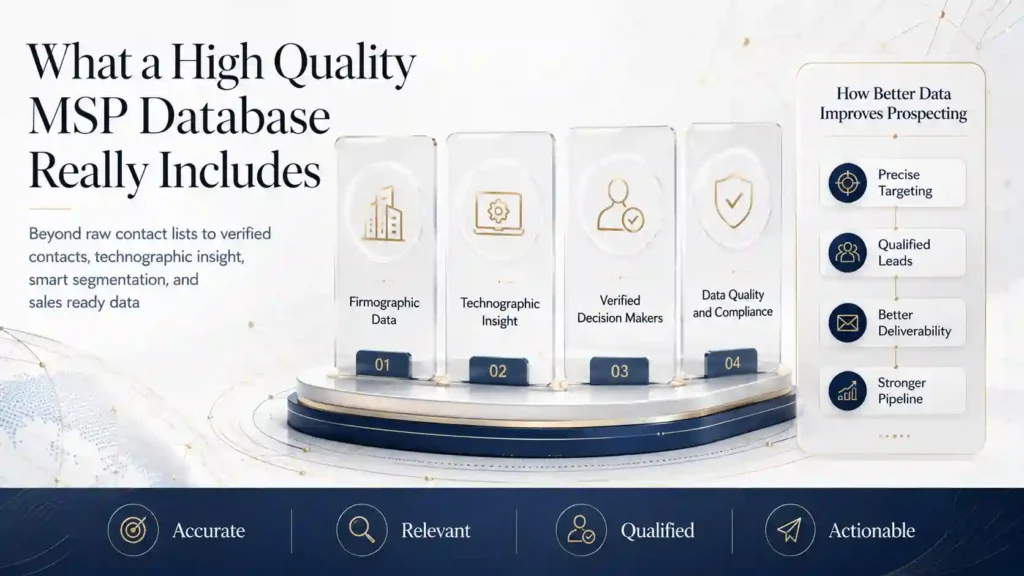
Effective commercial prospecting requires more than a physical address and a corporate phone number. When evaluating market intelligence for channel sales or vendor partnerships, the underlying data structure must support multi-layered segmentation.
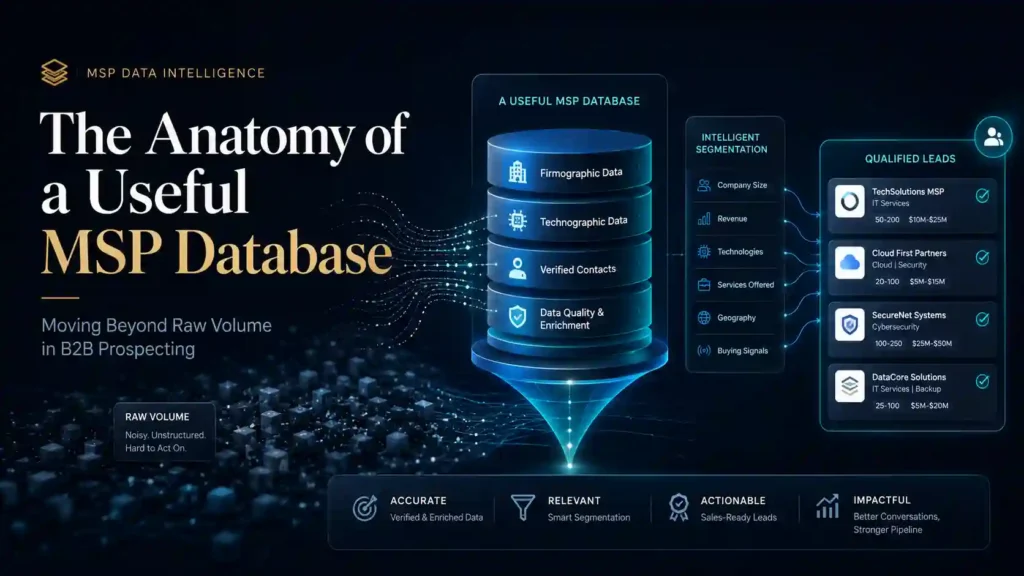
Comprehensive records generally incorporate several distinct intelligence layers. Firmographic parameters establish baseline company scale, geographic footprint, and operational maturity. Technographic markers reveal the vendor ecosystems surrounding the provider, indicating compatibility with specific software integrations or security suites. Contact intelligence bridges the gap between firm-level data and individual outreach, ensuring messages reach the appropriate desk rather than an unmonitored general inbox.
Furthermore, regional nuances dictate how intelligence must be structured. Outreach across the United States requires navigating state-level market variations, whereas operating in the United Kingdom involves adherence to specific regulatory frameworks and official organisational classifications. Data collection methodologies must account for these regional realities to maintain utility across international markets.
Why Generic Lead Volume Often Fails
Sales teams frequently measure prospecting success by the sheer size of their contact lists. Yet, expanding the top of the funnel with unqualified records creates a compounding operational burden.
When outreach campaigns target companies that lack the capacity, client base, or technical alignment for a given product, conversion rates drop close to zero. Sales representatives waste valuable hours sorting through dead numbers, unverified contacts, and mismatched profiles. Marketing automation platforms penalise senders whose campaigns suffer from high bounce rates and spam complaints, degrading domain reputation and damaging future deliverability.
Shifting the focus from volume to relevance alters the economics of B2B sales. Engaging a smaller cohort of accurately profiled managed service providers yields higher response rates, shorter sales cycles, and more productive partnership discussions. Quality segmentation replaces scattershot broadcasting with precise market penetration.
How an MSP Database Generates Qualified B2B Sales Leads
An MSP database produces viable B2B sales leads by giving commercial teams the structural criteria needed to qualify accounts before initiating outreach, rather than relying on post-contact qualification to filter out poor fits.
A static list of contacts does not generate revenue on its own. Commercial pipeline develops through an operational chain where each stage depends entirely on the accuracy of the preceding data layer:
- Ideal Customer Profile (ICP) Definition: Establishing the precise operational, technical, and geographic parameters of an ideal partner or client account.
- Account Filtering: Querying a structured msp companies database to isolate entities matching those exact criteria.
- Company Qualification: Verifying that each organisation maintains an active, relevant managed services practice rather than an adjacent, incompatible business model.
- Decision-Maker Identification: Mapping specific functional roles, such as Vice Presidents of Managed Services, Chief Technology Officers, or Heads of Procurement.
- Contextual Outreach: Crafting commercial messaging that directly references the prospect’s operational model, vendor ecosystem, or regional footprint.
- Sales Qualification: Conducting exploratory conversations focused on confirmed mutual alignment.
- Opportunity Creation: Advancing validated accounts into active commercial negotiations.
When data breaks down at the filtering or role identification stages, the entire sequence degrades. Representatives end up pitching cybersecurity suites to hardware repair shops or presenting cloud monitoring tools to executive assistants, wasting sales capacity and inflating customer acquisition costs.
How to Generate Leads in B2B Sales Using MSP Intelligence
Learning how to generate leads in b2b sales within the IT channel requires a disciplined workflow built around exclusion and precise account scoring rather than mass contact acquisition.
1. Define Exclusion Criteria First
Effective segmentation begins by identifying who should not receive outreach. Removing retail computer repair shops, residential internet resellers, and one-person consultancies protects team bandwidth and preserves sender domain reputation.
2. Establish Geographic Boundaries
Targeting should reflect service capability and operational jurisdiction. Cross-border outreach requires distinct messaging and compliance strategies, making geographical boundaries a necessary first-order filter.
3. Screen by Scale and Operational Maturity
Employee headcount and estimated annual revenue indicate whether a provider possesses the operational complexity required to partner with enterprise vendors or evaluate complex software solutions.
4. Isolate Core Service Capabilities
A provider specialising in medical compliance infrastructure requires an entirely different commercial approach than one managing educational desktop deployments. Categorising prospects by primary service delivery model ensures messaging remains relevant.
5. Layer Technographic Data
Examine the software environments and infrastructure platforms a provider uses. Overlaying granular technology data identifies which vendors already sit in a provider’s stack, highlighting integration opportunities or displacement targets.
6. Map the Decision-Making Unit
In managed service providers with ten to fifty employees, technical leadership often manages purchasing. In larger enterprise service organisations, dedicated procurement or vendor management directors handle product evaluations.
7. Prioritise and Sequence Accounts
Tier qualified accounts based on fit. High-fit organisations warrant multi-touch account-based research, while secondary prospects receive structured, semi-automated introductory sequences.
8. Track Downstream Conversion Metrics
Measure campaign efficacy by response rates, qualified discovery calls, and pipeline value rather than raw send volume. Feeding engagement results back into future targeting parameters continuously refines list quality.
Combining Firmographic and Technographic Intelligence
Firmographic and technographic datasets answer entirely different operational questions during market research. Firmographic attributes define who an organisation is in terms of scale and structure, while technographic attributes reveal how that organisation delivers its services.
| Data Layer | Core Data Points | Primary Prospecting Application |
| Firmographics | Geography, headcount, annual revenue, corporate structure, office locations | Establishing baseline commercial viability and organizational scale |
| Technographics | RMM platforms, PSA systems, backup solutions, cloud environments, security tooling | Assessing technical compatibility, stack integration, and vendor alignment |
Relying solely on firmographic classifications can lead to misdirected outreach. Two providers may both employ fifty staff members in the same metropolitan area, yet one operates primarily on Microsoft Azure infrastructure while the other builds private data center environments. Evaluating both intelligence layers allows sales teams to craft contextually accurate commercial proposals.
Navigating Regional Market Differences: USA, UK, and Canada
Segmenting service providers across international boundaries requires adjusting for regional market structures, regulatory environments, and commercial dynamics.
The United States Market
The American market represents a massive, highly competitive landscape characterised by significant regional clustering and deep vertical specialisation. Evaluating managed IT services providers in the USA requires multi-state geographic mapping, as mid-sized providers frequently operate across state borders while maintaining distinct regional delivery hubs.
The United Kingdom Market
In the UK, commercial operations concentrate heavily around major metropolitan regions such as Greater London, the Midlands, and the North West. When engaging the managed IT services UK market, campaign structures must also respect domestic regulatory standards, including the UK General Data Protection Regulation and the Privacy and Electronic Communications Regulations.
The Canadian Market
The Canadian ecosystem features dense commercial clusters in Ontario, Quebec, and British Columbia, separated by vast geographic expanses. Engaging managed IT services Canada involves accounting for provincial compliance mandates, such as Quebec’s Law 25, alongside federal frameworks like the Personal Information Protection and Electronic Documents Act.
Understanding Commercial Search Intent in Channel Research
Search queries in the technology channel reflect two entirely different business objectives. An end-user enterprise searching for a managed it services provider usa seeks an external partner to outsource its internal infrastructure and support. Conversely, a vendor searching for an MSP prospect directory seeks to sell software, hardware, or wholesale services directly to those providers.
A specialist intelligence directory serves both intents by separating external directory discovery from structured outbound database access. Clarifying this distinction ensures that prospective buyers find the right support, while channel vendors access the verified company data needed to build strategic partner ecosystems.
How to Evaluate an MSP Companies Database
Evaluating a specialist data vendor requires an objective inspection of the vendor’s underlying taxonomy and collection methodology rather than an assessment based on gross record volume.
A comprehensive evaluation framework should examine four distinct operational dimensions:
- Taxonomic Rigour: How does the vendor define a managed service provider? Ensure the platform separates outsourced infrastructure operators from software resellers, independent consultants, and internal enterprise IT departments.
- Granular Segmentation: Determine whether the dataset allows multi-layered filtering by sub-specialisation, client vertical, employee scale, and geographic territory, or if it simply delivers an undifferentiated list of accounts.
- Verification Methodology: Assess whether the vendor combines automated data scraping with structured human validation. Look for documented processes covering email syntax checking, domain validation, and phone verification.
- CRM and Export Usability: Review the delivery schema to confirm fields map directly into standard sales automation tools without requiring extensive manual normalisation.
Sales leadership should evaluate data quality across accuracy, relevance, and deliverability simultaneously. A dataset featuring pristine deliverability metrics remains useless if the contacts listed hold no authority over software procurement or channel partnerships.
What Makes MSP Contact Data Go Stale?
B2B contact intelligence deteriorates naturally over time. In the technology channel, this decay occurs at an accelerated pace due to market dynamics and workforce movement.
Several operational factors drive data obsolescence:
- Executive and Technical Turnover: Key decision-makers frequently change employers or transition into different roles, rendering direct phone numbers and email routing obsolete.
- Mergers and Acquisitions: Private equity consolidation across the managed services sector frequently leads to domain changes, brand retirements, and restructured management tiers.
- Service Model Evolution: Traditional value-added resellers often reposition themselves as security consultants or cloud architects, changing their relevance to specific vendor campaigns.
- Corporate Entity Adjustments: Smaller regional operators may alter their business names, close satellite branches, or dissolve entirely.
Without continuous data verification, contact lists quickly accumulate dead mailboxes and disconnected numbers. Ongoing hygiene routines protect sender reputation and prevent commercial representatives from wasting time on defunct records.
Specialist MSP Databases Compared to General B2B Directories
General commercial registries serve an important purpose when running broad, cross-industry prospecting initiatives that depend strictly on high-level firmographic markers like company size and general industry.
However, broad directories struggle with the structural nuances of the IT channel. They rely on coarse industry codes that bundle hardware vendors, custom software houses, and external service firms into the same category. This lack of granularity makes it difficult to distinguish an ordinary IT consultancy from dedicated managed security service providers or cloud hosting specialists.
| Evaluation Metric | General B2B Database | Specialist MSP Database |
| Industry Classification | Broad industry codes (e.g., Computer Systems Design) | Channel-specific taxonomies (e.g., Pure MSP, MSSP, Cloud Consultant) |
| Technographic Depth | Basic website trackers and digital tools | Operational stack details (RMM, PSA, Backup, Endpoint Security) |
| Persona Mapping | Generic corporate functions (Sales, Marketing, HR) | Channel roles (VP of Managed Services, Head of Cloud Infrastructure) |
| Prospect Relevance | Wide, variable commercial fit | High alignment with IT channel vendor ecosystems |
Distinguishing Managed Services from IT Staffing Providers
A common point of confusion in technology list-building involves conflating managed service providers with IT staffing firms. While both operate within enterprise technology, their business models differ fundamentally.
An it staffing provider places technical talent, contractors, and permanent personnel directly into client organisations, operating under a human capital model. In contrast, an MSP delivers ongoing, outsourced management of technology infrastructure under structured service level agreements.
Conflating these categories leads to misaligned sales messaging. A software vendor offering multi-tenant management tooling has no commercial application for a technical staffing firm, highlighting the importance of precise categorization within a prospect database.
Evaluating Platform Trust and Dataset Integrity
When considering an intelligence provider, commercial buyers often question whether newer platforms can match established data aggregators. Company longevity, however, does not directly dictate dataset accuracy. Legacy aggregators often carry millions of legacy records that suffer from slow refresh cycles and automated data bloat.
Prospective buyers should base purchasing decisions on verifiable operational standards rather than brand tenure:
- Methodological Transparency: The provider should openly explain its data sourcing channels and verification intervals.
- Compliance Documentation: Clear public disclosures regarding data collection standards, opt-out mechanisms, and international privacy alignment must be accessible on the vendor’s about and governance pages.
- Sample Testing: The availability of representative sample data allowing buyers to audit role relevance and technical categorization prior to commercial commitment.
How to Verify That a Dataset Fits Your Specific Requirements
Before acquiring an MSP list, revenue teams should follow a structured verification process:
- Define the Scope: Outline the target geographic territory, minimum and maximum employee headcounts, and required service delivery models.
- Identify Key Personas: Determine the exact job functions required, such as operational leadership, technical management, or procurement heads.
- Request a Representative Sample: Obtain a sample export matching your specific profile to manually check domain validity and persona alignment.
- Audit Structural Fields: Confirm the dataset includes essential segmentation columns, such as verified phone numbers, corporate domains, and physical office locations.
- Review Invalidation Policies: Clarify the vendor’s policy regarding outdated or invalid contacts to understand how inaccuracies are remediated.
Responsible Use of B2B Contact Intelligence
Acquiring a verified database does not relieve a commercial organization of its legal and ethical obligations regarding outreach. Purchasing contact intelligence simply provides access to commercial information; the responsibility for conducting lawful, professional, and targeted communication rests entirely with the sender.
Responsible B2B prospecting requires strict adherence to commercial communication standards across several core operational areas:
- Clear Sender Identification: Commercial communications must accurately identify the initiating business and provide a valid physical postal address.
- Transparent Subject Lines: Message headers and subject lines must reflect the actual commercial intent of the communication rather than using misleading deceptive phrasing.
- Functional Opt-Out Mechanisms: Every outreach email must include a clear, easy-to-use method for recipients to decline future communications.
- Suppression List Management: Organizations must maintain an internal, centralized suppression list to ensure unsubscribed contacts are permanently excluded from subsequent campaigns.
- Targeted Commercial Relevance: Outreach should only be directed to individuals whose professional responsibilities logically align with the proposed product or service.
Regulatory obligations vary significantly across international borders. In the United States, commercial messaging is governed primarily at the federal level. Senders should review the FTC’s CAN-SPAM compliance guidance to ensure their technical headers, message disclosures, and opt-out processing times comply with federal statutes.
In the United Kingdom, direct marketing rules operate under a distinct framework. Senders engaging corporate entities must review the ICO guidance on business-to-business marketing to understand the application of the Privacy and Electronic Communications Regulations alongside the UK General Data Protection Regulation. While marketing to corporate employees often permits electronic outreach without prior consent under specific conditions, data protection principles regarding fairness, transparency, and the absolute right to object still apply.
Organizations must assess the specific legal rules applicable to their jurisdiction, corporate structure, and communication channels, as regulatory requirements differ markedly between corporate entities and individual sole traders.
Data Governance and Privacy Alignment
Data providers must establish clear operational protocols regarding information collection, storage, and removal. Prospective buyers should review these policies to understand how a platform manages business directory information.
Platform governance is typically outlined in published documentation, such as a vendor’s privacy policy and dedicated GDPR compliance policy. These public records describe how business contact information is gathered from public directories, corporate registries, and industry publications, as well as the mechanisms available for individuals to request the review or removal of their profile.
Before executing campaigns with third-party intelligence, revenue teams should confirm several internal governance checkpoints:
- Ensure that your organization maintains a designated privacy contact or data protection officer to handle prospective removal inquiries.
- Confirm that any purchased dataset is integrated with your existing CRM suppression lists to prevent accidental contact with previously excluded prospects.
- Document the legitimate business interest and commercial rationale behind contacting specific industry roles.
Why a Database Does Not Replace Commercial Strategy
A common operational error is treating a verified database as a complete outbound strategy. Contact intelligence simply provides accurate routing; it does not persuade a prospect or validate an uncompetitive offer.
A high-quality contact list cannot compensate for fundamental commercial shortcomings:
- Weak Value Propositions: Pitching generic features without addressing the specific operational realities of managed service providers results in immediate deletion.
- Poor Outreach Timing: Contacting organizations during peak migration windows or fiscal end-of-year audits without acknowledging their operational cycles lowers engagement.
- Undifferentiated Messaging: Sending identical sales templates to pure-play cybersecurity specialists and general desktop support providers signals a lack of market awareness.
- Misaligned Roles: Delivering strategic partner proposals to junior systems engineers or technical product updates to procurement officers wastes valuable outreach capacity.
- Absence of a Structured Follow-Up Cadence: Single-touch campaigns rarely convert. Pipeline generation requires multi-channel follow-ups across structured intervals.
The database serves as the foundation for market access, but message relevance and commercial alignment determine pipeline velocity.
A Practical Pipeline Generation Workflow
To turn raw market intelligence into predictable B2B sales pipeline, revenue teams should execute a disciplined ten-stage campaign framework:
- Establish ICP Constraints: Define exact parameters for headcount, annual revenue, and service focus.
- Isolate the Account List: Query the dataset to create a focused cohort of qualifying businesses.
- Audit a Control Batch: Manually inspect twenty to thirty accounts to confirm classification accuracy before launching broad initiatives.
- Identify Primary and Secondary Personas: Map decision-makers alongside technical influencers within each target account.
- Segment by Operational Focus: Group selected accounts by specific technical capabilities, such as cloud migration, backup management, or compliance support.
- Draft Persona-Specific Messaging: Craft outreach angles addressing the operational pain points unique to each sub-segment.
- Initiate Controlled Sequences: Deploy outreach in measured batches of fifty to one hundred contacts to track deliverability and response metrics.
- Analyze Response Quality: Evaluate positive reply rates and booked discovery calls rather than relying on vanity open rates.
- Incorporate Feedback Loops: Use objections and disqualification reasons to refine upstream filtering criteria.
- Scale Validated Segments: Expand outreach volume only after a specific persona-segment pairing demonstrates sustainable conversion rates.
Common List-Building and Prospecting Mistakes
Revenue operations frequently encounter friction due to preventable execution errors during list acquisition and deployment:
- Over-Purchasing Volume: Procuring tens of thousands of records that the internal sales team cannot meaningfully work within a ninety-day window, allowing data to decay before outreach begins.
- Treating Every IT Business as an MSP: Failing to separate value-added resellers, software developers, and break-fix repair shops from true recurring-revenue service providers.
- Neglecting Account De-Duplication: Uploading external records without cross-referencing existing customer lists, active opportunities, and historical partner accounts.
- Relying Exclusively on Email Channels: Failing to combine direct email outreach with professional network touches and targeted phone discovery.
- Equating Email Deliverability with Sales Fit: Assuming that because an email address passes technical validation, the associated account represents an active commercial opportunity.
Who Actually Benefits from a Specialist MSP Database?
A dedicated MSP intelligence repository delivers significant commercial leverage to organisations whose revenue models depend directly on the IT channel, but it is not a universal solution for every B2B sales team.
Organisations that derive the highest commercial return from specialised channel data include:
- SaaS and Cybersecurity Vendors: Software providers seeking to recruit managed service providers as multi-tenant distribution partners or integrate directly into managed security portfolios.
- Cloud Infrastructure and Backup Providers: Vendors offering wholesale infrastructure, disaster recovery, or virtualization services that require technical compatibility with a provider’s existing client environments.
- Hardware Manufacturers and Distributors: Channel sales teams identifying regional service providers capable of deploying networking hardware, unified communications, or server infrastructure.
- M&A Advisory and Private Equity Teams: Market analysts and corporate development officers evaluating regional market density, technological specialization, and consolidation opportunities across the IT services landscape.
Conversely, broad consumer brands, companies selling horizontal office supplies, or teams targeting enterprise internal IT departments will find little utility in channel-specific datasets. Similarly, sales teams that lack a defined customer profile or an established outbound sales workflow will struggle to convert raw records into pipeline, regardless of data quality.
A Buyer’s Pre-Purchase Evaluation Checklist
Before committing budget to an external dataset, revenue operations leaders should audit prospective data vendors against twelve core functional requirements:
- Taxonomic Clarity: Does the vendor provide precise criteria distinguishing pure managed service providers from resellers and general IT consultants?
- Geographic Precision: Can lists be filtered cleanly across specific metropolitan clusters, states, provinces, or countries?
- Sub-Category Granularity: Is there an ability to separate managed security service providers from traditional IT support firms?
- Firmographic Breadth: Are core organizational attributes, including verified headcount, physical branch locations, and operational scale, provided?
- Role Relevance: Does the platform supply direct contacts for relevant functional leaders rather than generic administrative addresses?
- Verification Procedures: Does the provider use documented multi-step validation processes covering email deliverability and human verification?
- Refresh Cadence: How frequently are records audited, enriched, and purged of defunct entities?
- Sample Accessibility: Can prospective buyers review a representative data sample matching their exact targeting profile prior to purchase?
- Regulatory Transparency: Are public documentation, privacy disclosures, and opt-out mechanisms accessible?
- Schema Compatibility: Are data exports structured to import into major CRM platforms without requiring complex data transformation?
- Remediation Policies: Does the vendor offer a structured replacement or credit policy for invalid records?
- Custom Filtering Capability: Can the platform accommodate negative exclusions and custom target lists?
Frequently Asked Questions
1. What is an MSP database?
An MSP database is a structured B2B intelligence platform that catalogues managed IT service providers, managed security service providers, and cloud integration firms. It organizes company firmographics, operational software stacks, and decision-maker contact details specifically to support channel sales, partner recruitment, and market research.
2. How does a specialist MSP directory differ from a broad B2B database?
A specialist directory focuses exclusively on technology service providers, categorising organisations by service delivery models, technical specialisations, and platform ecosystems. General B2B databases rely on broad industrial classification codes that frequently bundle hardware retailers, custom software developers, and internal IT departments into generic categories.
3. How does structured MSP data help generate B2B sales leads?
Structured data enables revenue teams to filter the broader market into a focused group of qualified accounts based on geographic presence, technical specialisation, and organizational scale. This upfront qualification ensures sales outreach addresses verified decision-makers with messaging relevant to their specific technology stack.
4. How can a business find MSP companies in the USA, UK, or Canada?
Teams can identify providers across North America and Britain by querying an intelligence platform that supports regional filtering. Platforms such as DiscoverMSPs allow users to segment companies by national markets, regional territories, and service capabilities across the United States, the United Kingdom, and Canada.
5. What core information should a high-quality MSP record contain?
A high-quality record must provide verified firmographic metrics, including employee headcount, physical operational locations, primary service categories, and verified decision-maker details. Advanced datasets also incorporate technographic information, revealing the underlying management tools, security platforms, and cloud environments the provider deploys.
6. How can buyers determine if contact data is accurate before purchasing?
Buyers should assess accuracy by requesting a custom data sample aligned with their specific ideal customer profile. Testing this sample through manual verification, domain validation, and deliverability checks provides an objective measure of dataset health prior to a larger commercial commitment.
7. Is purchasing a contact dataset sufficient to generate qualified pipeline?
Purchasing data provides market visibility and contact access, but it does not generate sales opportunities on its own. Converting data into revenue requires a coherent positioning strategy, relevant messaging tailored to the recipient’s operational role, multi-channel outreach, and disciplined sales qualification.
8. What rules govern the responsible use of B2B contact data?
Responsible outreach requires adhering to applicable regional direct marketing and data protection regulations. Organizations operating in the United States must comply with federal standards regarding header accuracy and opt-out processing, while teams engaging United Kingdom or European entities must respect relevant electronic marketing and data protection rules.
Turning Market Intelligence into Commercial Outcomes
The commercial value of an intelligence platform is never measured by raw record counts. A file containing tens of thousands of unverified entries creates operational drag, degrading sales productivity and endangering domain reputation. True commercial value lies in taxonomic precision, reliable verification, and the ability to isolate exact operational profiles.
When a revenue team understands the specific geographic regions, service categories, and operational roles required for a campaign, list building shifts from speculative volume gathering to deliberate market penetration. Platforms that provide structured access to verified managed service providers allow channel managers and sales leaders to focus their resources entirely on high-fit accounts.
Before entering into any data acquisition agreement, sales leaders should audit available samples, review governance practices, and ensure the dataset mirrors their go-to-market model. Those evaluating prospective channel partners or planning structured outbound initiatives can review the background of the directory on the About DiscoverMSPs page, or contact DiscoverMSPs directly to evaluate whether their specific ideal customer profile can be accurately matched. Targeting precision, rather than indiscriminate scale, remains the foundation of sustainable channel revenue.