
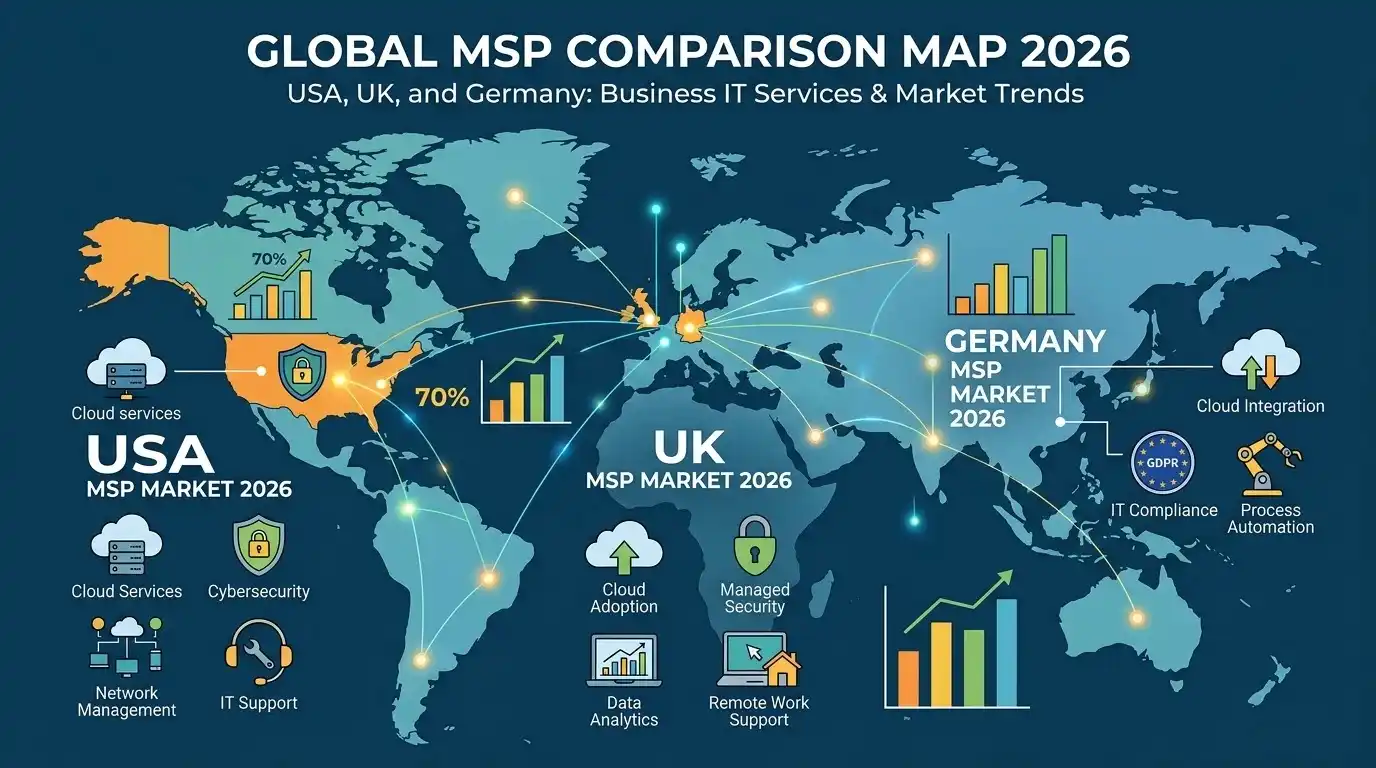
The criteria for evaluating external technology partners has fundamentally shifted. For a long time, companies viewed IT support through a purely reactive lens: a server went down, a ticket was opened, and a technician fixed the fault. Today, mid-market enterprises and global corporations require an entirely different level of operational resilience. When founders, IT directors, and procurement heads evaluate managed service providers, they are no longer trying to solve basic desktop troubleshooting.
The modern business landscape demands a strategic partner capable of overseeing multi-cloud architectures, complex cybersecurity frameworks, round-the-clock helpdesk operations, strict regulatory compliance, automated endpoint management, secure data backup routines, and distributed remote work environments. This guide serves as a comprehensive resource to navigate the evolving market of regional and global infrastructure partners, helping your business match specific engineering capabilities with your long-term commercial goals.
Why Managed Service Providers Matter More in 2026
The old break-fix model of IT no longer works for firms that want to grow. Waiting for things to break brings real risk, surprise costs and long outages. One bad outage can hurt a firm's name within minutes. Modern firms move to proactive managed IT instead. Automatic patching, constant scans and capacity planning stop problems before staff ever notice them.
This shift to outside help shows up in every market this guide covers. Software and IT services are the fastest-growing parts of tech spending. That shows how much firms now lean on outside cloud, security and infrastructure experts. Smart firms do not build large in-house teams for every niche skill. They use clear partnerships to stay nimble, keep costs down and run strong infrastructure.
What Is a Managed Service Provider?
A Managed Service Provider (MSP) is an outside firm that runs, maintains and protects a company's IT for an ongoing fee. Most work under Service Level Agreements (SLAs). Some act as the whole IT department. Others work alongside an in-house team. Either way, the business gets steady support for infrastructure, cloud, security and daily IT, with less strain on its own staff.
A good, enterprise-grade MSP offers a core set of linked services that keep the business safe and stable:
- 24/7 Monitoring and Help Desk: Round-the-clock watch on the network, plus layered support that fixes user issues in every time zone.
- Advanced Cybersecurity: Managed detection and response (MDR), endpoint security, identity and access management (IAM) and ongoing threat hunting.
- Cloud Management: Moves, resources and cost control across public, private and hybrid cloud.
- Backup and Disaster Recovery (BDR): Strict, automatic backups and written continuity plans, so you recover fast after an outage.
- Patching and Lifecycle: Regular checks and updates for operating systems, firmware and business apps, to close known security gaps.
- Vendor and Buying Support: Handling vendor ties, software licences and hardware setups with the big global tech vendors.
Why the USA MSP Market Leads Global Demand
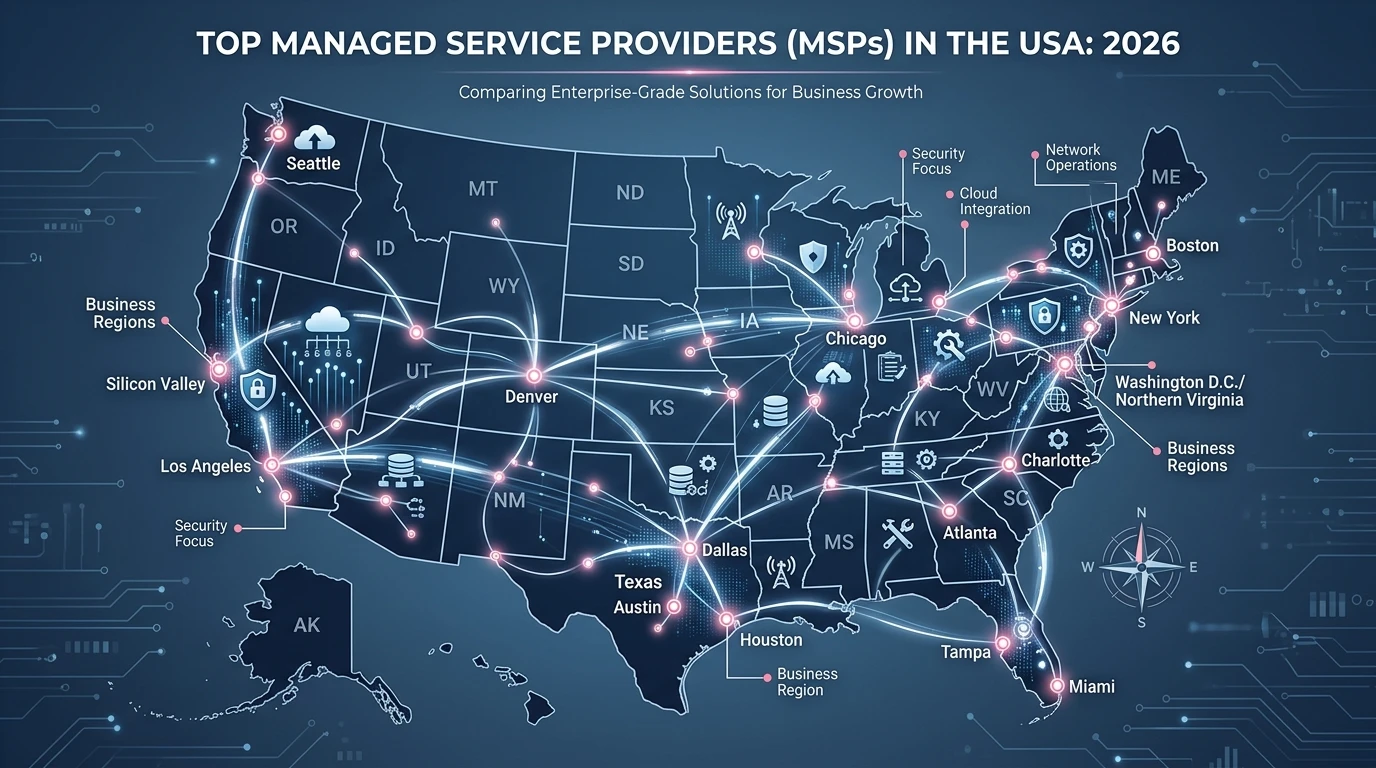
North America is still the main hub for business tech and large rollouts. If you look for the Top Managed Service Providers USA, you find a mature market. It is built for demanding firms, wide footprints and complex rules.
New York is packed with financial firms. Washington, DC has strict government and security rules. Los Angeles has fast-growing tech firms. So American providers must run very strong, high-speed infrastructure. Hubs like Delaware, with delivery teams in Middletown, have also bred providers who excel at fast rollouts, multi-state networks and cross-border data.
Opening in North America, or want a simpler tech setup at home? Then finding a vetted provider through a full MSP database is a key step. The best providers in this region turn complex tech needs into clear business results. They keep systems resilient, compliant and ready to grow.
Top Managed Service Providers UK: What Businesses Should Look For
Buying IT in Great Britain takes care. When mid-size and large firms review the Top Managed Service Providers UK, they want more than tech skill. British firms work in a structured setting. Data rules, a supplier's financial health and strict cyber defence are must-haves.
Firms in finance, professional services and manufacturing want partners who do more than watch networks from afar. They want providers who can design strong hybrid cloud, protect every endpoint with zero trust and run thorough backup and recovery. Supply chain risk also worries leaders. So UK buyers weigh a provider's certifications, and whether it will act as a trusted advisor rather than a faceless utility.
UK MSP Selection Factors
In this region, check how mature and reliable a partner is for the long run. Look past the marketing to see how it runs day to day under pressure. When you review partners, sort your checks into a few core areas:
- Service Desk Maturity: Look for frameworks like ITIL (Information Technology Infrastructure Library). They mean structured incident handling, clear escalation and steady updates during outages.
- Cybersecurity Coverage: Make sure the provider offers strong threat detection, constant monitoring and national standards such as Cyber Essentials Plus.
- Cloud and Microsoft 365 Support: Check that it can cut cloud costs, secure identities and manage tenant settings safely.
- Backup and Disaster Recovery: Confirm that backups are tested often, with recovery times (RTOs) that meet your continuity needs.
- Clear Response Times: Read the contract for clear SLAs that split urgent support from routine work.
- Industry Experience: Favour providers who know the rules, software and ways of working in your sector.
- Clear Contracts: Avoid complex fees. Pick partners with simple per-user or per-device pricing and clear terms to scale up or down.
- Data Protection: Confirm that the provider has solid ways to handle data safely across all your systems.
Managed IT Services Germany: Stability, Security and Compliance
Business tech in Europe's largest economy rests on engineering discipline, careful records and steady, long-term running. For global firms and local Mittelstand firms looking at Managed IT Services Germany, the bar is very high. Ad hoc patching and loose monitoring will not do in a culture that values prevention and flawless execution.
German firms look for Global Managed Service Providers that keep systems up at all times. They want tight control over network monitoring and cloud design. A tech partnership is seen as a long-term investment. Stability, low staff turnover and a careful approach to the infrastructure lifecycle all count. Security is never an add-on. It is built into every server, cloud instance and endpoint from the start.
Why Germany Needs a Different MSP Evaluation Lens
To work in the German market, you need to know local habits and admin standards. In Germany, good tech work must come with perfect records and total clarity on data. Providers must draw detailed network maps, log every change and set out precise service levels with no room for doubt.
Data sovereignty and control sit at the heart of this market. Firms must know where their data lives, how it moves and who can access it. General guidance, such as the European Commission data protection information, sets out the duties firms have for privacy and security across the region. But rules are complex and Germany enforces them strictly. So firms should check their own setups with qualified legal counsel or a compliance advisor. Local teams also often need support in more than one language, so staff on site and remote can report faults clearly and fix them fast.
USA vs UK vs Germany: How MSP Buying Priorities Differ
Every market needs stable IT. But what drives buyers, and what they put first, differs across these three economies. Knowing those differences helps global buying teams and vendors match their plans to each local market.
In the USA, tech choices are driven by scale, speed and fast moves to the cloud. American buyers often run teams across many states. They favour providers who deploy fast, scale easily and use strong security tools against complex threats. The focus is speed, agility and less friction as the firm grows.
In the UK, the focus shifts toward structured governance, contract clarity, and support desk maturity. British buyers place an immense premium on a provider’s operational reliability and their internal process alignment. They want to know exactly how a crisis will be managed, requiring predictable communication models and a demonstrable track record of supplier stability before committing to multi-year infrastructure agreements.
In Germany, the buying culture is defined by engineering discipline, exhaustive documentation, and a deep-seated commitment to security and compliance. System resilience and data control take precedence over rapid, ad-hoc deployment. German companies look for methodical execution, demanding to know the exact physical and logical parameters of their cloud environments, preferring long-term partners who view structural stability as the ultimate measure of technical success.
Where DiscoverMSPs Fits in the Global MSP Search
Finding a partner who can run complex tech across several borders has long been hard. Buyers wade through vague claims, loose service terms and unchecked reviews. None of it shows what a provider can really do.
DiscoverMSPs makes this easier with one place for verified market data. Through a full MSP database, buyers, founders and IT directors can review global partners by real company signals. No guesswork. Filter providers by location, service focus, client size and checked credentials. That way you find a Managed Service Provider whose size, regional reach and skills fit your continuity and growth needs.
How to Choose the Right Managed Service Provider in 2026
Selecting a technology partner is a significant operational decision that directly impacts your company’s long-term resilience and growth. When evaluating global IT partners, businesses must look past general marketing claims and carefully assess how a provider’s operational habits align with their business needs.
A practical evaluation framework should focus on several core pillars to ensure a successful partnership:
- Service Scope: Clearly verify what is included in the base fee and what requires an extra charge. The best providers offer a transparent service catalogue that spans infrastructure, security, and strategic planning.
- Security Maturity: Do not assume basic protection is enough. A qualified partner must demonstrate advanced capabilities, including managed detection and response, identity governance, and continuous vulnerability monitoring.
- Cloud Capability: Your provider should possess validated engineering certifications across major public and hybrid cloud environments, proving they can optimise resource allocations and control infrastructure costs effectively.
- Helpdesk Response Times: Review the contract for clear, contractually backed service level agreements. Pay close attention to guaranteed resolution times for critical incidents rather than simple automated ticket acknowledgements.
- Backup and Disaster Recovery: Request documented proof of regular restore tests. A reliable partner must demonstrate they can meet your required recovery time objectives and recovery point objectives during an unexpected outage.
- Industry Experience: Prioritise providers who already manage infrastructure for companies in your specific horizontal or vertical market, as they will be familiar with your core software applications and operational workflows.
- Regional Coverage: Ensure the provider has a physical presence or a proven remote management framework that fits your operational footprint, especially if you support distributed teams across different countries.
- Reporting and Account Management: Look for structured governance, including regular business reviews, clear capacity planning reports, and transparent performance metrics that show the ongoing health of your systems.
- Contract Flexibility: Avoid long-term arrangements that lock your business into rigid resource tiers. Look for scalable terms that allow your IT services to expand or contract alongside your actual headcount and commercial needs.
For Vendors: Why Verified MSP Data Matters
For SaaS companies, cybersecurity vendors, cloud distributors, and B2B growth teams, the managed services sector represents an incredibly valuable channel. However, breaking into this market requires a sophisticated approach to data and segmentation. Building a successful go-to-market strategy targeting Global Managed Service Providers requires much more than an unverified list of corporate names scraped from the internet.
To run efficient outreach campaigns, product vendors and enterprise sales teams need highly accurate, updated, and deeply segmented intelligence. Reaching the right decision-maker requires filtering prospects by exact geographic location, target company size, current cloud environment, and verified engineering specialities. Using structured data helps marketing teams avoid wasted budget on mismatched outreach, ensuring sales representatives spend their time speaking with partners who possess the exact scale and technical focus to adopt their solutions. Navigating this ecosystem with precision requires a dependable, CRM-ready MSP database built specifically to support high-growth B2B enterprise partnerships.
Common Mistakes When Comparing Global Managed Service Providers
Over my eighteen years writing for the technology sector, I have watched many procurement teams make identical mistakes when selecting external infrastructure partners. Recognising these common errors early in the evaluation process can save your organisation from unexpected expenses, poor service delivery, and difficult contract disputes.
The most frequent mistakes include:
- Choosing Only by Price: Opting for the lowest bidder often results in hidden fees, slow helpdesk support, and junior technicians managing your critical infrastructure.
- Ignoring Cybersecurity Capability: Treating security as an afterthought rather than a core requirement leaves your organisation vulnerable to sophisticated threats.
- Not Checking Regional Support Coverage: Selecting a provider without the capacity to support your specific offices or remote employees leads to inconsistent performance and frustration.
- Not Asking About Backup and Recovery: Assuming backups are working without demanding regular, documented restoration tests can lead to catastrophic data loss during a crisis.
- Confusing General IT Support with True Managed Services: Partnering with a traditional break-fix technician who responds only after a system failure, rather than a proactive provider focused on prevention.
- Not Comparing Providers by Business Fit: Selecting an enterprise-grade provider for a small business, or a small local shop for a multinational corporation, creates a significant operational mismatch.
- Using Outdated or Unverified MSP Data: Relying on old directories or unverified information when marketing to providers leads to bounced emails and unsuccessful sales campaigns.
FAQs About Top Managed Service Providers USA, UK and Germany
1.What are Top Managed Service Providers USA?
These are elite IT companies that manage, protect, and optimise business infrastructure across North America. The Top Managed Service Providers USA are known for their ability to scale rapidly, implement advanced cloud strategies, and deploy sophisticated cybersecurity tools designed to support highly distributed corporate workforces.
2.How are Top Managed Service Providers UK different from USA MSPs?
While both regions focus on technical excellence, providers in the UK operate with a heavy emphasis on formal corporate governance and structured service frameworks like ITIL. British buyers typically focus on supplier financial stability, clear contract frameworks, and rigorous operational processes to minimise supply chain risk.
3.What should businesses check before choosing Managed IT Services Germany?
For the German market, put engineering discipline, careful records and clear SLAs first. Data sovereignty and privacy matter a great deal there. So make sure your provider has clear, written ways to handle data safely. For specific compliance or data protection needs, always ask a qualified legal advisor or check official guidance.
4.What does a Managed Service Provider usually handle?
A good provider takes ongoing charge of your core IT. That covers 24/7 network monitoring, help desk support, cloud management, strong security, patching, automatic endpoint protection and regularly tested backup and recovery.
5.How can vendors find Global Managed Service Providers for outreach?
SaaS vendors, cloud distributors, and cybersecurity companies can access verified data through specialised global platforms. Using a reliable B2B directory allows growth teams to filter prospective partners by region, company size, and specific service offerings, ensuring highly targeted and efficient marketing campaigns.
Final Thoughts
Building strong, scalable IT across the USA, UK and Germany means choosing tech partners with care. The right choice balances skill, local presence and cultural fit. You might be growing fast in North America, building governance in the UK or seeking careful engineering in Germany. Either way, your provider will shape how stable your operations are. Use real data and a clear review process, and you can build safe, long-term partnerships that support your goals.
Frequently Asked Questions
How accurate is DiscoverMSPs’ data?
DiscoverMSPs combines automated technographic and firmographic verification with manual human review, targeting 95% accuracy across every record.
How often is DiscoverMSPs’ data refreshed?
Records are refreshed on a 45-day cycle, so contact and company details reflect recent changes rather than a stale, one-time snapshot.
Can I get a free sample before committing?
Yes. DiscoverMSPs offers a free data sample so you can review record quality and formatting before requesting a full custom list.
Is DiscoverMSPs’ data compliant with outbound marketing regulations?
Yes.
Data is collected and delivered in line with GDPR, CCPA, and CASL requirements, so it is safe to use for compliant outbound campaigns.
How quickly can I get a custom data list from DiscoverMSPs?
Custom, filtered data lists are typically delivered within 48 hours of a request.
Does DiscoverMSPs offer data outside the USA?
Yes. DiscoverMSPs tracks verified contacts across 60+ countries, including dedicated coverage for the UK, Canada, Australia, India, Germany, Singapore, and the Netherlands.


 ChatGPT
 Claude
 Google AI Mode