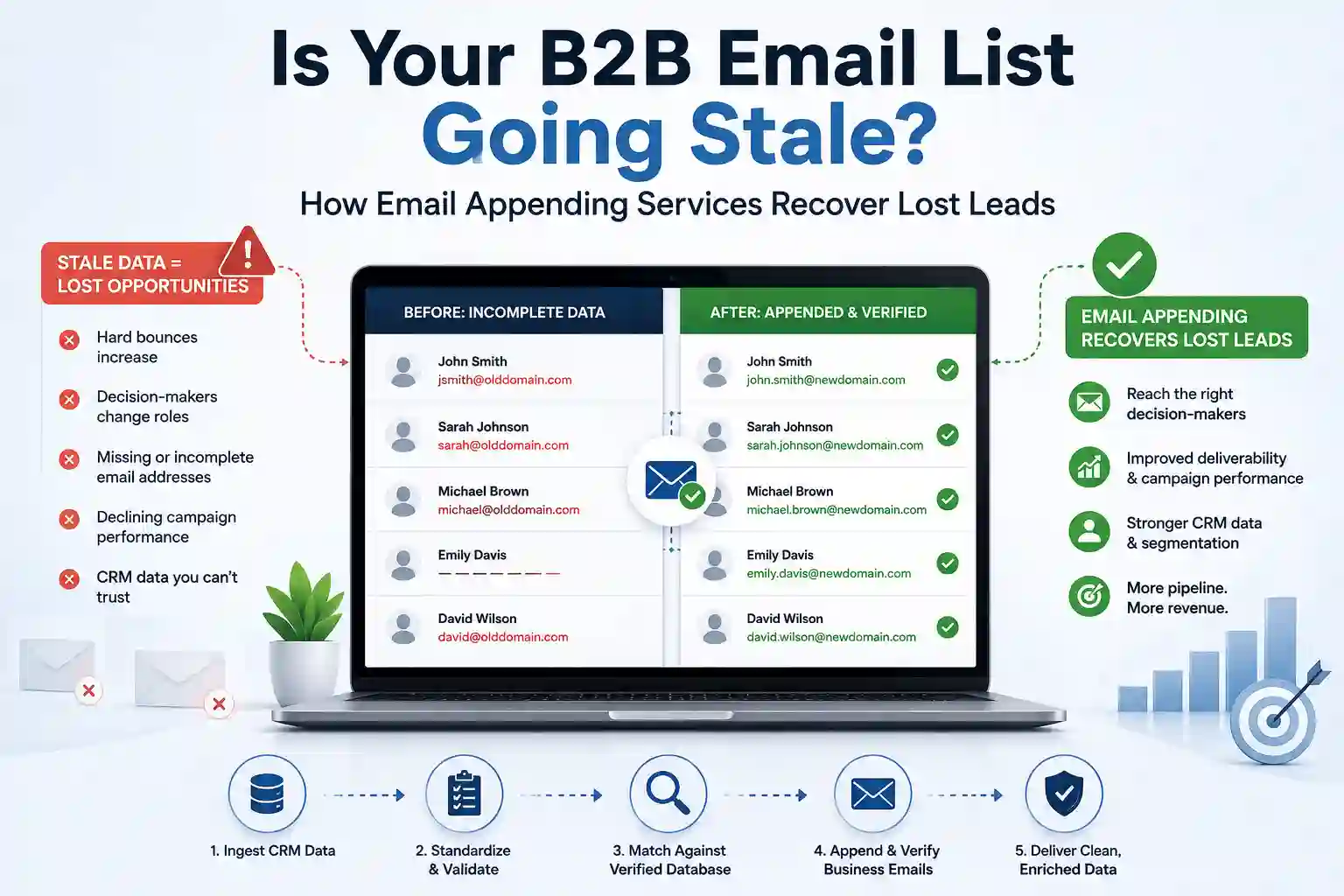
A deteriorating B2B email list quietly drains revenue from sales and marketing operations long before the symptoms become obvious. Every month, contact data decays. Decision-makers change roles, companies rebrand, and standard communication channels migrate. When a CRM database relies on outdated information, the immediate fallout is poor campaign performance, but the long-term cost is a loss of pipeline confidence. Recovering these lost connections requires targeted intervention. An email append service is designed to bridge this gap, matching your existing incomplete or outdated records with current, verified business email addresses to restore the utility of your database.
How Do You Know Your B2B Email List Is Going Stale?
Recognising data decay requires monitoring specific operational metrics rather than simply relying on visual database inspections. When a B2B database begins to age without regular maintenance, the first indicators usually appear in campaign execution reports and frontline sales feedback.
The primary warning signs include:
- Increasing hard bounce rates on automated marketing sends, negatively impacting domain reputation.
- Sales representatives reporting that historically engaged contacts have left their organisations or changed roles.
- A growing segment of legacy accounts containing missing business emails or incomplete CRM fields.
- A steadily declining usable audience size for highly segmented campaigns, limiting revenue potential.
- Duplicate records created when prospects re-enter the system under a new email address, fracturing the account history.
- Segmentation logic fails because critical firmographic or job title fields are empty.
- Sales teams demonstrate a lack of confidence in the CRM, preferring to manually source their own contacts.
What Is an Email Append Service?
An email append service is a data enrichment process that matches an incomplete customer or prospect database against a verified master dataset to locate and append missing business email addresses. It cross-references known identifiers, such as a contact’s name and company name, to fill database gaps and re-establish communication lines with dormant leads.
It is vital to distinguish email appending from simple list purchasing. Buying a list injects unvetted, entirely new contacts into a system. Conversely, email appending services build upon the relationships and historical data already sitting in your CRM. You are not buying new leads; you are repairing the contact pathways for individuals who have already shown interest in your organisation or who fit your ideal customer profile perfectly.
Understanding the broader data ecosystem clarifies where this fits into database management. B2B email verification is the process of testing an existing email address to ensure it can receive mail, without necessarily correcting it if it fails. Data cleansing removes formatting errors, invalid records, and structural anomalies. By contrast, a b2b data append actively adds missing information. While cleansing prunes the dead wood, a b2b email append grafts new life onto the existing branches.
Both are crucial elements of comprehensive data enrichment. For platforms mapping complex vendor ecosystems like DiscoverMSPs, accurate contact data is the baseline for engagement. Implementing structured B2B data cleansing services alongside data append services ensures that new data is attached only to properly formatted, validated records.
Why Good Leads Become Unreachable
An unreachable lead is rarely a reflection of their initial intent; it is usually a symptom of professional mobility. In the technology and B2B sectors, the average tenure in a role is relatively short. When a key decision-maker transitions to a new organisation, their previous email address generates a hard bounce, severing the connection.
Similarly, corporate restructuring introduces data chaos. Mergers, acquisitions, and rebranding exercises frequently trigger sweeping domain changes. A previously pristine b2b email list can degrade overnight if a major account migrates its server architecture and updates its standard email nomenclature. Relying on outdated data in these scenarios risks violating standard sender requirements, such as those outlined in Google’s email sender guidelines, by generating high bounce rates that heavily damage domain reputation and deliverability.
Further data gaps originate at the point of entry. Incomplete form submissions, where prospects omit details or provide generic aliases, complicate lead scoring. Legacy CRM imports, particularly those involving old event or webinar attendee lists, often lack the strict validation rules applied to modern demand generation channels. Without understanding a provider’s data collection methodology, ingesting these old lists introduces substantial risk into your marketing automation platform.
How Does an Email Append Service Recover Lost Leads?
An email append service recovers lost leads by ingesting incomplete CRM records, standardising the available identifiers, and matching them against authoritative business datasets to locate, verify, and append the correct, active business email address before returning the enriched data.
The mechanism of this record matching is highly methodical, designed to replace guesswork with verified sales intelligence. When an organisation initiates the process, existing records are securely supplied to the data provider. Before any matching occurs, the available identifiers-typically the contact name, company name, and perhaps a legacy domain-are standardised to remove formatting inconsistencies and normalise corporate structures.
These cleaned data points are then systematically matched against comprehensive, regularly updated business data sources. The system searches for the specific individual at their current organisation. When candidate business emails are identified, they do not simply bypass quality control. Professional email appending services subject these new addresses to stringent validity checks, ensuring the domain is active and the specific inbox can receive mail, often mitigating risks associated with catch-all servers or spam traps. Finally, the enriched records are returned in a structured, CRM-ready format, ready for immediate campaign deployment.
Email Appending vs Data Cleansing: Why the Difference Matters
As CRM enrichment becomes a priority, operational leaders often confuse the distinct processes required to rehabilitate a b2b email list. The distinction is foundational: data cleansing fixes, standardises, removes, or flags problems in existing data, whereas data appending adds missing information to incomplete records. Data enrichment serves as the broader category encompassing both, injecting deeper firmographic, contact, or technographic intelligence into the profile.
Attempting to append data to a fundamentally flawed database wastes both time and resources. If a CRM record contains a misspelled company name, an outdated merger designation, or inadvertently merges two different contacts into a single entry, any subsequent record matching will likely fail or return inaccurate results. The matching algorithms require clear, accurate inputs to locate the correct outputs.
For this reason, a strategic approach requires that most organisations execute a thorough hygiene pass before attempting to add new fields. Engaging professional B2B data cleansing services ensures that the foundational database is accurate. By standardising nomenclature, standardising job titles, and removing structural anomalies first, the subsequent b2b email append phase yields significantly higher match rates and greater data confidence.
What Can B2B Data Append Add Beyond an Email Address?
While recovering the inbox connection is the primary objective of lead reactivation, robust data append services rarely stop at a single field. True database completeness requires context. When a record is successfully matched within a broader B2B dataset, the appending process can simultaneously populate an array of critical CRM fields that drive strategic decision-making.
Depending on the provider’s database depth and the specific match confidence, a b2b data append can introduce updated job titles, current seniority levels, active company domains, direct business phone numbers, and precise geographic locations. At the organisational level, appending can attach vital firmographic information such as primary industry verticals, employee headcount ranges, and occasionally, specific technology stack information if available.
This supplementary data fundamentally changes how a recovered lead is actioned. An email address alone allows for basic communication, but a complete profile enables precise segmentation and strategic account-based marketing. It dictates how a lead is routed through marketing automation platforms and determines sales prioritisation. A marketing operations team can transition a previously dormant contact straight into a high-intent, industry-specific nurture sequence because they now possess the contact’s current seniority and precise market sector.
Naturally, not every record will return every possible field; match rates vary based on industry and data availability. For highly specialised targeting where standard database matching falls short, organisations often pivot to custom data research to manually build out bespoke, niche fields. However, the aggregate improvement in database depth provided by standard appending is usually transformative for day-to-day operations.
What should you provide to an email append service?
To maximise match rates and ensure high-fidelity returns, the quality of the input data is paramount. Stronger source identifiers generally improve matching confidence. When preparing a file for processing, provide as many of the following as possible:
- Full contact name (first and last separated in distinct columns).
- Company name (legal entity or known trading name).
- Last known company domain or website URL.
- Previous business email addresses, even if they currently hard bounce.
- Any known geographical data, such as city or state, to resolve duplicate name conflicts.
- LinkedIn profile URLs, if captured during the initial lead generation phase.
What Does Stale Email Data Actually Cost a B2B Team?
The financial impact of a decaying database extends far beyond the immediate loss of a single prospect connection. When a b2b email list goes stale, it creates a cascading operational drag across both sales and marketing departments. For sales development representatives (SDRs), outdated CRM entries translate directly into wasted hours. Instead of initiating meaningful conversations and closing pipelines, highly paid sales professionals spend their time manually researching bounce-backs, hunting for updated contact details on external networks, and attempting to reconstruct broken account hierarchies.
In the marketing department, stale data silently compromises strategy. Complex nurture sequences and automated workflows fail to reach their intended targets, resulting in a shrinking reachable audience. This leads to inaccurate campaign attribution and misleading CRM reporting. A marketing director might analyse a pipeline dashboard showing five thousand enterprise contacts, unaware that a significant percentage of those records contain obsolete or invalid email addresses. Consequently, audience segmentation becomes weak and unreliable, and territory coverage for field sales teams is rendered artificially low.
Perhaps the most significant hidden cost is the missed account opportunity combined with unnecessary acquisition spend. When a primary contact leaves a target account, the CRM record often goes dormant. Sales teams lose their entry point. Without intervention, organisations frequently allocate substantial top-of-funnel advertising budgets to generate net-new leads, inadvertently paying to acquire contacts they already possess in their database, simply because the original record lacked a current email address.
It is crucial to recognise a fundamental database principle: a larger B2B email list is not necessarily a more valuable list. Raw volume is a vanity metric. Usable, relevant, and verified records dictate true database value, and a compact, highly accurate database will consistently outperform a massive, outdated one.
When Should You Consider a B2B Email Append?
An organisation should deploy an email append service when a material portion of its CRM lacks current contact information, or when preparing for strategic initiatives that require absolute data fidelity. Rather than adhering to an arbitrary numerical threshold for data decay, operational leaders should monitor for specific business triggers that necessitate intervention.
Strategic timing is essential. B2B data append processes are typically highly effective when initiated under the following circumstances:
- Before launching an account-based marketing (ABM) programme: Precise penetration into specific target accounts is mandatory, requiring up-to-date contact details for multiple stakeholders within a single organisation.
- Prior to lead reactivation: When attempting to re-engage dormant historical prospects, repairing the communication pathway is the necessary first step.
- After a CRM migration or database consolidation: Mergers and system migrations frequently expose historical data gaps and highlight the need for comprehensive profile completion.
- Following trade shows and events: Captured lead data is notoriously incomplete, often consisting of just a name and a company, or relying on personal rather than business email addresses.
- Before launching into a new region: Expanding geographic operations requires maximum visibility and accurate routing for existing local contacts.
- When analytics decline: When regular campaign reports reveal that hard bounces and obsolete records are noticeably reducing your usable audience coverage.
In these scenarios, proactive data append services bridge the gap between historical CRM investments and current operational requirements, ensuring that campaigns launch against a fully validated audience.
Can Email Appending Improve Deliverability?
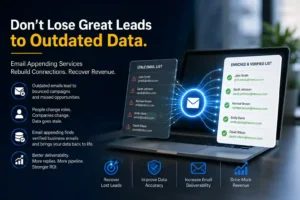
The relationship between data accuracy and email deliverability is significant, but it requires careful management. A professional b2b email append directly removes avoidable delivery failures by replacing invalid, bouncing addresses with active, verified connections. By strictly reducing hard bounce rates, an organisation protects its sender reputation, which is a foundational metric in algorithmic spam filtering.
However, appending accurate data is only one component of a successful outreach strategy. Deliverability also depends heavily on technical infrastructure and sender behaviour. Domain authentication protocols specifically SPF, DKIM, and DMARC where applicable must be correctly configured to prove sender identity. Furthermore, maintaining high inbox placement relies on a positive sender reputation, consistently low complaint rates, relevant content, and strict list management hygiene, including the immediate processing of unsubscribes. Adhering to established technical standards, such as Google’s email sender guidelines, remains non-negotiable for enterprise senders.
Furthermore, while an email append service can successfully locate a correct business address, the deployment of that data must align with regional compliance frameworks. Outreach and personal-data obligations differ significantly across the USA, UK, Canada, and Australia. Adding a verified email address to a CRM record does not automatically grant the legal or regulatory right to initiate commercial communication. Organisations must independently evaluate their lawful basis for processing and their marketing consent obligations before executing email campaign services targeting newly appended contacts.
Is email appending the same as buying a new B2B email list?
No. Email appending and list purchasing are fundamentally different strategies serving completely different purposes. Email appending normally starts with the incomplete records an organisation already possesses within its CRM. The goal is to repair, complete, or update missing contact fields for individuals who already have a documented history or prior engagement with the brand. List acquisition, conversely, involves sourcing an entirely new dataset of individuals to build an audience from scratch. Appending rehabilitates your existing operational assets, whereas list buying attempts to acquire new ones.
How Do You Choose the Right Email Append Service?
Evaluating an email append service demands considerably more than comparing pricing tiers and promised turnaround times. A mature procurement process focuses heavily on data provenance and matching logic. Decision-makers must interrogate how a provider builds its intelligence and validates its outputs.
Key evaluation criteria should examine exactly what identifiers the provider uses for matching and how candidate emails are ultimately validated. It is essential to understand whether the provider relies purely on algorithmic permutation, which involves guessing an email based on common corporate naming conventions, or if they verify the address through active pinging and SMTP checks. Furthermore, buyers should confirm how uncertain matches are handled, whether invalid or risky records such as catch-all domains or known spam traps are clearly flagged, and how recent the underlying dataset is.
A credible provider will be able to clearly articulate its data collection and verification methodology. They should also offer the opportunity to test a sample before you commit to a large-scale project. You must also determine precisely what fields can be appended alongside the email address and how the final output is formatted to ensure frictionless integration with your specific CRM platform.
Crucially, a trustworthy b2b data append partner will sometimes return a “no confident match” result rather than force an email into every single record. Recognising when a data point cannot be safely verified is a hallmark of responsible data stewardship.
Accuracy Matters More Than Append Rate
It is tempting to select the data append services that guarantee the highest overall match rate, assuming that more emails equal better value. However, a provider claiming to append nearly every record is not automatically superior. There is an inherent trade-off between coverage and confidence. Pushing for maximum coverage often requires loosening the matching criteria, which introduces significant risk into your database.
False matches are substantially worse than blank fields. When a record is appended with an incorrect or unverified email, the resulting wrong-person outreach immediately damages brand perception. Sales representatives waste valuable time pursuing false leads, and marketing teams risk privacy and compliance complications by emailing individuals who have no connection to the intended target account.
Furthermore, inaccurate data actively corrupts CRM records and generates misleading engagement data. A hard bounce on a newly appended email not only damages deliverability but fractures the historical integrity of the account. High-confidence matching, even if it yields a lower overall append rate, protects the underlying asset and ensures that the marketing budget is deployed against genuinely reachable prospects.
What Should You Ask Before Sending Your Database?
Before transferring proprietary CRM data to any third party, establish strict parameters regarding data handling, methodology, and security. Use the following checklist to evaluate potential vendors:
- Matching logic: Do you use active verification or merely algorithmic guessing to append emails?
- Data provenance: Can you provide documentation detailing your data collection methodology?
- Security protocols: Where is my data processed, and how long is it retained after the project concludes?
- Compliance alignment: How does your privacy policy govern data processing for regions with stringent marketing regulations?
- Output transparency: Are high-risk, catch-all, or unverified emails flagged clearly in the final return file?
- Sample testing: Will you run a subset of our data to prove match confidence before the main project begins?
Why should a company trust a specialist data provider when larger, older databases exist?
When evaluating email appending services, buyers frequently question why they should trust a specialised provider over legacy data aggregators possessing massive historical databases. The reality is that B2B data decays rapidly. Larger, older databases often suffer from profound bloat, retaining obsolete records to artificially inflate their total numbers. Buyers should judge a provider not on raw volume, but on their verification methodology, transparency, and relevance to the required market. A specialist provider that executes rigorous sample testing, maintains a transparent refresh process, and offers dedicated support will consistently deliver higher-fidelity data than a bulk aggregator relying on stale historical archives.
Where Do DiscoverMSPs Fit?
Within the broader B2B intelligence ecosystem, DiscoverMSPs focuses on delivering verified, highly targeted contact data, particularly regarding managed service providers and the surrounding technology sector. Rather than functioning as a generalist aggregator, the organisation focuses on structural data integrity and precise account mapping.
For organisations dealing with deteriorating CRM records, DiscoverMSPs provides foundational B2B data cleansing services to standardise and repair existing files before any enrichment occurs. When standard off-the-shelf database verification is insufficient for highly specific or niche requirements, their custom data research capabilities allow organisations to manually build out bespoke fields and verify complex account structures.
Their documented methodology emphasises active verification and strict quality controls, ensuring that any appended data is genuinely useful for enterprise campaign execution. By prioritising CRM enrichment accuracy over arbitrary match rates, DiscoverMSPs equips B2B revenue teams with the actionable intelligence required to confidently reactivate their dormant leads and scale their demand generation operations.
How to Prepare Your B2B Email List for Appending
Before engaging a b2b email append provider, internal preparation is essential. Adopting a strategy of “append everything” often wastes budget and complicates CRM architecture. Instead, organisations should define clear business objectives and prepare their records methodically to ensure the highest possible match confidence.
To prepare your data for enrichment, follow this actionable sequence:
- Preserve an untouched source copy: Never overwrite your master CRM database until the newly appended data is fully vetted and accepted by the operations team.
- Remove obvious duplicates: Execute a baseline deduplication process to avoid paying for multiple append attempts on the same contact or fracturing the account history further.
- Standardise basic fields: Normalise company names, stripping out inconsistent legal entity designations, and ensure contact names are properly separated into distinct columns.
- Separate known invalid records: Isolate contacts who have explicitly opted out or previously lodged spam complaints, as appending new emails for these individuals violates compliance policies.
- Retain useful matching identifiers: Keep legacy corporate domains, previous job titles, and known geographic locations. These historical data points serve as critical breadcrumbs for sophisticated matching algorithms.
- Define specific field requirements: Determine if the objective is strictly lead reactivation via email, or if the campaign also requires updated seniority levels, phone numbers, and company domains.
- Segment records by priority: Focus initial append efforts on high-value target accounts, specific industry verticals, or tier-one prospects rather than submitting the entire dormant database simultaneously.
- Test a representative sample: Provide a highly complex subset of your data to the vendor to evaluate their match accuracy and validation protocols before authorising the full project.
- Import enriched records carefully: When mapping the returned file back into the CRM, preserve the original data source tags and log the exact verification date of the new email address.
What Happens After Email Appending?
Data enrichment is an event; database maintenance is a continuous operational discipline. Once an email append service returns validated contacts, immediate operational changes are required to protect that investment and prevent rapid re-decay.
Post-append hygiene must focus on periodic verification, active duplicate management, and rigorous bounce monitoring. When deploying updated records into a specialised environment, such as a core MSP database, tracking the exact date of verification ensures that sales professionals know the intelligence is current before they initiate outreach.
Managing suppression lists and opt-out requests remains vital for legal compliance. Depending on the jurisdiction, B2B outreach must align with regional regulatory frameworks, such as the Information Commissioner’s Office (ICO) guidelines for electronic communications and direct marketing. To maintain high data standards and regulatory alignment, organisations should integrate ongoing B2B data cleansing services into their quarterly operations. For deeper context on managing technology-focused vendor ecosystems and maintaining precise data standards, review the About DiscoverMSPs overview.
Frequently Asked Questions About Email Appending Services
How accurate is DiscoverMSPs’ data?
How often is DiscoverMSPs’ data refreshed?
Can I get a free sample before committing?
1. What is an email append service?
It is a structured data enrichment process that takes incomplete or outdated CRM records and matches them against verified business datasets. The primary objective is to locate, validate, and append active business email addresses, allowing organisations to securely reconnect with prospects already residing in their systems.
2. Can email appending recover old B2B leads?
Yes, provided the individual remains active in the professional workforce. If a lead has transitioned to a new organisation, sophisticated appending can identify their current corporate address. However, it cannot recover a lead who has retired or entirely exited the target industry.
3. What information is needed for B2B email append?
The highest match rates require the contact’s full first and last name alongside their current or former company name. Supplying a legacy company domain, previous email addresses, and known geographic location points significantly improves matching accuracy and resolves duplicate name conflicts.
4. Is email appending the same as data enrichment?
Email appending is a highly specific subset of data enrichment. While appending focuses squarely on attaching correct and verified email addresses to existing records, broader data enrichment services encompass adding firmographic details, technographic stacks, direct business phone numbers, and current job titles.
5. How often should a B2B email list be reviewed?
There is no universal interval. Review frequency must be dictated by campaign performance metrics and data age. If hard bounce rates begin creeping upward, or if a list segment has sat dormant for over six months, a comprehensive review is necessary. High-turnover industries naturally require more frequent verification.
Restoring the Strategic Value of Your B2B Database
A B2B email list quietly losing usable contacts is a standard operational reality, but replacing the entire database is rarely the most efficient or cost-effective response. When key decision-makers move roles or enterprise target accounts undergo corporate rebranding, the underlying relationship and brand awareness often remain intact. Repairing these severed digital connections through targeted data appending allows a revenue team to reclaim tangible pipeline value from assets the company already owns.
Ultimately, accuracy and relevance matter far more than raw database volume. A compact, highly validated list of reachable decision-makers will consistently outperform a massive directory of unverified, obsolete contacts. By applying stringent verification methodologies, executing targeted appending, and committing to ongoing CRM hygiene, businesses can restore confidence in their data and ensure their campaigns reach the intended audience.
If your database is exhibiting signs of decay, the team at DiscoverMSPs can help you assess the scale of the problem. Whether your organisation requires a comprehensive data audit, structural cleansing, or highly targeted enrichment, we provide the verifiable intelligence necessary for high-performance B2B outreach. To discuss your specific data requirements and explore a tailored approach to lead reactivation, contact DiscoverMSPs today.