

India graduates more than 1.5 million technology professionals annually. That statistic from NASSCOM’s technology sector research is the foundational reason why India has become the most trusted destination for managed IT service providers serving global clients. It is not cost alone, though cost remains a meaningful factor. It is the combination of volume and quality of technical talent, 24/7 coverage capability enabled by India’s time zone position, three decades of IT services export experience, and the maturation of Indian MSPs from helpdesk delivery into sophisticated cloud, cybersecurity, and AI-enabled managed services.
For global businesses looking at managed IT service in India, the market in 2026 is far more capable than offshore IT was even five years ago. The leading Indian managed IT service providers do not just copy Western service models at a lower price. They run cloud-native operations and mature security operations centres. They also manage compliance for global clients whose rules span GDPR, HIPAA, SOC 2 and ISO 27001. The India MSP directory on DiscoverMSPs covers checked providers across Bengaluru, Hyderabad, Pune, Chennai and Mumbai.
This article looks at what really sets Indian MSPs apart, which compliance points global clients must cover, and how to find the right Indian MSP for enterprise work.
The Technical Depth Driving India’s MSP Leadership
The perception of India as a provider of low-cost IT support has not been accurate for the leading segment of the Indian managed IT services market for several years. The firms that have built their practice around global enterprise clients have invested in technical capability that competes directly with Western MSPs on quality, not just cost.
Cloud-native operations centers
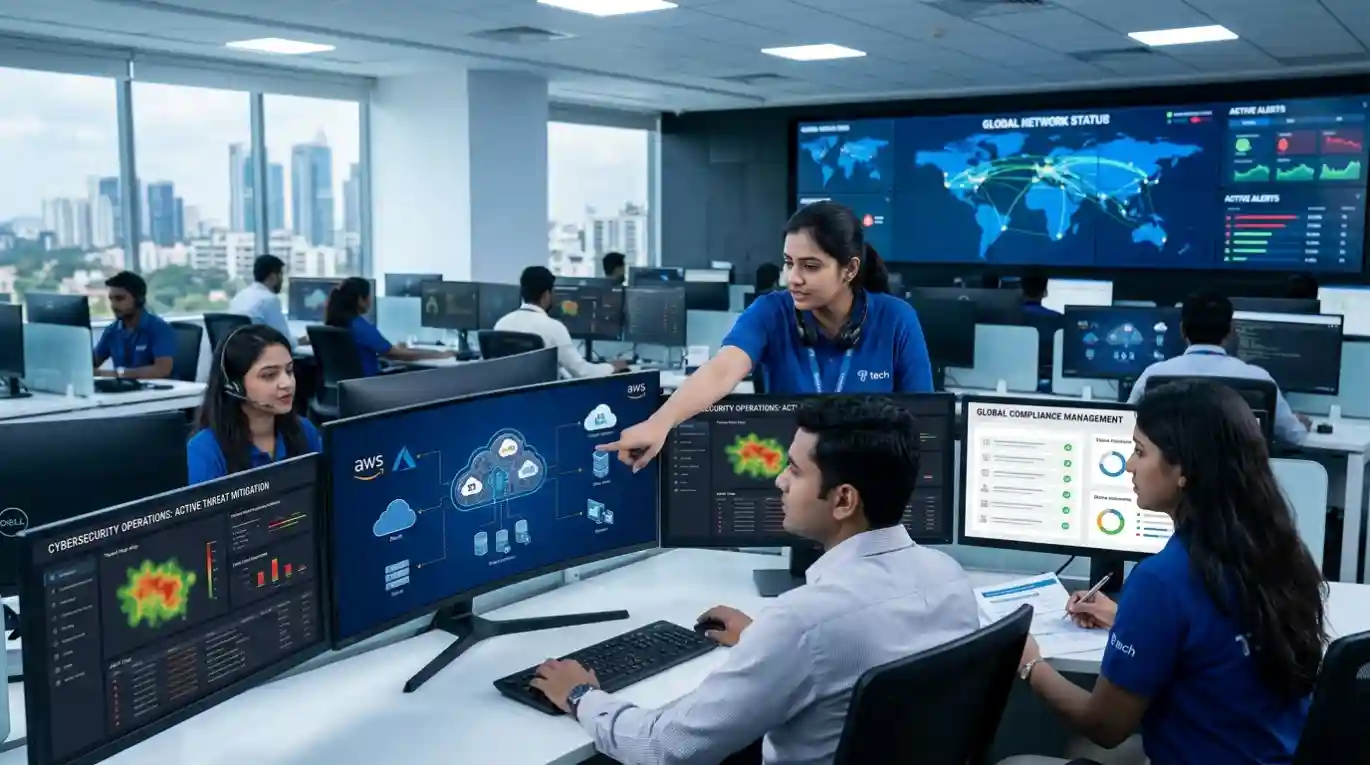
The leading Indian managed IT service providers have built cloud operations centers that manage complex multi-cloud environments for clients across the US, UK, Europe, and Australia. Teams in Bengaluru and Hyderabad manage Azure, AWS, and Google Cloud deployments at scale, with the monitoring tools, automation frameworks, and incident response procedures that enterprise cloud management requires. The time zone advantage enables these teams to provide overnight coverage for US and European clients as part of their standard shift structure rather than as premium add-on services. This makes 24/7 cloud operations economically accessible to clients who cannot justify the cost of equivalent round-the-clock coverage from US or UK-based providers.
Cybersecurity operations maturity
India's cybersecurity services have real depth. Indian managed security service providers run SOCs that watch global client systems. They run threat intelligence programmes and handle incident response for breaches that hit clients in several time zones at once. They also manage compliance for clients under GDPR, HIPAA and other international rules. Security talent is especially strong in Bengaluru and Hyderabad. That reflects demand from India's own large finance and tech sectors, and experienced security staff returning from global tech firms. MSSP-capable Indian providers listed on DiscoverMSPs show this level of security maturity.
AI and automation-enabled service delivery
Indian managed IT service providers have taken up AI tools quickly. They have the skills, and they are under pressure to raise margins without cutting quality. Automated ticket sorting, predictive maintenance and AI-assisted root cause analysis are now standard at leading Indian MSPs, not experiments. This automation speeds up fixes, cuts false alarms and frees engineers for hard problems instead of routine checks. Clients get faster, more consistent service. Providers run more efficiently.
The Compliance Landscape for India-Based Managed IT Services
Global businesses working with Indian managed IT service providers face compliance points that are easy to handle, but need attention up front, not as an afterthought. The most common compliance failure in India-based MSP contracts is not deliberate data misuse. It is weak paperwork for moving data across borders, which leaves the client, not the provider, exposed to regulators.
GDPR and international data transfers
Any global business subject to GDPR that engages an Indian managed IT service provider with access to personal data of EU residents must ensure that approved cross-border data transfer mechanisms are in place. Standard Contractual Clauses are the most commonly used mechanism and must be incorporated into the Data Processing Agreement with the Indian provider. The provider’s sub-processor list, data storage locations, and breach notification timelines must also be clearly documented in the DPA.
Indian MSPs who serve European clients regularly have these mechanisms in place as standard; those who are less experienced with GDPR obligations may require guidance to produce compliant documentation.
India’s Digital Personal Data Protection Act
India’s Digital Personal Data Protection Act, enacted in 2023, imposes obligations on Indian organizations handling personal data, including data processors acting on behalf of foreign clients. Global businesses engaging Indian managed IT service providers should understand that both parties now have defined obligations under Indian law in addition to the compliance requirements of the client’s home jurisdiction. The DPDPA framework is still maturing in its implementation guidance, but its existence is relevant to contracts signed with Indian data processors.
ISO 27001 and SOC 2 as quality filters
The most practical compliance check for Indian managed IT service providers is current outside certification. ISO 27001, audited every year by an accredited body, shows the provider's security management meets an international standard. SOC 2 Type II is a US framework, but US and Australian clients of Indian MSPs now often ask for it. It gives audited proof of security, uptime and confidentiality controls. Providers that hold both have invested in a way unchecked newcomers have not. The data verification methodology at DiscoverMSPs records certification status as part of each provider profile.
Looking for verified managed IT service providers in India? Browse the DiscoverMSPs directory to compare Indian MSPs by certification, city, and service specialization.
India’s Technology Cities: What Each Brings to Managed IT Services
India's managed IT sector is clustered in a few cities, each with its own tech strengths built over decades. Knowing which city best fits your need helps you find the right Indian provider faster.
Bengaluru: cloud, cybersecurity, and AI
Bengaluru has more tech talent than anywhere else in India, and the most advanced managed IT market. Google, Microsoft, Amazon, Cisco and almost every major global tech firm run large engineering and service teams there. The talent pool for cloud design, security operations and AI services is deeper than in any other Indian city. Indian MSPs based in Bengaluru take on the most technically complex managed services work from global clients.
Hyderabad: Microsoft ecosystem and scale
Hyderabad’s technology sector has been shaped significantly by Microsoft’s large campus in the city, which has created a deep Microsoft Azure expertise pool that benefits local managed IT service providers. Hyderabad-based MSPs with Microsoft Gold or Azure Expert status often have former Microsoft engineers on their teams, which translates into genuine technical depth rather than certification-only competence. The city has also grown substantially as a delivery hub for US clients given its time zone coverage and the quality of its engineering graduate output.
Pune, Chennai, and Mumbai
Pune has become a major delivery hub for European clients. It is strong in SAP, ERP management and IT services for manufacturers. Chennai has long been strong in infrastructure management and has many banking tech providers. Mumbai managed IT service providers serve India's finance sector. They have the compliance skills finance rules demand, including RBI cybersecurity frameworks and SEBI tech governance rules.
Frequently Asked Questions
How accurate is DiscoverMSPs’ data?
How often is DiscoverMSPs’ data refreshed?
1.Why is India the most trusted destination for managed IT service providers?
India has a very large pool of tech graduates and more than thirty years of experience exporting IT services. It combines top technical talent, strong English, round-the-clock delivery thanks to its time zone, and costs that give real value next to Western markets. That has made India the global reference point for managed IT service at scale.
2.What makes India’s managed IT service providers technically capable for global clients?
Leading Indian MSPs now deliver cloud design, security operations, AI and automation, DevOps and compliance programmes for global clients. The technical depth in Bengaluru, Hyderabad and Pune reflects decades of investment in engineering education. It also reflects experienced staff returning from global tech firms, who bring enterprise skills to Indian service teams.
3.What are the compliance considerations when using an India-based managed IT service provider?
Global businesses using Indian MSPs need to address cross-border data transfer compliance for clients subject to GDPR or other data protection regulations. Standard Contractual Clauses should be in place for any personal data accessible from India. India’s Digital Personal Data Protection Act, enacted in 2023, also imposes obligations on Indian data processors handling personal data on behalf of foreign clients.
4.Which Indian cities have the strongest managed IT service provider ecosystems?
Bengaluru hosts the highest concentration of technology talent with particular strength in cloud, cybersecurity, and AI services. Hyderabad has a deep Microsoft Azure ecosystem. Pune serves as a major delivery hub for European clients with SAP and ERP strength. Chennai is strong in infrastructure management. Mumbai-based providers serve India’s financial sector and have developed RBI and SEBI compliance expertise.
5.How do I verify the quality of an India-based managed IT service provider?
To check quality, focus on five things. Outside certificates, including ISO 27001 and SOC 2 Type II. References from global clients in your industry. SLAs with penalty clauses. Papers on data handling and cross-border transfers. And how stable the account team is. High engineer turnover is the most common risk in Indian MSP contracts. Cover it in the contract with named key staff.
6.Can India-based managed IT service providers deliver 24/7 support globally?
Yes, and this is one of India’s primary structural advantages. India Standard Time enables Indian operations centers to cover overnight hours for both European and US clients within a single working day. Many Indian MSPs operate three shifts for genuine 24/7 coverage, at a cost structure that makes round-the-clock IT operations economically viable for clients who cannot justify equivalent coverage from US or UK-based providers.
India’s Managed IT Services Market Has Earned Its Leadership Position
India’s position as the world’s most trusted destination for managed IT service delivery is not an accident of geography or simply a function of lower labor costs. It is the product of three decades of investment in technical education, operational maturity built through millions of hours of global enterprise service delivery, and a sustained commitment to quality frameworks that have earned the trust of clients who had every reason to look for alternatives.
The managed IT service providers in Bengaluru, Hyderabad, Pune, and Chennai who serve global enterprise clients in 2026 are delivering services that compare favourably with providers in any market on technical quality, and favourably on cost with providers in virtually every market. The compliance considerations are real and manageable. The talent advantage is structural and durable. The 24/7 coverage model is commercially accessible in ways that equivalent coverage from other geographies is not.
DiscoverMSPs provides verified managed IT service provider data across India. It covers every major tech city, with certification data, specialty profiles and contacts for the people who manage global client accounts.



 ChatGPT
 Claude
 Google AI Mode