Think about the three weeks it takes to build the perfect outbound campaign. Your product team just shipped a feature that solves a massive pain point for Chief Technology Officers in the mid-market SaaS space. Your target list is built, your sequencing tool is set up and you send. Twenty minutes later, and your inbox is flooded with automated bounce messages. A week later, your sales development reps are telling you half the phone numbers on the list ring to dead switchboards, and the other half are people who changed jobs two years ago.
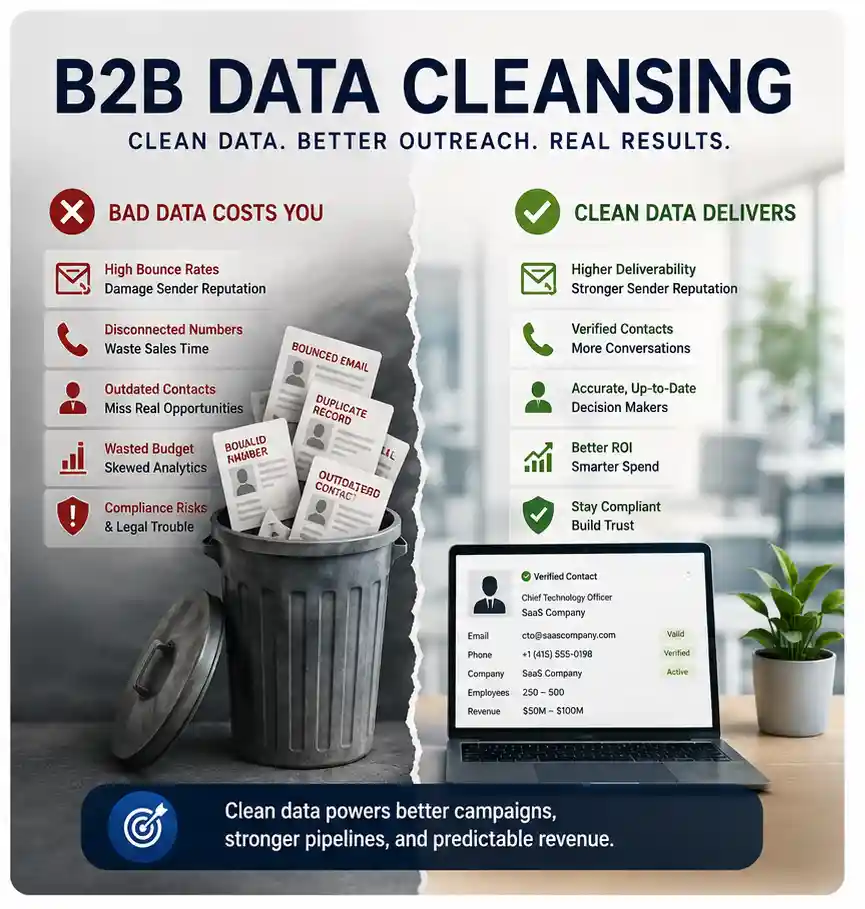
Rings a bell? This isn’t just a random headache. This is the reality for hundreds of growth teams across the world every day. Your marketing automation tool is not showing good open rates, you suffer from domain reputation damage and your budget is wasted. All because your database is rotting at an alarming rate. About thirty percent of B2B data decays each year, with people changing jobs, companies merging and corporate domains shutting down. Relying on a non-maintained database is like running a marathon in boots that do not fit. You will waste energy, you will ruin your tools and you will get nowhere.
Let’s discuss the financials. Bad data is not only an operational annoyance, it is a silent revenue killer. According to Gartner’s research on data quality, poor data costs organisations an average of twelve point nine million dollars every year. Let that settle in for a moment. This isn’t the price of a few bounced emails. Lost sales hours, wasted ad spend, skewed marketing analytics, and the unseen compliance risk of messaging people who have not opted in. Your sales ops managers are spending half their week manually patching lists instead of refining the pipeline. Your business is actively losing cash.
What is the fix? It starts with a commitment to proper b2b data cleansing. In plain English, B2B data cleansing is the systematic process of identifying and correcting corrupt, inaccurate, or irrelevant records within your marketing database and CRM system. It is a thorough cleanup operation. This involves removing duplicate entries, standardising formats like phone numbers and postal codes, verifying active contact details, and enriching existing profiles with missing firmographic data points.
There is also a misconception that cleansing entails removal of all the bad emails. This is not the case at all, as the procedure is much more complex. The cleansing procedure ensures that all the noise is stripped off, while the context of the targeted accounts is preserved and improved.
In the cleaning ecosystem, there is also a confusion between verification and cleansing. Let us make things clear right now.
What is data verification? In B2B marketing, data verification is the process of checking contact records against live, authoritative databases to confirm they are accurate, active, and valid. This step ensures that email addresses exist, phone numbers connect, and job titles match current reality before you send an outreach campaign.
Think of it like this: Cleansing builds the structure and verification tests the foundation. If you don’t verify, you’re still guessing. You might have a well formatted record for a director working in a major firm. If that director left the company last month, your well formatted record is worth nothing.
So, how do you solve this issue without bringing the entire sales pipeline of the business to a halt? It is not as simple as suspending all sales activities for a month in order to clean your CRM. You will need a proper data cleansing process.
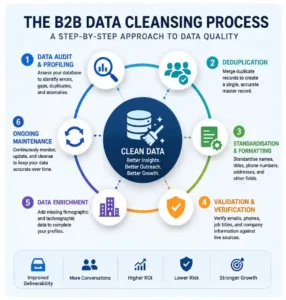
A standard enterprise-grade data cleansing process generally follows four distinct phases. First, you run a comprehensive data audit to establish a baseline of your data health. Second, you execute deduplication and standardisation to ensure your formatting is uniform. Third, you run the verification step we just discussed to purge the dead weight. Finally, you focus on data enrichment to fill in the blanks, adding crucial details like company size, revenue, and direct-dial phone numbers.
Doing this whole process on your own inside your organization will most likely make you frustrated. This requires specialized software and lots of manual effort which your teams don’t have enough time to spend on. That’s why savvy marketers leave all the hard work to data cleansing service providers. At discovermsps.com, we provide a dedicated data cleansing service tailored specifically for complex B2B databases. We handle the formatting, the checking, and the scrubbing so your sales reps can focus on what they do best: talking to real, live prospects.
Let us go through the stages in the clean up process to see exactly how your data is handled in its professional makeover. The first structure challenge that affects nearly all corporate CRMs is that of duplicate and unstandardized entries. Where there are different forms entering data into a single database, format inconsistencies are bound to arise.
Why B2B Data Cleansing Matters for Growing Companies
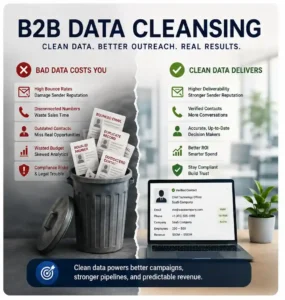
When your database decays, the damage ripples across your entire sales and marketing operation. It is not just about a few rejected emails. The real cost shows up in the daily workflow of your sales development representatives. Imagine a rep spending twenty minutes researching a prospect, customizing an outreach pitch, and tailoring a value proposition, only to find the phone number belongs to a residential home or the target buyer left the firm during last year’s restructuring. Multiply that by thirty reps across an entire quarter. That is thousands of high-value sales hours spent chasing ghosts instead of closing deals.
Marketing automation platforms compound this waste. Most B2B marketing systems charge you based on the total number of contacts in your database. If twenty per cent of your CRM consists of duplicate records, invalid emails, and abandoned corporate domains, you are paying your software provider a hefty premium to host trash.
Worse still, sending campaigns to these dead inboxes actively destroys your sender reputation. Internet service providers track bounce rates closely. If your outbound campaigns consistently hit hard bounces, email servers begin to tag your corporate domain as a source of spam. Once that happens, your emails stop landing in the primary inbox of even your valid prospects. Your deliverability tanks, your campaign metrics collapse, and your forecasting becomes complete guesswork.
How do you get an accurate sense of the pipeline valuation in the face of fictional data? Clean data solves this forecast dilemma. It gives you a solid starting point, one in which you can trust your conversion rates and attribution revenue.
The Data Cleansing Process, Step by Step
To fix a compromised database, you cannot rely on ad-hoc updates. You need a structured methodology that addresses data quality systematically. True data hygiene requires looking at the framework established by data management professionals. Experts evaluate data health using specific parameters. If you look at the industry standards, you will find DAMA International’s recognised six dimensions of data quality, which include accuracy, completeness, consistency, timeliness, uniqueness, and validity. A proper cleanup addresses every single one of these dimensions through a logical sequence.
Data Audit and Profiling
Before altering a single record, you must understand the current state of your database. A thorough data audit scans your system to flag the volume of blank fields, formatting anomalies, and obvious syntax errors. This step does not fix the data; it simply shows you where the rot is concentrated so you can choose the correct data cleansing solutions.
Deduplication
Duplicate records create chaotic customer experiences. If a prospect downloads two separate whitepapers using slightly different name variants, your system might create two independent leads. Two different sales reps might call the same person on the same afternoon. Deduplication uses advanced matching logic to merge these scattered entries into a single, clean master record, saving your team from embarrassing operational blunders.
Standardisation and Formatting
Data enters your CRM from various touchpoints: web forms, webinar sign-ups, and manual entries. This creates structural messiness. One record might list a country as “USA,” whilst another says “United States.” Phone numbers might lack country codes, and job titles might be written in uppercase alphabet soup. Standardisation forces every piece of information into a uniform format, ensuring your segmentation filters actually catch every relevant lead.
Validation and Verification
Once the structure is uniform, you must test the validity of the data. This means checking that the email box actually exists without sending a live message, verifying that the phone line is active, and confirming that the target individual still holds the designated role at the company. It is about weeding out the dead data before it touches your live outreach sequences.
Data Enrichment
A clean record is useful, but an enriched record is powerful. Once the old data is scrubbed, professional data cleansing services add fresh context to your profiles. This involves appending missing firmographic details like annual revenue brackets, exact employee headcounts, and corporate location data. For sophisticated campaigns, this step should also include a dedicated data enhancement strategy to layer in verified technographic profiles, showing you exactly what software stack your target account is currently running.
Ongoing Maintenance
Data cleansing is not a one-off project that you complete and forget for three years. The moment your database cleanup finishes, decay begins again. True data hygiene requires establishing an ongoing maintenance schedule, setting up automated validation rules at the point of entry, and scheduling regular data sweeps.
Implementing a continuous data cleansing process keeps your database pristine over the long term. This ensures your growth teams never revert to wasting time on stale leads. Now that you understand the mechanics of the cleanup framework, the next step is assessing whether your organisation should build an internal data maintenance operation or partner with an external provider.
How to Choose the Right Data Cleansing Service
Selecting the right partner to scrub your database is not a decision you should make based on pricing pages alone. A low-cost provider often costs you more in the long run if their methods are flawed. When you evaluate an external data cleansing service, you must look closely at their actual verification methodology. Many budget operations rely exclusively on automated web scraping. They pull old data from public profiles and call it a day. The problem is that public profiles are often outdated. You need a partner that combines algorithmic checking with human verification to ensure the data is actually fresh.
Ask prospective vendors about their accuracy guarantees and replacement policies. A reputable provider will stand behind their data quality. They should offer clear policies to replace any records that hard-bounce within a specific timeframe after delivery. If a vendor hedges when you ask about accuracy percentages or refuses to define what constitutes a failed record, walk away.
You must also scrutinise their compliance posture. With regulations like GDPR, CCPA, and various international privacy laws actively enforced, how a vendor sources and verifies information matters immensely. If they cannot explain their data privacy protocols, they are putting your brand at serious legal risk.
Watch out for red flags during the initial sales conversation. If a vendor refuses to provide a free sample batch of your own data to prove their capabilities, they are likely hiding a high error rate. Vague explanations about how they source their records or claims that their database never decays are clear warning signs. A trustworthy provider will be entirely transparent about their data age, their matching algorithms, and their data refresh frequency.
Depth of information is another critical factor. A standard cleanup might fix simple formatting errors, but sophisticated marketing operations require deeper insight. You want a provider that can deliver thorough technographic and firmographic details without compromising turnaround times.
For security-focused outreach, this depth becomes paramount. If you are targeting highly technical buyers like Managed Security Service Providers, clean and verified data matters even more because of how specialised that buyer audience is. These prospects are notoriously difficult to reach, highly sceptical of generic marketing, and quick to block domains that send irrelevant or poorly targeted messages.
The Role of a Data Verification Specialist
While software can catch obvious formatting blunders and duplicate entries, human oversight remains the gold standard for data accuracy. This is where a dedicated data verification specialist comes into play within a professional data cleansing service. These specialists do not just run automated scripts; they manage the complex edge cases that software inevitably misses.
On a day-to-day basis, a verification specialist reviews conflicting data points that automated tools flag as ambiguous. For instance, if an executive’s profile shows one job title on a corporate website but a different title on a press release, the specialist investigates further. They conduct manual checks against primary source records, cross-reference official corporate registries, and sometimes even make direct phone calls to confirm that a specific decision-maker is still managing a particular department.
This manual intervention is what separates high-grade data cleansing solutions from cheap scraping software. An automated tool might see a valid email syntax and mark it as safe. A human specialist, however, will recognise that the company recently restructured its internal email conventions, meaning the old format will quietly drop into a catch-all inbox without ever reaching the intended recipient.
Specialists understand the nuances of corporate hierarchies. They know that a “Director of Infrastructure” at a mid-market firm might have the exact same purchasing power as a “Vice President of Operations” at an enterprise organisation. They ensure that these contextual nuances are preserved and properly categorised within your CRM database.
Organisations with highly specific targeting needs often discover that standard off-the-shelf databases fail to move the needle. When your ideal customer profile requires niche criteria that standard filters cannot capture, you need a more tailored approach. These organisations often need a custom approach to data sourcing, which is why a targeted custom data-research strategy is so effective. This methodology combines the analytical power of automated cleansing tools with the precise curation of human specialists to build a pipeline of pristine, highly targeted accounts from scratch.
Data Cleansing Considerations Across Global Markets
Managing corporate records across multiple jurisdictions requires an understanding of distinct international regulations. Data hygiene is not just about campaign efficiency; it directly impacts regulatory compliance.
In the United States, your outbound outreach and data storage practices are governed by a mix of federal and state laws. The federal CAN-SPAM Act regulates commercial email formatting and opt-out mechanisms, whilst state-level frameworks like the California Consumer Privacy Act (CCPA) grant consumers strict rights regarding the sale, sharing, and deletion of their personal information. Keeping your CRM scrubbed ensures you can honour opt-out requests promptly across state lines.
Crossing the Atlantic introduces stricter frameworks. In the United Kingdom, operations must align with the UK GDPR and the Privacy and Electronic Communications Regulations (PECR). These laws dictate strict rules around consent and legitimate interest for business messaging. Similarly, the European Union’s GDPR sets a high benchmark for data protection globally, requiring businesses to justify holding any personal corporate data and to delete records that are no longer accurate or necessary. Utilizing professional data cleansing services helps ensure your database does not contain non-compliant or expired records that invite heavy regulatory fines.
Further afield, Canada enforces the Personal Information Protection and Electronic Documents Act (PIPEDA) alongside Canada’s Anti-Spam Legislation (CASL). CASL is famously stringent, requiring explicit or implied consent for almost all electronic corporate messaging. Meanwhile, in Australia, data storage and outreach are regulated by the Privacy Act 1988 and the Spam Act 2003. Regularly deploying b2b data cleansing routines keeps your global lists scrubbed against national do-not-call registries and opt-out lists, keeping your international marketing operations on the right side of local authorities.
Frequently Asked Questions
How accurate is DiscoverMSPs’ data?
How often is DiscoverMSPs’ data refreshed?
Can I get a free sample before committing?
1. What is data verification?
Data verification is the specific component of database maintenance that confirms the accuracy and operational status of individual data points. Whilst general cleansing formats and structures records, verification cross-references details like email addresses, direct-dial phone numbers, and job titles against live sources to ensure they are active before a campaign launches.
2. How often should B2B data be cleansed?
B2B databases should undergo a thorough cleansing at least once every quarter. Because professional contact data decays at a rate of roughly two to three per cent each month due to job changes and corporate restructuring, waiting a full year to run cleanup routines allows thousands of invalid records to accumulate, severely damaging your domain deliverability.
3. What is the difference between data cleansing and data enrichment?
Data cleansing focuses on purging errors, removing duplicate entries, and correcting formatting flaws within an existing database. Data enrichment is the subsequent process of adding new, missing context to those clean records, such as appending firmographic details, company revenue brackets, or technographic profiles to complete a prospect’s profile.
4. How long does a data cleansing process take?
The duration of the cleanup operation depends entirely on the size of your database and the depth of verification required. A standard automated scrub of fifty thousand records can occur within forty-eight hours, whereas a comprehensive review involving manual verification by data specialists may take five to seven business days to ensure complete accuracy.
5. Can bad data affect my marketing automation software costs?
Yes, inaccurate data directly inflates your software expenses. Most marketing automation and CRM platforms base their subscription pricing tiers on the total volume of contacts stored in your system. Retaining thousands of duplicate, inactive, or invalid email records means you are paying a premium to host unusable data.