
Every Tuesday morning at 08:30, the Chief Operations Officer of a fast-growing London-based logistics firm sat through the same IT status update. Every week, the report was green. Systems were operational; tickets were being closed within the agreed service level agreement (SLA); the baseline was holding. Yet, underneath this veneer of technical stability, the company was fracturing.
A new supply chain platform slowed down badly during peak trading hours. It cost the business about £12,000 a week in unfilled orders. Staff often skipped the official cloud storage and used unsafe personal accounts. Why? The company file-sharing tool asked for three separate logins every time a document opened. The outside IT provider met its contract to the letter. But it had lost touch with what the business needed. This is where Top Managed Service Providers stand apart. They look past basic service levels to improve speed, security, the user experience and long-term growth.
This is the quiet crisis of modern IT. Picking the wrong partner rarely causes a dramatic outage that makes the news. Instead, it is a slow leak of output. Small points of friction quietly eat into profit, and the daily reality drifts far from what the board wants.
The decision to review your outsourcing strategy has never carried higher stakes. The modern enterprise technology stack is no longer just an operational utility; it is the infrastructure upon which market valuation and competitive advantage are built. When an IT partner acts merely as a digital caretaker, the business inevitably hits a growth ceiling.
Why Businesses Outgrow Their Existing IT Partner
Growth changes how a business is built. A tech setup that works well for a forty-person firm in one region becomes a bottleneck when the firm grows to three hundred staff across several countries. Firms usually outgrow their IT partner not because the provider is bad. It is because the provider runs out of capacity, skills and vision.
As firms grow from regional players into global ones, their risks change a lot. A local IT shop that is great at desktop fixes and simple server moves is rarely ready for complex supply chains, international data laws or the strict standards of bodies like the National Institute of Standards and Technology (NIST).
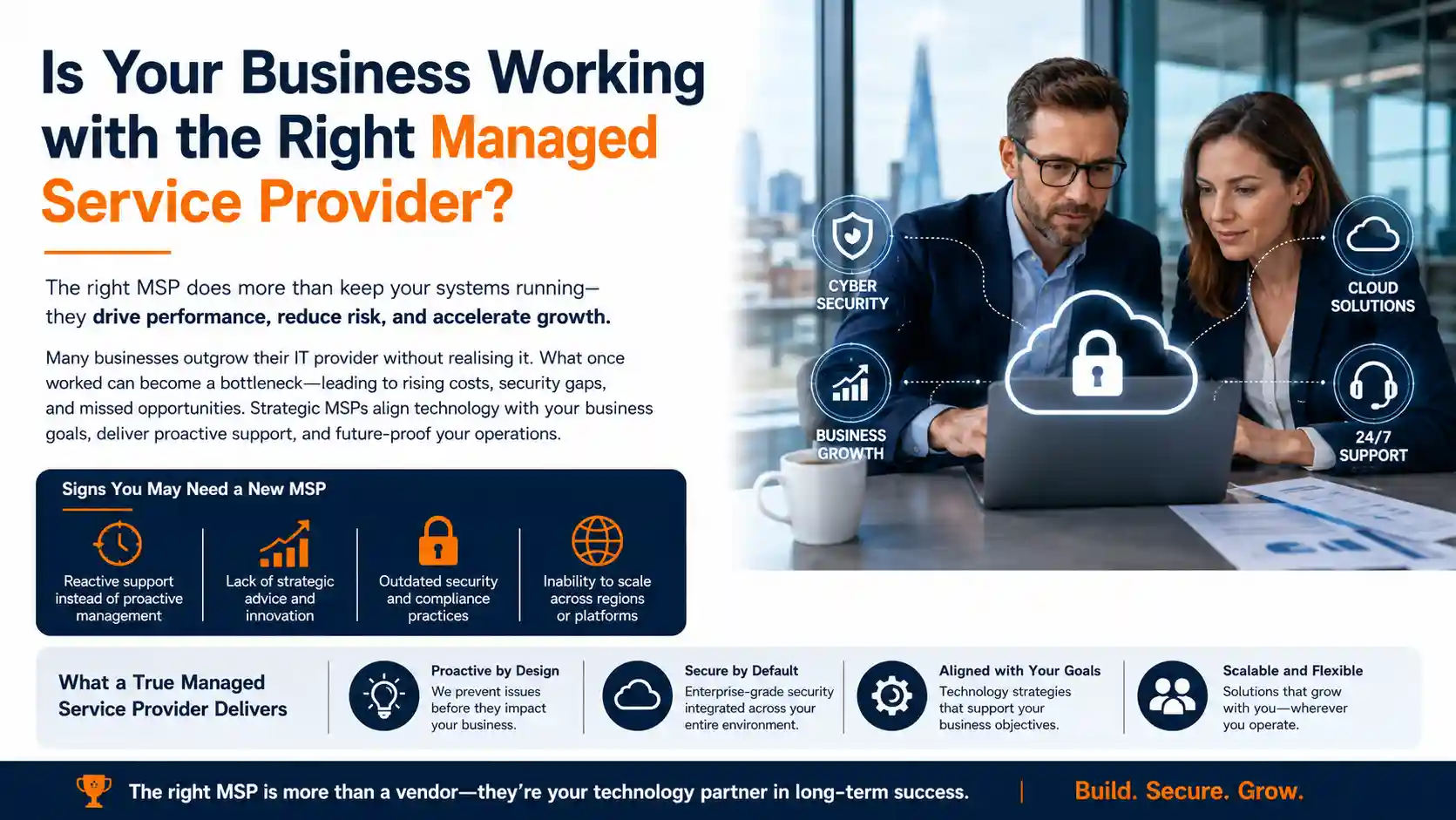
Signs that your business has outgrown its current provider include:
- Reactive troubleshooting over proactive governance: Your provider resolves issues efficiently after they occur, but fails to anticipate architectural vulnerabilities before they disrupt operations.
- Stale advice: Quarterly reviews look only at past ticket numbers. They never cover your roadmap, cloud design or how tech could give you an edge.
- Weak security: The provider sets up basic antivirus and firewalls. It lacks the round-the-clock monitoring needed to stop advanced, persistent threats.
- Cannot scale across regions: You need compliance in many countries, local support and smooth cross-border data. Your current provider cannot deliver it.
To build a firm that is nimble and can scale, leaders must research the field of top managed service providers. Look for partners with the deep sector skills that real growth needs.
The Difference Between IT Support And A True Managed Service Provider
It is a common misconception among growing firms that all technical outsourcing is created equal. Many organisations operate under the assumption that they have hired a strategic partner, when in reality, they have simply outsourced a break-fix helpdesk under a recurring monthly fee. Understanding the distinction between basic IT support and an enterprise-grade partner is critical to making informed procurement decisions.
Basic IT support is inherently reactive. When a server goes down, a laptop fails, or a user cannot access the local network, the support team steps in to remedy the immediate failure. The relationship is defined by volume: how many tickets were logged, how quickly were they resolved, and did the resolution fall within the contracted time limits?
Conversely, the best managed service providers act as an extension of your internal executive leadership team. They don’t just fix what breaks; they design, deploy, and continuously optimise the entire technological ecosystem to drive specific business outcomes.
To judge your current partner, compare how delivery models differ across a few key areas:
- Operational Philosophy: Traditional IT support waits for your staff to report an anomaly. A premier managed service provider utilises predictive monitoring and automated analytics to resolve system degradation before your internal teams are even aware a vulnerability existed.
- Data and Infrastructure Design: Basic support keeps your databases online. An advanced partner checks how well your platforms are built. It uses an enterprise msp database to plan strong, cloud-native data setups with no single point of failure.
- Security Built In: Standard IT firms often treat security as an add-on: a firewall here, a patch cycle there. True top managed security service providers build security into the core of your network. They run full Security Operations Centres (SOC) and align your setup with the guidance published by the Cybersecurity and Infrastructure Security Agency (CISA).
- Aligned Incentives: A tactical vendor sees your budget as income from hourly or per-user bills. A strategic partner sets its service goals around your business numbers. So your tech spend leads to lower running costs and faster launches.
Are you working with a partner who understands where your business needs to be in five years, or are they simply keeping the lights on today? If you are tasked to find an msp that can navigate the realities of modern enterprise cloud migration, data compliance, and sophisticated threat landscapes, the evaluation must move far beyond standard technical checklists.
When you decide to leave an old vendor, or to outsource for the first time, the market looks crowded and unclear. The problem is rarely too few candidates. It is how many claim exactly the same skills. To cut through the noise, use a structured method. Then your partner fits both your tech needs now and where the business is heading.
A Methodical Framework to Find an MSP That Fits
The initial phase of procurement frequently relies on professional networks, peer recommendations, and digital listings. However, enterprise leaders must ask a foundational question: can I trust online MSP directories? The short answer is that value depends entirely on data structure and commercial neutrality. A basic, unverified directory frequently functions as a pay-to-play advertising space where positioning is bought rather than earned.
A strong, verified msp database instead lets operations managers and CIOs filter candidates on detailed criteria. The focus should move from who is nearby to who truly fits how you run.
To see if a provider really knows your sector, look for hard evidence, not marketing promises:
- Dedicated compliance competencies: If your enterprise operates within highly regulated sectors such as healthcare, financial services, or defense aerospace, the provider must demonstrate a working familiarity with specific frameworks. A generic promise to “keep data secure” is insufficient when your operations require strict adherence to SOC 2 Type II audits, HIPAA protocols, or international data transfer regulations.
- Industry software experience: A top partner should have a track record with the core apps in your sector. That might be complex ERP, legal practice software or supply chain analytics.
- Case studies with real numbers: Ask how they fixed design problems for firms of your size and complexity. Strong partners will gladly share anonymised data that shows the gains after onboarding.
Critical Questions for the Vetting Process
Moving from a longlist to a shortlist requires a rigorous technical evaluation. The primary objective is to move past the polished sales presentations and interrogate the actual operational engine of the provider. How do I compare providers fairly when their service models appear identical on paper? The answer lies in forcing specificity during the request for proposal (RFP) stage.
Every business leader should get clear, plain answers to these questions before signing a contract:
- What percentage of your staff are dedicated, certified tier-three engineers versus first-line helpdesk agents? This ratio dictates whether your account will be handled by strategic infrastructure architects or simply passed through a call-routing center.
- Can you define the exact boundary between your standard service inclusion and out-of-scope project work? Unclear definitions here are the primary cause of post-contractual budgetary friction, particularly during cloud migrations or hardware refreshes.
- How do you handle data sovereignty and regional storage requirements? For global organisations, it is imperative to know exactly where backups reside and how the provider complies with cross-border privacy mandates.
- What is your documented disaster recovery protocol for your own business operations? A technology partner must prove their own business continuity plans are robust before they can be trusted to protect your enterprise infrastructure.
Recognising the Signs of Hidden Operational Weakness
In contract talks, strong providers are open and clear. Struggling vendors often show small signs of strain or tech limits. Spotting these early can save a firm millions in lost output and failed migrations later.
Watch closely for these critical red flags during the evaluation phase:
- Reluctance to provide direct access to technical architects: If every conversation must be brokered by a sales representative and you are blocked from speaking directly with the engineers who will design your cloud architecture, the provider may lack senior technical depth.
- Vague SLAs: Avoid vendors who promise uptime in general terms, without clear penalties or credits when they miss it.
- Too much outsourcing: Some providers lean on white-label outside teams for core work like threat detection or 24/7 monitoring. That adds unchecked links to your supply chain.
The True Cost of Commodity IT Pricing
When you pick on the lowest monthly price per user, the business almost always loses money elsewhere. Cheap IT outsourcing is an illusion. A vendor charging far below the market must make its margin back somehow. It usually does so by under-staffing the help desk, delaying key patches or charging high fees for work outside the scope.
A low-cost procurement strategy frequently leads to hidden costs, including:
- Compounded technical debt: Cheap providers focus on quick fixes that resolve the immediate ticket but ignore the underlying architectural instability, leaving you with a brittle system that hinders future growth.
- Opportunity loss from employee downtime: Saving a few thousand pounds on a monthly retainer is instantly erased if a poorly managed network outage leaves hundreds of staff unable to access core enterprise applications for a full afternoon.
- Higher security risk: Skimping on threat hunting and patching leaves you open to heavy fines and serious harm to your name if a breach happens.
To keep your IT an asset, not a growing burden, focus on value, not price. The verified platforms on DiscoverMSPs give you a clear way to find top managed service providers who see tech as a driver of growth. As the buying process moves on, shift the conversation from basic support to long-term resilience.
The old way of finding a new tech partner is slow. Buying teams spend months building spreadsheet lists from random searches. They book calls with unverified vendors and chase basic credentials. This adds huge delays. By the time a firm narrows its options, the problem it set out to solve has often changed. Meanwhile, the business runs on old infrastructure and leaders stay stuck in admin checks.
Accelerating the Research Phase with Verified Databases
The core reason business leaders waste months researching providers is a lack of structured, centralized information. Searching for technical partners via standard web queries exposes decision-makers to thousands of fragmented websites, each using identical marketing language and unverified claims of enterprise capability. Sorting through this digital clutter to determine a vendor’s actual scale, compliance posture, and engineering depth is a monumental task.
A modern, structured msp database changes this. Instead of checking websites one by one, tech directors filter the global market on standard criteria. Months of ad hoc research shrink to days. Firms match their exact needs against a verified pool of proven partners.
But it only works if the data is sound. What sets a verified MSP database apart from random online directories? How it checks the data. Random directories are passive noticeboards. Anyone can post a listing, claim cloud migration skills and hide behind a smart landing page. A professional database curates its data. Providers must prove their results, specialties and regional compliance before they are listed.
The Critical Importance of Verifiable Information
In an era of sophisticated digital supply chain risks, data accuracy is not a luxury, it is a compliance necessity. Enterprise leaders frequently ask: how can I trust MSP information found online? Trust cannot be based on marketing brochures or unverified aggregate review scores. True validation requires looking for structures that cross-reference a provider’s stated capabilities against actual technical realities, such as certified engineering counts, verified toolsets, and established historical performance.
Tech changes fast. So how often should provider data be updated? In a healthy market, data cannot stand still. A provider that had twenty certified cloud architects a year ago may have lost many of them since. That changes whether it can handle a big migration. Good databases need regular review, ideally every quarter or every six months. Then staff numbers, security certificates and compliance status match the vendor's real state.
Before you contact a possible MSP, your buying team should check a few basics to protect your timeline:
- Current tier-three engineering capacity: Ensure the vendor has the internal human infrastructure to support your deployment scale without relying on unvetted subcontractors.
- Real framework compliance: Confirm they follow global standards in practice. Cross-check their profiles against industry networks like the About Managed Service Providers Network to make sure they are legitimate.
- Real-world regional support coverage: Verify that their active helpdesk operating hours align perfectly with your global office locations and shift patterns.
Evaluating Top Managed Security Service Providers
Corporate networks face ever more complex attacks. So checking a general IT provider is very different from judging a dedicated security provider. When the talk turns to protecting your assets, leaders must know how to compare managed security service providers without getting lost in jargon.
A general IT partner keeps systems running. A security partner protects the data that flows through them. To tell a standard provider with basic security add-ons from a true security firm, check a few key abilities.
Real security is defined by these benchmarks:
- Dedicated, proprietary Security Operations Centres (SOC): The provider must operate a dedicated team of threat analysts working round-the-clock, rather than assigning security monitoring to general helpdesk engineers who are distracted by day-to-day troubleshooting tickets.
- Threat hunting and SIEM: The vendor must use a strong Security Information and Event Management (SIEM) system to study network data in real time. It should hunt for odd behaviour, not wait for a firewall alert.
- Written incident response plans: A top security partner gives you clear, step-by-step plans. They show how it will contain, isolate and remove a breach within minutes of finding it.
Moving from ad hoc searching to a data-driven review protects your firm from the long-term friction of a bad match. The goal is a fair comparison based on verified facts. Then your final choice is a strong pillar for the future of your business.
Where a firm operates shapes what its tech setup needs. A buying plan that works well for a single head office in Chicago will soon fail if used as-is across the UK, Australia and Canada. Handling these regional differences is the mark of a mature buying process.
When evaluating potential technology partners, enterprise decision-makers frequently face a fundamental structural question: should I choose a local MSP, or can a global MSP be better? The answer is dictated by the complexity of your footprint and the localized nature of your regulatory exposure.
In the United States, IT management is tied closely to cloud setups that scale fast and complex state privacy laws. In the United Kingdom, providers must follow UK GDPR closely. They must also know the Crown Commercial Service frameworks if any public sector work is involved.
In Australia, sheer distance brings its own speed and connection issues. Top partners there must run hybrid cloud across great distances. They must also follow the Australian Signals Directorate (ASD) Essential Eight. In Canada, firms must meet federal and provincial data laws, such as PIPEDA. That often means hosting data locally, so sensitive data never crosses into the US.
To determine which model suits your firm, contrast the core operational priorities of local versus global providers:
- The Local Provider Model: Ideal for single-jurisdiction firms that require rapid, on-site hardware support, high-touch local engineering relationships, and deep familiarity with regional telecom infrastructure.
- The Global Provider Model: Key for global firms that need 24/7 help desk support across time zones, one international bill and the capacity to roll out network updates in many countries at once.
Industry-Specific Architectural Realities
Beyond geographical boundaries, a provider’s true value is measured by their understanding of your industry’s unique operational friction points. A generic approach to network design fails to account for the specialized software ecosystems and compliance penalties native to individual sectors.
Healthcare and Finance
In these sectors, a specialist security provider is no longer optional. It is essential. Healthcare needs full encryption of data at rest and in transit, to meet strict patient privacy laws. Financial services need fast, high-volume transaction systems, plus automated audit tools that satisfy strict banking rules.
Manufacturing and Legal
For industrial firms, IT reaches deep into the factory floor. Providers must secure older Operational Technology (OT) and Industrial Control Systems (ICS) without stopping production. Law firms rely on secure document systems, precise time tracking and e-discovery tools. These need full data isolation to protect client confidentiality.
Retail, Education, and Professional Services
Busy retailers need partners who keep store tills (POS) and online stores up all the time during peak sales. Schools and universities need networks that safely handle thousands of guest users across large campuses. Professional firms need flexible cloud setups, so teams around the world can reach project files safely from anywhere.
Preparing Infrastructure for Future Enterprise Scalability
When a firm grows fast, its tech debt can pile up quickly if the infrastructure is not ready. How should growing firms prepare for future IT needs? Moving from reacting to planning ahead takes careful design, long before the hiring surge starts.
Scaling a business depends on three tech pillars:
- Cloud Decentralisation: Migrating away from rigid, on-premises legacy hardware in favor of highly adaptable, hybrid cloud environments that allow your business to provision new computing resources instantly as operational demand increases.
- Ever-stronger security: Move from basic firewalls to a full Zero Trust Architecture (ZTA). Every user and device must prove who they are before they reach company data.
- Automated compliance: Use tools that log setting changes, patch status and access rights automatically, so the firm is always ready for an audit.
To avoid the bottlenecks that slow growth, firms need clean, organised data to review the market. The full msp database lets buying teams find partners with the right regional reach and certificates for the next stage. For firms under high threat, filter for verified managed security service providers, so strong defence is built into the base of your network. The aim is a fair, clear review process. Then, as you grow globally, your tech speeds you up rather than holds you back.
The Enterprise Transition: A Practical Decision Framework
Moving to a new tech partner is really about managing risk. To do it without disrupting the business, buying teams must look past their impressions from the sales process. They need a structured review. The last step is to check each candidate against a firm checklist, to expose gaps before contracts are signed.
Common Procurement Pitfalls to Avoid
- Accepting generic master services agreements (MSAs): Standard contracts frequently contain vague clauses regarding project scope, leaving the client vulnerable to unexpected engineering fees during critical infrastructure upgrades.
- Ignoring the exit plan: Firms often forget to agree how they would leave. Make sure that if the partnership ends, the vendor must hand back all system records, admin logins and data settings, with no penalty fees.
- Judging vendors only on today's size: A partner that fits you perfectly today may not cope after a big acquisition or a move into new countries.
The Strategic IT Partner Checklist
Before you sign, make sure the partner meets these benchmarks:
| Operational Pillar | Requirement | Verification Method |
| Architectural Depth | Proven alignment with global infrastructure standards. | Review documented compliance with NIST or ISO 27001 frameworks. |
| Response Integrity | Financial penalties for failure to meet service level agreements (SLAs). | Verify structured service credits within the active contract. |
| Operational Health | Internal financial stability and low engineering staff turnover. | Request historical headcount metrics and corporate duration data. |
| Threat Mitigation | Proactive threat hunting and continuous system monitoring. | Verify direct alignment with CISA operational directives. |
Frequently Asked Questions
How accurate is DiscoverMSPs’ data?
How often is DiscoverMSPs’ data refreshed?
1. How do I find an MSP?
Finding a good tech partner means moving past scattered searches to verified industry sources. Use a structured msp database to filter candidates by proven results, industry certificates and regional reach, not by unchecked marketing sites.
2. What is the difference between an MSP and an MSSP?
A standard Managed Service Provider (MSP) focuses on efficiency, network uptime and general infrastructure. A Managed Security Service Provider (MSSP) focuses only on cyber defence, threat intelligence and data protection. An MSP keeps your systems online. An MSSP runs a 24/7 Security Operations Centre (SOC) to hunt, isolate and remove advanced threats. Firms under strict rules should look at dedicated managed security service providers to secure their networks.
3. Why use an MSP database?
A central database cuts buying time, because you no longer need to check unverified vendors by hand. A professional platform such as DiscoverMSPs gives you a curated view where provider data is checked step by step. IT directors can compare candidates openly on real engineering capacity and compliance.
4. How often should businesses review their MSP?
Hold informal reviews every quarter to track ticket trends and system performance. Hold a formal strategic review once a year. Check whether the provider's tech roadmap still fits your growth, and whether the market now offers better value.
5. Can small businesses work with enterprise MSPs?
While it is technically possible, it is frequently counterproductive. Enterprise-tier providers build their service models around large-scale architectures and structured procurement paths. A smaller firm may find itself deprioritized in favor of larger corporate accounts. It is wiser to select a high-growth, verified partner whose mid-market expertise matches your current operational scale.
6. When should I change providers?
Change provider when stale tech starts to hold back growth. Clear signs are a shift from planning ahead to just fixing problems, outages that keep coming back, no advice on new tech, or no support for new regional rules.
Securing Long-Term Technical Resilience
Changing how you outsource tech is never a simple purchase. In a global market driven by speed, cloud maturity and complex threats, your tech partner is the base of how you operate. The wrong partner quietly drains momentum. It brings constant tech friction, surprise costs and weak security that exposes the business to serious legal and survival risks.
Choosing a partner through a data-driven review keeps your IT a strong engine for growth. Use verified networks like the About Managed Service Providers Network to filter the global market. Then leaders can find top managed service providers who truly understand how firms grow. Ready to leave break-fix support behind for an enterprise-grade setup? Taking charge of your research is the first step. Start a fair comparison by speaking with certified specialists through our Contact Us page, and align your IT with your long-term goals.
The Strategic IT Partner Checklist: How to Evaluate and Select a Top Managed Service Provider
A structured operational checklist for CIOs, procurement teams and enterprise leaders to evaluate, compare and select the right managed service provider before signing any contract.
Define your operational requirements and growth trajectory
Before approaching any vendor, document your current infrastructure scale, projected growth over 24 months, regional compliance obligations, and the specific technical capabilities you need. Clarity here eliminates mismatched vendors from the first call.
Use a verified MSP database to build your longlist
Avoid fragmented web searches. Use a structured, verified MSP database to filter candidates by geography, compliance certifications, engineering headcount, and service specialisation. This compresses months of manual research into days.
Check dedicated compliance competencies
Verify that the provider holds active certifications relevant to your sector: SOC 2 Type II, HIPAA, ISO 27001, NIST, or CISA alignment. A generic promise to keep data secure is insufficient for regulated industries.
Ask for the ratio of tier-three engineers to helpdesk agents
This ratio reveals whether your account will be handled by strategic infrastructure architects or routed through a first-line call centre. A provider heavy on helpdesk agents cannot deliver proactive architecture governance.
Demand clarity on SLA penalties and out-of-scope definitions
Force specificity during the RFP stage. Ask the vendor to define the exact boundary between included service and billable project work. Vague SLAs are the primary source of post-contract budget friction during migrations and upgrades.
Verify data sovereignty and regional storage compliance
For global organisations operating across the USA, UK, Australia and Canada, confirm exactly where backups reside and how the provider complies with GDPR, CCPA, PIPEDA, and ASD Essential Eight mandates.
Request verifiable case studies with performance metrics
Ask for documented examples of how they resolved architectural challenges for businesses of a comparable size and complexity. High-performing partners will share anonymised post-onboarding efficiency data without hesitation.
Negotiate the offboarding framework before signing
Ensure the contract specifies that if the partnership dissolves, the vendor is obligated to return all system documentation, administrative credentials, and data configurations without punitive fees. Failing to negotiate this upfront is one of the most common and costly enterprise procurement mistakes.

 ChatGPT
 Claude
 Google AI Mode