If you lead channel sales, manage revenue operations, or run marketing for an Independent Software Vendor, you know the frustration of a poorly constructed target list. The exact same frustration applies to teams selling to SaaS companies, cybersecurity firms, cloud distributors, and MSP-focused vendors. You spend weeks building a campaign based on company size, employee headcount, and job titles across the USA, Australia, Canada, and global markets. The list looks perfect on paper. Then your sales team starts making calls, and they hit a wall. The prospects are using incompatible legacy systems, or they just signed a long-term contract with your direct competitor.
This is where technographic data changes the conversation entirely.
If you are comparing vendors for this kind of data, see our breakdown of the best technographic data providers in the USA for a look at what separates verified, human-checked datasets from generic automated lists.
The disconnect between marketing and sales often starts right here. Marketing builds a list of ten thousand potential buyers. They filter for the right revenue bands and the correct job titles. However, when the sales representatives initiate contact, they discover that most of these prospects lack the foundational infrastructure required to run your solution. It is a highly inefficient way to operate.
Firmographics tell you if a company has the budget to buy. Demographics tell you who might sign the cheque. Neither of these data points can tell you if the company actually needs your specific solution right now. Relying solely on industry and revenue bands leaves your team guessing.
Technology data acts as the missing layer between seeing a company that looks right from a distance and knowing a company is actually ready for your offer. It removes the guesswork by showing you exactly what is running under the hood of your target accounts. For channel leaders and technology partners, having this level of visibility completely changes how you prioritise outreach and personalise your messaging.
What is technographic data in B2B sales?
At its core, this intelligence shows the technologies, platforms, tools, and infrastructure a company currently uses. Instead of assuming a prospect might need your integration because they operate in a certain vertical, b2b technographic data gives you concrete evidence. It reveals their software stack, hardware deployments, and cloud environments.
When revenue teams leverage a reliable B2B technology users database, they gain actionable insights that drive real commercial outcomes:
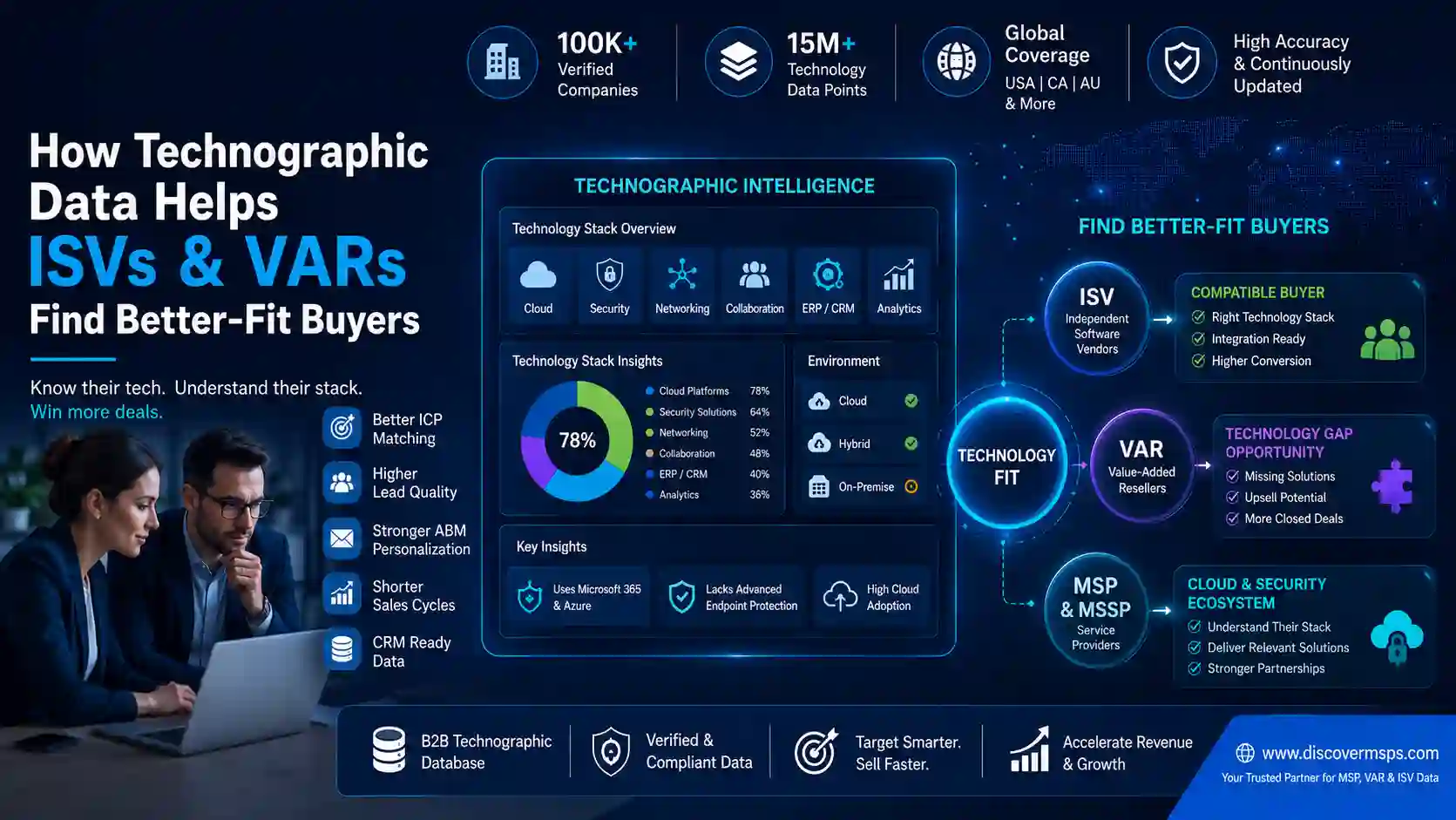
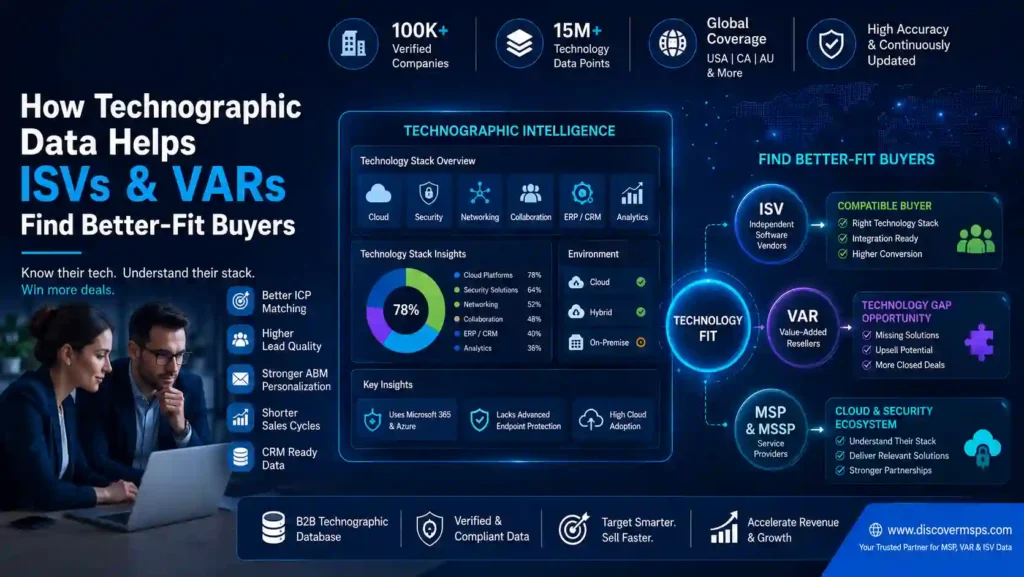
- Better ICP matching: You can filter out companies that use incompatible legacy systems before your sales team wastes time calling them.
- Higher lead quality: Marketing campaigns can target accounts based on their actual infrastructure, ensuring the leads passed to sales are genuinely qualified.
- Stronger ABM personalisation: Account-based marketing teams can craft highly specific messages that reference the prospect’s exact technology stack.
- Shorter sales cycles: Sales representatives enter the first meeting already knowing the prospect’s software environment, allowing them to skip basic discovery questions and immediately discuss integration or replacement value.
Working with reputable technographic data providers allows you to shift your perspective from reactive to proactive. You are no longer grouping companies by mere geographic location. You are grouping them by their technology footprint, their cloud maturity, and their digital behaviour.
Why does buyer fit matter more for ISVs and VARs?
Buyer fit is important for every B2B technology company, but for Independent Software Vendors and Value-Added Resellers, it is absolutely critical. The sales cycles are complex, the technical requirements are rigid, and the cost of pursuing the wrong account is incredibly high.
When you build an ISVs database without a technographic layer, you are essentially looking at a list of names and addresses. You have no idea what those companies are actually capable of supporting. ISVs must understand the operational reality of their prospects. They need to identify companies with compatible platforms, specific integration needs, matching deployment patterns, or obvious software gaps. If your software requires a mature cloud infrastructure to function correctly, calling a prospect who operates entirely on legacy on-premise servers is a futile exercise. You need to know their environment before you pick up the phone.
VARs face a similar challenge. Building a highly targeted VARs database requires extreme precision. A reseller needs to find accounts that already work with relevant vendors, specific infrastructure, and compatible security tools. If you are selling advanced network security solutions, you want to speak with an MSPs partner or an MSSP that lacks a comprehensive endpoint protection tool in their current stack. Having access to accurate technology data allows VARs to spot these software gaps instantly.
For example, if you are targeting managed service providers globally, you cannot afford to send generic pitches. The MSP contact data you use must be enriched with technical insights. Knowing that a prospect recently deployed a specific cloud platform gives your sales team the perfect hook to introduce an integration or a complementary managed service. It transforms a cold call into a highly relevant, timely consultation.
Without this intelligence, ISVs and VARs are forced to cast a wide net, hoping to catch a few accounts that happen to have the right infrastructure. This approach drains marketing budgets, exhausts sales teams, and leads to high churn rates when poorly matched clients realise the product does not fit their actual environment.
Integrating these technology insights into your daily workflows requires a strategic approach. It changes how you write your emails, how you structure your discovery calls, and how you position your value proposition. Moving away from generic firmographics and towards a deeply technical understanding of your buyer takes effort, but the return on investment is undeniable. Exploring the practical steps of this transition reveals exactly how top-performing teams execute their campaigns.
How technographic data helps ISVs find better-fit buyers
Independent software vendors operate in a highly specific ecosystem where products are built to connect with, enhance, or replace existing systems. If you target a broad list of companies simply because they have a Chief Information Officer or sit within a certain revenue bracket, you are wasting valuable resources. Using a reliable ISVs database layered with technographic insights allows your revenue team to identify compatible software environments before a single email is sent.
Consider the value of integration-friendly accounts. If your software integrates natively with a specific customer relationship management platform or enterprise resource planning system, targeting companies that actively use those platforms creates a natural reason to connect. The conversation instantly shifts from a cold introduction to a highly relevant discussion about improving their existing stack.
Furthermore, identifying accounts using competing or adjacent tools provides a massive strategic advantage. You can craft sales messaging that highlights your specific differentiators or addresses known weaknesses in their current setup. Buyers showing signs of platform maturity, such as adopting advanced analytics platforms or enterprise-grade marketing automation, often signal a readiness for more sophisticated vendor solutions.
An ISV can use technographic data to ask better questions before outreach, such as:
- Does this account use the foundational software required to run our product?
- Are they currently paying for a competitor tool that might be up for renewal?
- Does their adoption of specific cloud platforms indicate a mature digital infrastructure?
- Is there a clear software gap in their daily operations that our solution can seamlessly fill?
How technographic data helps VARs find better-fit buyers
For value-added resellers, the sales motion is built entirely around ecosystems. Your commercial value lies in advisory, implementation, migration, licensing, integration, and ongoing support. Pitching these complex services without knowing the prospect’s current infrastructure is incredibly difficult. Building your outreach upon a solid VARs database enriched with technology insights is the most effective way to solve this problem.
VARs need deep buyer context before they ever pick up the phone. You need to understand their existing vendor ecosystems and cloud infrastructure signals. If your goal is to sell complex security services, having access to an MSSP database or an MSP database segmented by technology focus allows you to pinpoint exact security stack signals. You can clearly identify which accounts use specific endpoint protection, backup solutions, network monitoring, or collaboration tools.
If you see a company using legacy on-premise infrastructure, you have a natural entry point to discuss a cloud migration strategy. If they have heavily invested in marketing automation but lack a connected CRM, you can step in to offer integration support and licensing. You are no longer selling generic IT services. You are offering a highly specific solution to a technical problem you already know they have.
What makes a technographic fit stronger than a generic contact list?
A standard contact list provides a very basic introduction. It tells you the name of the company, the industry they operate in, and the contact details of the decision-maker. While this is necessary information, it lacks the commercial context required to close modern B2B deals. A generic list tells you who the company is, but technographic data tells you what the company is already using, where the exact fit may exist, and why the timing might be right for a conversation.
When you move beyond basic demographics and firmographics, you unlock a much higher level of sales efficiency. This deeper level of intelligence provides several distinct advantages for your revenue teams:
- It reveals active software applications, cloud platforms, and cybersecurity solutions, giving your team a complete blueprint of the buyer’s environment.
- It dramatically improves lead quality and ICP matching, ensuring sales representatives spend their time on accounts with genuine intent.
- It enables true ABM personalisation, allowing marketers to tailor content based on the precise infrastructure tools a prospect uses daily.
- It improves overall conversion rates and sales cycle efficiency by removing the need for extensive technical discovery in the early stages of a deal.
Understanding the immense value of this intelligence is only the first part of the equation. The real challenge for modern revenue leaders lies in sourcing this information accurately. B2B technology environments change rapidly, and working with outdated or inaccurate intelligence is just as harmful as having no intelligence at all. Finding a partner who can deliver fresh, compliant, and verified technology insights is the next critical step in refining your go-to-market strategy.
How do you choose the right technographic data provider?
The market is currently flooded with vendors claiming to have the most accurate intelligence available. For revenue leaders, this creates a significant challenge. When sourcing technographic data for B2B targeting, the primary concern is almost always the same. You want to know how to ensure a provider will not just sell you another stale spreadsheet filled with obsolete information.
There is nothing more demoralising for a sales team than dialling into a list that is six months out of date. Bounced emails, disconnected phone numbers, and prospects who migrated away from a specific software platform a year ago are the hallmarks of poor intelligence. To avoid this scenario, channel heads and marketing directors must evaluate potential partners with intense commercial scrutiny. You need complete transparency regarding how the intelligence is gathered, cleaned, and maintained.
A good provider should be able to show:
- How the data is collected and the specific methods used to identify software usage.
- How often technology signals are refreshed to maintain high accuracy and relevance.
- Whether records are verified by humans to catch nuanced errors that automated scrapers miss.
- Whether contact and company data are checked together to ensure the decision-maker actually sits within the correct technical environment.
- Whether the data can be segmented by market, role, technology stack, geography, and company size.
- Whether the provider truly understands the complexities of the MSPs, MSSP, ISV, and VAR ecosystems.
- Whether privacy and compliance are clearly explained and strictly followed.
- Whether the buyer can review a sample before committing to a larger purchase.
Working with reputable technographic data providers requires a shift in how you view procurement. You are not just buying a list of names. You are investing in a foundational layer of technical intelligence that will dictate the success or failure of your entire go-to-market strategy.
How can you make sure the data is right before using it?
Even when you find a vendor that answers all those questions perfectly, the responsibility of validation still falls on your revenue team. Trusting the provider is important, but verifying the intelligence against your own internal standards is absolutely essential. Before you load thousands of new contacts into your marketing automation platform and launch an expensive campaign, you must take the time to evaluate the quality of the information.
Loading unverified b2b technographic data into your systems can damage your domain reputation and exhaust your sales representatives. A careful, systematic review process protects your operations and ensures high campaign performance.
When evaluating a new dataset, you should follow these practical steps:
- Ask for a sample to review the formatting, field structure, and overall cleanliness of the file.
- Check whether the records genuinely match your ideal customer profile and commercial objectives.
- Review job titles and authority levels to ensure you will be speaking with actual decision-makers.
- Check whether technology stack fields are useful, rather than vague or overly broad categories.
- Compare company size, location, and service category against your known market parameters.
- Test a small segment of the list in a pilot campaign before scaling a larger, resource-heavy outreach effort.
- Ask how invalid records are handled and what the replacement policy entails if data decays quickly.
Finding a partner that seamlessly aligns with these rigorous standards can be difficult. DiscoverMSPs is useful here because its site presents a highly transparent approach to intelligence gathering. They offer CRM-ready delivery and a strict 45-day refresh cycle, providing specific ISVs database and VARs database segments within one connected ecosystem.
What truly matters is the methodology behind the information. They utilise a comprehensive data verification approach covering contact verification, company verification, role and authority validation, email and phone validation, and technographic verification. This blend of automated verification and manual validation ensures a high level of accuracy. Furthermore, their commitment to data privacy and B2B data protection is clearly outlined, covering all user records, site services, and data enrichment tools. With GDPR and CAN-SPAM compliance built into their operations, buyers have the assurance that the technology data is both highly accurate and legally sound.
This level of operational transparency changes the entire buying dynamic. When sales and marketing teams know exactly how their intelligence is sourced, verified, and protected, their confidence in the outreach process increases dramatically. As data regulations tighten globally and buyer expectations evolve, the B2B landscape is shifting heavily toward trust, strict privacy adherence, and deep niche expertise. This evolution raises an important question regarding why newer, highly specialised platforms are now successfully competing against much older, generalised data providers in the modern channel ecosystem.
Why should a buyer trust a specialist platform over an older general data provider?
When revenue leaders begin evaluating intelligence vendors, they often face a choice between massive legacy databases and newer specialist platforms. The immediate assumption is sometimes that older, larger providers are inherently safer. This is not always the case. Older general providers certainly offer massive scale, which is useful if you are selling office supplies or generic business insurance across every industry imaginable. However, when you are selling complex cloud infrastructure or cybersecurity software, scale is much less important than context.
Specialist platforms can often offer significantly sharper category context for specific technology ecosystems. A general database might label a company as “IT Services” but a specialist provider understands the profound commercial difference between a managed service provider and an independent software vendor.
Ultimately, a buyer should not trust a provider simply because it is old or new. A buyer should trust the provider that can clearly demonstrate technical competence and operational transparency. Before signing a contract, you must ensure the vendor can show:
- Relevant category coverage that aligns exactly with your ideal customer profile.
- Clear segmentation that separates different types of technology businesses accurately.
- Transparent verification processes so you know exactly how the intelligence is cleaned.
- Freshness controls that guarantee you are not buying outdated technology signals.
- Sample records that allow your sales team to test the format and accuracy directly.
- Compliance information that protects your brand from regulatory fines.
- Useful fields designed for actual sales and marketing work, rather than vanity metrics.
- A team that truly understands your buyer’s target ecosystem and the nuances of channel sales.
For teams selling into these specific ecosystems, DiscoverMSPs is positioned as a specialist source. Its site intentionally separates these complex audiences into dedicated datasets, such as their ISVs database and VARs database, instead of treating them as one generic technology audience. You can read more about the DiscoverMSPs network to see how this targeted approach supports more accurate market segmentation.
How does DiscoverMSPs handle privacy and buyer confidence?
Buying B2B contact lists always carries a degree of risk regarding privacy compliance. Your marketing operations team needs absolute confidence that the information they are loading into your systems was gathered legally and ethically. Data privacy is not merely a legal checkbox. It is a fundamental component of protecting your corporate domain reputation and maintaining trust with your future customers.
Buyers should always review a vendor’s privacy policy meticulously before purchasing data. You need to understand exactly how the information is collected, processed, and protected from unauthorised access. A trustworthy provider will gladly explain their opt-out handling procedures, their adherence to global compliance standards, and the specific usage boundaries applied to their records. Furthermore, examining a vendor’s data verification methodology reveals how seriously they take the quality of their product. You should make sure the intelligence supports responsible, highly targeted outreach, rather than careless, high-volume spam campaigns. If you have specific questions about compliance parameters, you can always Contact DiscoverMSPs directly to discuss their processing frameworks.
Is technographic data useful for MSP and MSSP targeting?
Yes, technographic data is exceptionally useful for targeting managed IT and security providers. These businesses are entirely defined by the technology they use, integrate, and sell to their own clients. You cannot effectively pitch a new software solution to a managed security service provider without first understanding their existing security stack.
When you leverage an MSP database or an MSSP database enriched with technology signals, your sales approach changes completely. You transition from guessing what they might need to know exactly where their technical gaps are.
This intelligence is highly effective for these specific segments because it allows you to:
- Identify which security vendors they currently partner with to spot displacement opportunities.
- See if their cloud infrastructure matches the requirements for your software deployment.
- Determine if they are using legacy backup or network tools that are ripe for modernisation.
- Personalise your outreach by referencing the exact endpoint protection or PSA tools they use daily.
- Bypass generic introductory calls and move directly into technical integration discussions.
Once you have secured this level of accurate, compliant, and highly segmented intelligence, the next phase is operational execution. Having the right insights sitting in a spreadsheet is useless unless your revenue team knows exactly how to activate it. Building a practical framework for deploying this information across your marketing campaigns and sales sequences requires a disciplined approach to both strategy and timing.
How should ISVs and VARs use technographic data in real campaigns?
Acquiring high-quality intelligence is only the first step. The true commercial value emerges when your marketing and sales teams activate this information within live outreach sequences. To see a tangible return on investment, revenue leaders must shift away from volume-based email blasts and move towards highly structured, context-rich campaigns.
When you integrate technographic data into your daily operations, the entire structure of your go-to-market strategy becomes more precise. Instead of guessing what a prospect might need, your team can operate with absolute certainty about the environment they are selling into.
Practical campaign execution should follow a clear, methodical framework:
- Define the ICP by technology fit, not just industry: Move beyond basic firmographics and build your ideal customer profile around the specific technology data that indicates a true readiness to buy.
- Segment accounts by stack, size, location and service category: Break your master list down into highly specific cohorts. A cohort of small businesses using Google Workspace requires a very different message than a cohort of mid-market enterprises running legacy Microsoft Exchange servers.
- Personalise messaging around the buyer’s existing tools: Ensure every email and LinkedIn message directly references the software platforms they already use, making your outreach immediately relevant.
- Build partner campaigns for MSPs, MSSPs, ISVs and VARs: Use the intelligence to identify potential channel partners who share a complementary technology footprint.
- Prioritise accounts with the clearest technical fit: Direct your most expensive sales resources (your senior account executives) to work only on the accounts showing the strongest technical alignment.
- Give sales teams context before the first conversation: Equip your representatives with a complete map of the prospect’s infrastructure, allowing them to lead discovery calls with insight rather than basic interrogation.
- Use smaller test segments before scaling: Take a small sample from an ISVs database or a VARs database, run a pilot campaign, measure the engagement, and refine the messaging before launching a massive global sequence.
Final checklist: what should you look for before choosing a technographic data provider?
Procuring b2b technographic data is a significant operational decision. The intelligence you purchase will sit at the very foundation of your revenue engine. If the foundation is weak, outdated, or legally non-compliant, your marketing campaigns will fail to perform.
Before signing a contract with any technographic data providers, run through this practical checklist with your procurement and revenue teams to ensure the vendor meets professional standards:
- Does the provider understand your target ecosystem?
- Can you filter by geography such as USA, Australia, Canada and Global markets?
- Can you filter by technology stack?
- Can you filter by MSP, MSSP, ISV and VAR category?
- Are records verified?
- Is compliance explained?
- Is there a sample?
- Is the data CRM-ready?
- Is there a clear way to contact the provider?
- Is the provider useful for real campaign execution, not just list volume?
If a vendor hesitates to answer these questions or provides vague assurances about data quality, it is usually a sign that their intelligence lacks the depth required for modern B2B targeting.
So, can technographic data help ISVs and VARs find better-fit buyers?
Yes, when it is accurate, verified and used with a clear ICP, technographic data can help ISVs and VARs identify accounts that are more likely to understand, need and value their offer.
- For ISVs, it shows where the product can fit seamlessly into an existing software ecosystem.
- For VARs, it shows where the solution conversation is already relevant based on the prospect’s current infrastructure gaps.
- For MSP and MSSP-facing vendors, it brings structure to a market that is often fragmented and difficult to segment using traditional business metrics.
- For revenue teams, it reduces wasted conversations and improves the quality of outreach, protecting both sales morale and brand reputation in a competitive market.
If your team is ready to move away from generic contact lists and start targeting accounts based on real technical alignment, taking the next step is straightforward. You can Explore DiscoverMSPs to see how dedicated channel intelligence is structured, read more about DiscoverMSPs to understand their ecosystem expertise, or simply reach out to request a verified data sample to test the accuracy for yourself.
Frequently Asked Questions
1. What is technographic data in B2B sales?
Technographic data provides a detailed map of the software applications, cloud platforms, hardware, and infrastructure tools a company currently uses. Instead of guessing a prospect’s technical environment, revenue teams use this intelligence to see exactly how a business operates digitally.
2. How does technographic data differ from firmographic data?
Firmographic data tells you who a company is by categorising them by industry, employee headcount, and revenue. It indicates if they have the budget to buy. Technographic data tells you what systems they run. It indicates if they actually have the operational infrastructure and technical need to deploy your specific solution.
3. Why is an ISVs database more effective when enriched with technology signals?
Independent software vendors build products that must connect with existing systems. Without technology signals, an ISV is called blind. When enriched with this intelligence, an ISV can filter their database to find accounts that already use compatible platforms, ensuring a natural integration fit before they even initiate contact.
4. How do VARs use technology data to find better prospects?
Value-added resellers rely on this intelligence to understand a prospect’s existing vendor ecosystem. By seeing which endpoint protection, CRM, or cloud infrastructure a company runs, VARs can spot clear software gaps. This allows them to pitch highly specific implementation, migration, or licensing services rather than generic IT support.
5. Is technographic data useful for targeting MSPs and MSSPs?
Yes, it is essential for this market. Managed service providers and managed security service providers are defined entirely by their technology stacks. Knowing which backup solutions, network monitoring tools, or security frameworks they already deploy allows vendors to bypass basic discovery and immediately discuss displacement or complementary integrations.
6. What should channel leaders look for in technographic data providers?
Revenue and channel leaders should look for complete operational transparency. A reliable provider must demonstrate clear data collection methods, regular refresh cycles, human verification processes, and strict adherence to privacy compliance. They should also offer a sample file so you can verify the accuracy against your own ideal customer profile.
7. How can revenue teams verify the accuracy of a B2B technology users database?
Before scaling a massive campaign, revenue teams should request a data sample to review the formatting and field structure. They should check whether the technology stack fields are highly specific rather than vague. Finally, testing a small, focused segment in a pilot campaign helps measure bounce rates and actual engagement before rolling out a larger sequence.
8. How does DiscoverMSPs ensure data privacy and compliance?
DiscoverMSPs maintains a strict privacy policy that covers all B2B email lists, user records, and technology intelligence. They utilise a multi-layer verification approach and build GDPR and CAN-SPAM compliance directly into their operations. This ensures that the intelligence provided supports highly targeted, responsible outreach rather than careless volume.