
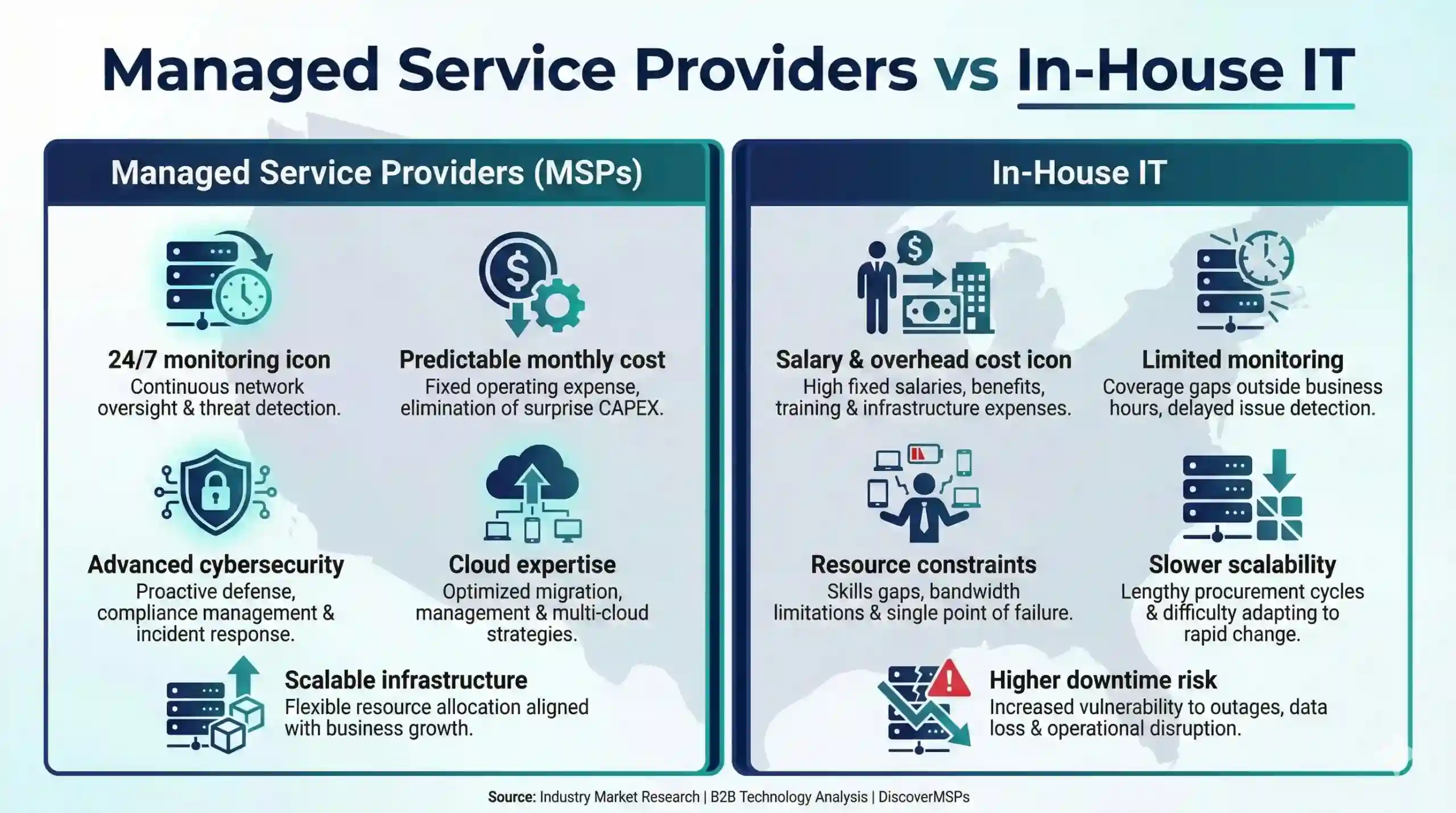
There are over 40,000 managed service providers operating across the United States. Every one of them has a website that describes exceptional service, deep expertise, and a commitment to client success. For businesses comparing the best managed IT service providers, separating genuine operational capability from strong marketing can be challenging.The reality, as anyone who has been through a difficult MSP relationship knows, is that the gap between what providers claim and what they deliver is wider in the US market than in almost any other, simply because the market’s scale and competitive density have produced an environment where marketing investment often exceeds service investment.The question of which company is the best managed service provider in the USA is not one that can be answered with a ranked list. It is one that can only be answered relative to a specific business’s requirements.
This is the insight that most “best MSP” content misses. CompTIA’s channel research identifies vertical specialisation as the single strongest predictor of managed service provider client retention in the US market. The best healthcare MSP in the country is not the best MSP for a defence contractor. The best financial services MSP in New York is not the best IT partner for a mid-market logistics company in Memphis. This guide explains how to identify the best managed service providers in the USA for your specific requirements, what the quality indicators are that separate top performers from the market average, and how verified provider intelligence accelerates the search. The DiscoverMSPs US MSP directory covers over 40,000 verified providers across all US markets.
Contents hideWhat the Best US Managed Service Providers Consistently Do Differently
After studying managed service provider performance across the US market, the characteristics that consistently distinguish the top tier from the average are not primarily technical. They are operational and commercial: the way the provider communicates, the depth of industry knowledge they bring to client relationships, and the commercial structure that determines whose interests the provider’s operational decisions serve.
Proactive communication before problems become incidents
The most reliable indicator of a top-performing US managed service provider is how often they contact their clients to flag potential problems before those problems become incidents, versus how often the client calls them with a problem they were unaware of. Average MSPs are reactive: they manage tickets and respond to alerts. The best US managed service providers are proactive: they review monitoring data trends, identify degrading system performance before it causes an outage, flag vulnerability scan results before the client’s insurer or auditor asks about them, and initiate conversations about capacity planning before growth creates performance constraints. This proactive posture is not accidental. It is the product of deliberate operational investment in review cadences, alert threshold calibration, and account management culture that prioritises client outcomes over ticket closure rates.
Vertical expertise that produces measurably better compliance outcomes
The best US managed service providers in regulated verticals have built compliance delivery into their service architecture rather than treating it as a billable project. A healthcare MSP whose standard service package includes monthly HIPAA risk assessment updates, continuous BAA inventory management, and quarterly security training coordination for client staff is delivering materially better compliance outcomes than one who offers HIPAA consulting as an add-on. The compliance expertise that produces these outcomes is built through years of serving clients in a specific regulated environment, not through reading framework documentation. Compliance-focused US MSPs listed on DiscoverMSPs reflect this vertical depth across healthcare, financial services, legal, and defence sectors.

Commercial structures that align incentives with client outcomes
The best US managed service providers use commercial structures that align their financial incentives with client technology outcomes rather than with activity volume. Fixed-price monthly contracts that include all core services without per-incident charges create an environment where the MSP is financially motivated to prevent problems rather than to generate billable ticket activity. Providers who charge per ticket, per call, or per incident are commercially incentivised by the opposite: more problems mean more revenue. When evaluating US managed service providers, the commercial structure of the proposed engagement is as revealing of the provider’s service orientation as any technical specification or reference conversation.
The Compliance Certifications That Identify the Best US MSPs
Third-party compliance certifications are not a guarantee of service quality, but they are the most objective evidence available that a US managed service provider has invested in building and maintaining operational programmes against independently verified standards.
SOC 2 Type II: the operational maturity benchmark
SOC 2 Type II is the most widely recognised compliance certification in the US managed IT services market. Unlike SOC 2 Type I, which attests to the design of controls at a point in time, SOC 2 Type II attests to the operating effectiveness of those controls over a period of at least six months, audited by a certified public accounting firm. The security, availability, and confidentiality trust service criteria covered by a typical SOC 2 Type II report provide clients with independently verified evidence that the MSP’s operational processes meet a defined standard. When reviewing a SOC 2 Type II report, pay particular attention to the exceptions section: a clean report with no exceptions is genuinely meaningful; one with multiple exceptions and management responses indicates areas where operational execution has not matched control design.
ISO 27001: the international information security standard
ISO 27001 certification demonstrates that the MSP has implemented, maintained, and had independently audited an information security management system meeting the requirements of the international standard. The 2022 revision of ISO 27001 added supply chain security, cloud security, and threat intelligence as explicit control domains, making current ISO 27001 certification more relevant to managed IT services than the previous version. US MSPs who hold both SOC 2 Type II and ISO 27001 certifications have invested in two independent assurance programmes, which is meaningfully stronger than either alone. DiscoverMSPs’ data verification methodology captures certification status as part of provider profiling, allowing businesses to filter for certified providers before beginning evaluation.
Sector-specific certifications for regulated verticals
The best US managed service providers serving regulated industries hold the sector-specific certifications that their primary verticals require. CMMC Level 2 for defence contractors. NIST CSF alignment documented for federal agency-adjacent clients. HIPAA Privacy and Security Rule compliance programme capability for healthcare. Microsoft Gold or Azure Expert designation for cloud-heavy managed services. These certifications are not interchangeable: an MSP with CMMC Level 2 certification is not inherently better suited for a healthcare client than one without it, because healthcare compliance requires HIPAA expertise, not CMMC. The best US MSP for your business holds the certifications most relevant to your specific regulatory environment.
Looking for the best managed service providers in your US market? Browse the DiscoverMSPs US directory to compare providers by vertical specialisation, certification, and regional coverage.
Regional Market Differences: Where the Best US MSPs Are Concentrated
The US managed IT services market is not homogeneous. Regional industry concentrations have produced MSP ecosystems with distinct specialisations that reflect the dominant sectors in each geography.
Northeast corridor: financial services and healthcare depth
The concentration of financial services firms, healthcare networks, and life sciences companies from Boston through New York to Washington DC has produced the deepest compliance expertise in the US MSP market. Northeast US managed service providers with financial services and healthcare specialisations have been refined by decades of NYDFS, HIPAA, and SOC 2 audit exposure that has eliminated providers who cannot meet the compliance standard. The best MSPs in this corridor command premium pricing that reflects genuine expertise rather than marketing spend.
Technology corridor: cloud-native and DevSecOps capability
The Seattle-to-San Francisco technology corridor has produced US MSPs with the strongest cloud architecture and DevSecOps capability in the country, reflecting the demands of technology sector clients who expect MSPs to understand multi-cloud environments, CI/CD pipeline security, and developer-oriented IT management. The best technology sector MSPs in this corridor are essentially indistinguishable from internal IT organisations in their technical sophistication, which is exactly what their clients need.
Texas and the mid-continent: energy and mid-market breadth
Texas-based managed service providers serve a diverse market combining energy sector OT security expertise, mid-market generalist managed IT services for the state’s large business community, and healthcare IT for one of the most populous healthcare markets in the country. The best Texas MSPs combine genuine OT security knowledge for energy clients with the broad managed IT capability that serves the mid-market businesses across Dallas, Houston, Austin, and San Antonio.
Frequently Asked Questions
How accurate is DiscoverMSPs’ data?
How often is DiscoverMSPs’ data refreshed?
1.What makes a managed service provider the best fit for a US business?
The best managed service provider for any US business is the one whose vertical expertise, compliance capability, geographic coverage, and commercial model best match that specific business’s requirements. There is no single best MSP in the USA. The evaluation criteria that matter most are vertical specialisation, compliance expertise for your regulatory frameworks, reference quality from current clients of comparable size, and SLA structure covering your actual operating requirements.
2.How do the best US managed service providers differ from average ones?
The best US managed service providers consistently outperform on proactive communication before problems become incidents, deep vertical expertise producing better compliance outcomes, and commercial structures that align provider incentives with client success. The most reliable indicator of a top-performing US MSP is the length of average client relationships: providers retaining clients for five or more years are delivering something average providers are not.
3.Which US regions have the strongest managed service provider ecosystems?
The Northeast corridor from Boston to Washington DC leads for financial services, healthcare, and government compliance expertise. The Seattle-to-San Francisco technology corridor leads for cloud-native and DevSecOps capability. Texas leads for energy sector OT security and mid-market breadth. The Research Triangle in North Carolina is strong for biotech and university sector clients. Each regional ecosystem reflects the dominant industries in that geography.
4.How do I verify that a US managed service provider is actually among the best?
Verification requires: current client references in your industry who have been with the provider at least two years; third-party certifications including SOC 2 Type II and ISO 27001; and a structured pilot measuring actual SLA performance rather than quoted commitments. Providers who resist reference conversations or cannot produce current certification documentation are not demonstrating the transparency that top-performing US MSPs consistently offer.
5.What compliance certifications distinguish the best US managed service providers?
SOC 2 Type II distinguishes operational maturity across the market. ISO 27001 indicates investment in a documented information security management system. Sector-specific credentials matter for regulated verticals: CMMC Level 2 for defence contractors, HIPAA compliance capability for healthcare, and Microsoft Gold or Azure Expert designation for cloud-focused managed services. The best US MSPs hold certifications most relevant to their primary verticals.
6.Should I choose a national or regional managed service provider in the USA?
Businesses with operations across multiple states typically benefit from national providers delivering consistent standards across locations. Businesses concentrated in a single metro area often receive better service from regional providers with deeper local market knowledge, faster on-site response, and stronger relationships with local technology vendors. The right choice depends on your operational footprint and how important on-site response capability is relative to geographic consistency.
The Best US MSP Is the One That Fits Your Business, Not the One That Ranks Highest
The search for the best managed service providers in the USA ends not with a ranked list but with a methodology. The methodology requires defining what best means for your specific business before evaluating any provider, using verified data to shortlist providers who match your actual requirements rather than those who market most aggressively, verifying claims against third-party evidence rather than accepting proposals at face value, and conducting structured reference conversations that reveal how the provider performs under pressure rather than only during normal operations.
US businesses who follow this methodology consistently identify managed service providers who deliver on their commitments, improve over time as they develop deeper knowledge of the client’s environment, and contribute to business outcomes rather than simply managing infrastructure. Those who skip steps in the methodology consistently end up in the 53% CompTIA identifies as switching providers within three years due to misaligned expectations.
DiscoverMSPs provides the verified provider intelligence that makes the methodology faster and more reliable. Over 40,000 verified US managed service providers, segmented by vertical, certification, geography, and technology stack. Start with the data and find the best managed service provider in the USA for your specific business.