Over the past fifteen years of speaking with IT buyers, channel sales teams, and MSP founders, I have noticed a distinct shift in how technical procurement operates. Selecting an IT partner used to be a relatively simple task. You would search a local directory, invite a few technical directors to your office, and pick the firm that felt right. That approach no longer works. Today, evaluating Managed IT Services Providers is a complex strategic process. Business leaders must look far beyond a basic vendor list or a polished sales presentation. Finding the right provider is about securing the correct operational fit, comprehensive geographic coverage, strict regulatory compliance, and sufficient service depth. It requires verified data and mutual trust.
While this search is a global challenge, USA buyers often face the widest choice of prospective partners. This vast market volume actually makes the shortlisting process considerably harder. Sifting through thousands of companies to find the one firm that truly understands your specific operational requirements takes time, patience, and a highly disciplined evaluation framework.
Why the right MSP search starts with clarity, not a list
Before you can compare providers properly, your organisation must know what it actually needs. I frequently see business leaders begin scheduling introductory calls with Managed IT Services Providers before defining their internal gaps. This always leads to fragmented conversations and misaligned commercial proposals. A highly capable provider might specialise in enterprise data centre environments, while your company might only need remote helpdesk support for a distributed workforce. If you do not categorise your technical requirements early, you risk wasting valuable procurement time on vendors who simply cannot serve your use case.
The first step in any successful IT procurement journey is an internal audit. You need to map out your current infrastructure, assess the capabilities of your existing staff, and decide precisely what you are trying to outsource. Different providers offer completely different engagement models. You must determine if your business requires:
- Full IT outsourcing to replace an internal department completely and manage all technology needs
- Co-managed IT to support an existing but overstretched internal team with specialised skills
- Cybersecurity support with advanced threat monitoring, threat hunting, and incident response
- Cloud migration and cloud management for complex platforms like AWS or Microsoft Azure
- Helpdesk support to ensure your employees can resolve daily software and hardware issues quickly
- Backup and disaster recovery to protect against crippling data loss and ensure business continuity
- Compliance support to navigate strict data privacy regulations and pass industry audits
- Multi-location support for distributed offices, regional branches, and remote workers
When you prioritise these requirements, you can eliminate generic providers immediately. A firm that excels at full IT outsourcing for single-office operations might struggle terribly with multi-location support across different time zones. Clarity allows you to measure every candidate against a defined standard rather than relying on a sales pitch.
Managed IT Services USA: why the American MSP market needs careful filtering
The American technology landscape is vast, highly fragmented, and incredibly competitive. When searching for Managed IT Services USA, procurement teams are often overwhelmed by the sheer volume of available choices. The USA market contains thousands of MSPs spread across 50 states. While this density offers incredible variety, it also means that not every provider fits every business profile.
An IT firm based in a specific region will naturally develop core competencies based on local economic drivers and industry clusters. A healthcare company in Texas needs a partner deeply versed in state compliance rules, HIPAA regulations, and secure patient data transfers. A SaaS company in California requires an MSP focused on rapid scaling, agile cloud environments, and high-level software development integrations. Meanwhile, a logistics firm in New Jersey needs bulletproof network stability, warehouse connectivity, and disaster recovery systems that prevent costly supply chain downtime. These three companies cannot use the same IT partner and expect the same high-quality results.
Because the United States market is so broad, buyers must apply strict filtering criteria. A structured evaluation prevents companies from signing expensive contracts with providers who lack the necessary scale or industry context. When you begin to shortlist USA MSPs, you must actively evaluate the following areas:
- Check state and regional coverage to ensure they can deploy onsite technicians to all your physical locations if hardware fails.
- Compare response times and SLA structure to guarantee their contractual commitments match your operational pace and financial expectations.
- Look at cybersecurity and compliance experience to confirm they have successfully navigated the exact federal and state regulations your industry faces.
- Confirm cloud platform experience to ensure they hold top-tier certifications with Microsoft, Google, or Amazon directly.
- Ask whether support is local, national or hybrid so you know exactly who is answering the phone when your staff encounter critical network issues in the middle of the night.
- Review whether the MSP understands your industry by asking for specific case studies and references from companies identical to yours.
Gathering this intelligence manually is a frustrating and time-consuming task for any procurement team. This is exactly where verified data platforms become an essential tool for technology buyers. Platforms like DiscoverMSPs help buyers filter providers by location, service type, certification, company size and industry. Using a verified directory removes the guesswork and allows decision-makers to focus their energy on interviewing only the most qualified candidates. By relying on accurate firmographic data, American businesses can confidently narrow down a list of thousands into a short, manageable selection of highly capable partners.
Once an organisation understands how to navigate the complex American market, the next challenge is evaluating providers in environments with entirely different regulatory structures and geographic demands, beginning with the United Kingdom.
Managed IT Services UK: choosing an MSP where compliance and service maturity matter
Transitioning from the American market to the United Kingdom requires a shift in how you evaluate service maturity. In my conversations with British CIOs and operations directors, the word that appears constantly is resilience. UK businesses operate under tight regulatory frameworks and compact geographic conditions, meaning they require Managed IT Services UK that look past standard day-to-day troubleshooting. A capable provider must act as a strategic partner that understands highly regulated sectors, data protection, complex cloud environments, cyber risk, and the realities of long-term hybrid working models.
The British market places an exceptionally high premium on data sovereignty and governance. With the strict implementation of UK data regulations, an MSP cannot simply promise that your information is secure. They must prove exactly where data rests, how it is backed up, and who has administrative access to it. Furthermore, as organizations rely heavily on unified communications and modern cloud infrastructure, your chosen provider must show deep technical competency across Microsoft 365, Azure, Google Workspace, or AWS. The focus must be on keeping your business operationally resilient against unexpected downtime or security breaches.
When evaluating vendors in England, Scotland, Wales, or Northern Ireland, look for structured methodologies rather than informal promises. What should UK buyers check before shortlisting an MSP?
- Does the provider understand UK data protection expectations and hold relevant security certifications?
- Can they support Microsoft 365, Azure, Google Workspace or AWS depending on your current software stack?
- Are response times written clearly in the SLA, with defined penalties if those commitments are missed?
- Can they support multi-site offices and remote staff seamlessly across different regional networks?
- Do they have sector experience in finance, legal, healthcare, manufacturing or professional services?
- Can they explain escalation processes clearly without hiding behind confusing technical language?
Navigating these detailed requirements is far easier when you understand the standards that define a top-tier technology partner. Reading through the background of verified industry networks via About DiscoverMSPs helps buyers see how professional vetting simplifies this entire selection process. Choosing a partner with verified credentials ensures your organisation is protected by mature operational standards.
Managed IT Services Australia: why local context changes the shortlist
Moving your focus to the Southern Hemisphere reveals an entirely different set of procurement challenges. When looking for Managed IT Services Australia, business leaders quickly realise that geographic isolation, vast distances, and specific regional time zones completely change the shortlisting criteria. A provider that looks excellent on paper might struggle if they do not have the physical footprint or the structural capability to support operations across major commercial hubs like Sydney, Melbourne, Brisbane, Perth, and Adelaide, let alone regional territories.
In Australia, cybersecurity awareness is exceptionally mature, driven largely by clear frameworks established at the federal level. Any serious technology provider operating in this market must be intimately familiar with local security priorities. They need to demonstrate a practical approach toward implementing the Australian Cyber Security Centre Essential Eight framework to mitigate cyber threats effectively. Beyond security, Australian companies frequently face high internet infrastructure costs and complex cloud consumption fees, making cloud cost control and governance a major priority for local leadership teams.
When dealing with Australian providers, your discovery calls should focus on practical availability and proactive cost management. A strong Australian MSP shortlist should answer:
- How do you support offices outside the main metro areas when physical hardware interventions are required?
- Do you offer after-hours escalation that aligns with our specific operating hours and global clients?
- How do you manage backup and recovery testing to prove our data can be restored during an emergency?
- What cyber controls do you review first when taking over an existing corporate network?
- Can you support cloud cost governance after migration to prevent unexpected monthly billing spikes?
- Do you give plain-language reporting to leadership so we can make informed budgeting decisions?
Reviewing these international regions highlights how much corporate culture and geography dictate IT requirements. The USA market usually gives buyers more volume and choice, forcing teams to spend extra time filtering out underqualified firms. The UK market often places stronger pressure on compliance maturity and highly structured service delivery frameworks. Meanwhile, the Australian market requires careful checking around geographic coverage, operational resilience, and practical support availability across vast distances.
Understanding these regional dynamics allows global organisations to adjust their expectations as they expand their search northward into the Canadian technology landscape.
IT Managed Services Canada: finding providers that understand scale, security and province-level needs
Looking toward the Canadian technology ecosystem, the market presents a unique blend of geographic expanse and concentrated commercial hubs. Canada has a broad provider landscape where physical location, bilingual support capabilities, cloud maturity, cybersecurity readiness, and specific industry background can all significantly affect your final decision. The reality is that a corporate office in Toronto, a resource business in Calgary, a tech firm in Vancouver, an agency in Montreal, or a public sector contractor in Ottawa may not need the same type of technology partner.
When you evaluate IT Managed Services Canada, you must consider both provincial nuances and national delivery standards. A vendor providing excellent support in Ontario might lack the field resources to service remote offices in British Columbia effectively. Furthermore, companies operating in Quebec require vendors who can deliver technical support and documentation flawlessly in both French and English. This adds a layer of complexity to the selection process that buyers must not ignore.
When comparing Canadian MSPs, ask your prospective partners:
- Which provinces do you actively support with direct, on-the-ground engineering staff?
- Do you offer fully bilingual support where needed by regional offices?
- Can you support both cloud-first and legacy hybrid infrastructure models?
- How do you document SLA response targets and formal escalation paths?
- What industries do you already serve within the Canadian market?
- How do you protect customer and business data according to local privacy laws?
- Can you provide references from similar organisations in our exact sector?
Ultimately, the right Canadian MSP should feel like a dedicated operating partner rather than a reactive ticket desk. They should understand your business objectives and actively look for ways to align your technology investments with your long-term growth plans.
Managed IT Services India: why cost is only one part of the decision
As global organisations look to scale their technical operations efficiently, India remains a highly compelling destination for technology partnerships. The market is historically attractive because of its tremendous technical depth, vast cloud skills, support scalability, and undeniable cost efficiency. However, treating the region simply as a budget-saving exercise is a fundamental mistake. Procurement leaders looking at Managed IT Services India must thoroughly vet vendors on operational quality, not just pricing schedules.
When offshoring or outsourcing critical IT functions, buyers must carefully check process maturity, clear communication standards, meticulous technical documentation, strict security protocols, business overlap hours, and the true quality of issue escalation. A provider might offer an incredible hourly rate, but if their tier-one support desk cannot resolve a critical network outage promptly, the cost of operational downtime will far exceed any initial savings. You need a partner who integrates seamlessly with your internal culture and understands the rhythm of your daily operations.
Before choosing an India-based MSP, always check:
- Whether the vendor team has proven experience managing technology for your specific business size
- Which enterprise cloud and cybersecurity platforms they support natively
- How they document infrastructure changes and track major security incidents
- Whether senior engineers are actually available during high-level technical escalations
- What reporting cadence they follow to keep executive leadership informed
- How they handle customer data governance and enforce strict access control
- Whether their time zone coverage truly fits your core business hours without disruption
Managed IT Services Germany: why compliance and engineering discipline matter
Moving into the European landscape, the criteria for selecting an IT partner become heavily focused on precision, privacy, and regulatory adherence. German buyers and international companies operating within Germany care deeply about GDPR compliance, strict data residency requirements, flawless documentation, and rigorous engineering discipline. The market here does not tolerate vague service agreements. An effective partner must offer highly structured service delivery, proactive cloud governance, and strong bilingual support for businesses operating across borders.
When evaluating Managed IT Services Germany, you are essentially looking for an organisation that treats technology management as a precise science. Security cannot be an afterthought. This is why many successful IT leaders rely on established methodologies, such as the NIST Cybersecurity Framework, to provide a structured way to think about cyber risk when comparing prospective vendors. While local German standards are paramount, aligning with internationally recognised frameworks ensures that your provider takes a systematic, verifiable approach to identifying threats and protecting corporate assets.
As we examine the stringent requirements of the European market, it becomes clear that selecting a technology provider is an exercise in managing complex regional demands. This level of scrutiny applies just as strongly when expanding the search further into major commercial hubs like Singapore, the Netherlands, and other highly competitive global MSP markets.
Managed IT Services Singapore: why regional reach and security maturity matter
Expanding your operations into the Asia-Pacific region typically brings your focus to one primary commercial gateway. Singapore stands out as a powerful hub for APAC operations, financial services, complex cloud deployments, advanced cybersecurity monitoring, and regional IT delivery. Because of this unique positioning, selecting an IT partner in this market requires evaluating more than just basic desktop troubleshooting. A business choosing an MSP in Singapore must actively check security maturity, regional support capabilities, cloud certifications, PDPA (Personal Data Protection Act) awareness, response structures, and the ability to support distributed teams across Southeast Asia.
The Singaporean market operates at a highly advanced technical level. Organizations here frequently use a hybrid mix of multi-cloud architectures and localized data centres to serve clients across multiple neighboring countries. This means your chosen vendor must have the engineering depth to handle cross-border latency issues, varied regional telecom providers, and complex data sovereignty rules. They must be able to maintain consistent network stability whether your staff are operating out of a central office in Downtown Core or a regional facility across the border.
For Singapore MSP selection, always verify the following operational areas:
- APAC support coverage to determine if they can manage infrastructure across Southeast Asian offices
- Cybersecurity and cloud certifications with major global providers like AWS, Microsoft, and Google
- PDPA and data handling awareness to ensure strict compliance with local privacy commissioners
- Experience with regional offices and managing communication across diverse cultural environments
- Helpdesk hours and escalation paths that match your international business operations
- Cloud cost management processes to keep cloud spending aligned with actual infrastructure use
- Reporting clarity for leadership teams who need to understand technical risk quickly
Managed IT Services Netherlands: why European coverage and data discipline matter
Shifting back toward Western Europe, the focus shifts heavily toward strict regulatory compliance and strategic transport links. The Netherlands serves as an essential hub for businesses that require comprehensive European coverage, robust cloud infrastructure, advanced logistics support, SaaS hosting, financial services, international operations, and GDPR-aware service delivery. Whether your corporate entity operates out of Amsterdam, Rotterdam, Utrecht, or Eindhoven, the expectation for technical discipline and operational transparency remains uniformly high across the country.
The Dutch market is known for its excellent digital infrastructure and highly multilingual workforce. However, the true test of a provider in this region lies in their relationship with data. Under European privacy mandates, an MSP cannot afford to be casual about data protection, remote access logging, or backup storage locations. The ideal partner must demonstrate a clean, systematic approach to managing security risks while maintaining the high network performance that modern logistics and SaaS enterprises demand.
A Netherlands MSP should be able to explain clearly:
- Where customer data is stored physically and how backup redundancy is handled
- How GDPR and local Dutch privacy expectations are integrated into daily service operations
- Which cloud environments they manage natively with in-house certified engineers
- How they support English-speaking and Dutch-speaking teams without communication friction
- Whether they provide network optimization, backup, security, and helpdesk under one unified agreement
- How they report operational risk, vulnerability patches, and monthly system uptime to your board
Beyond country pages: how to compare MSPs across global markets
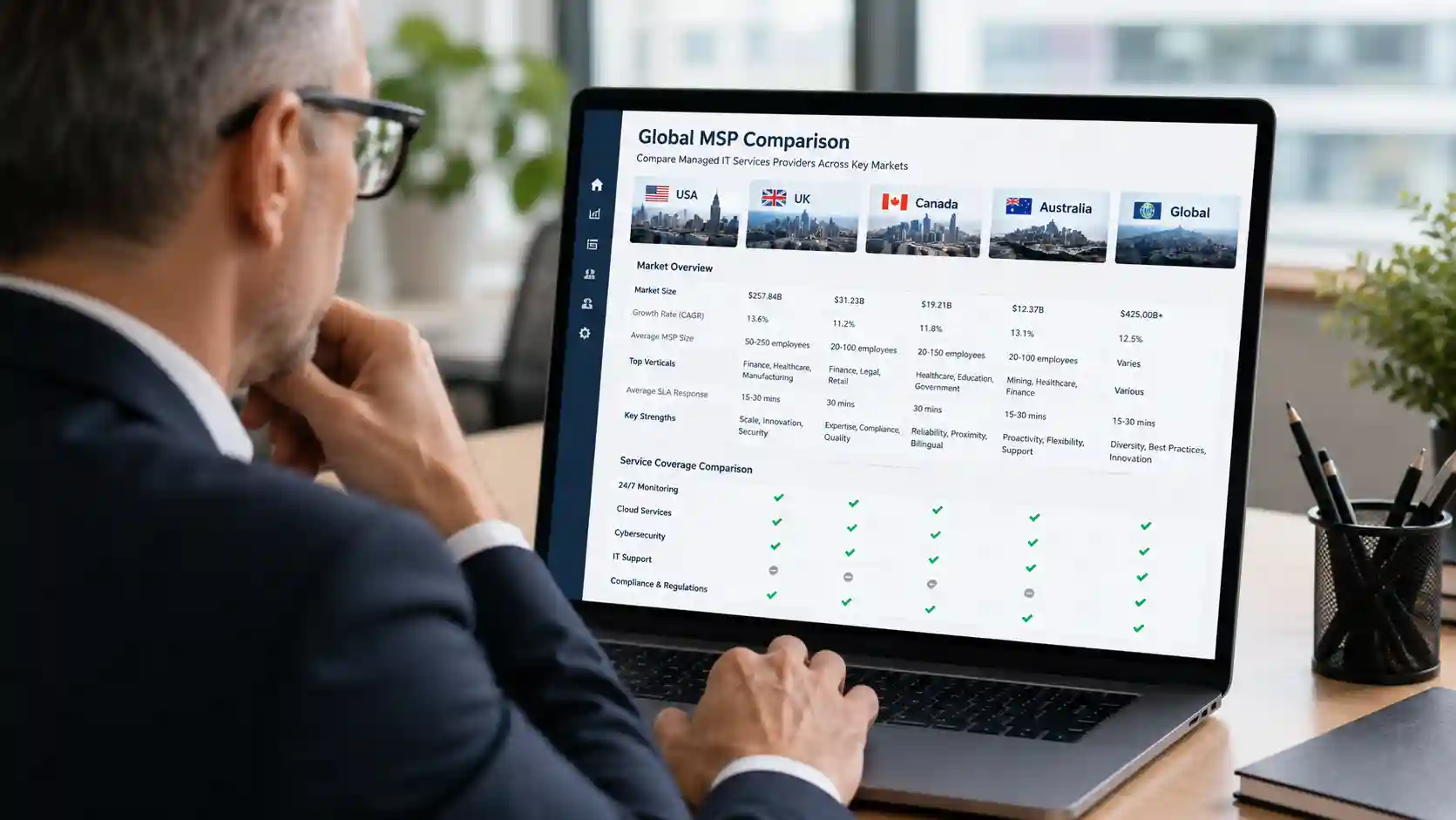
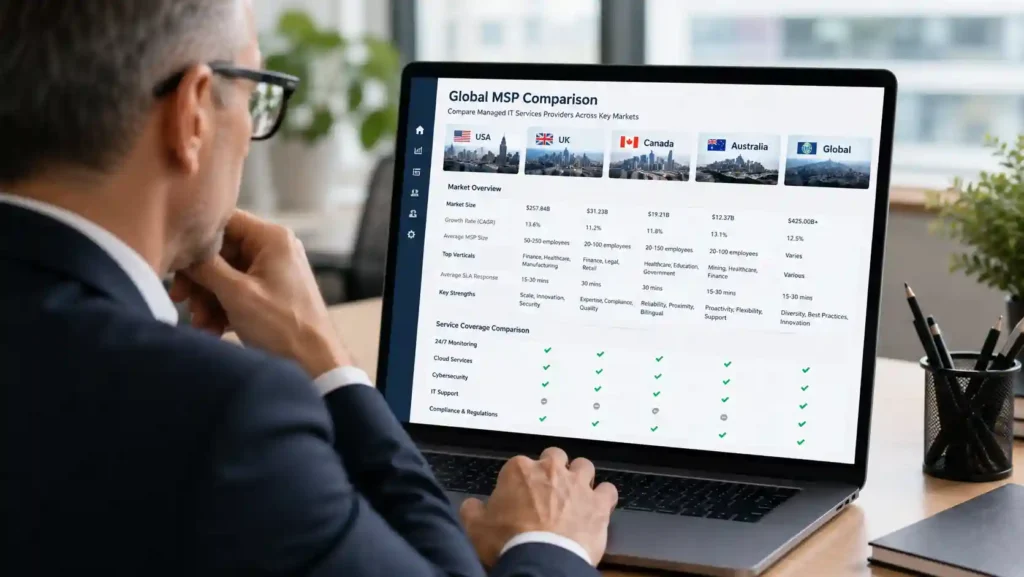
For businesses operating across more than one country, the procurement equation becomes much more complex than simply identifying a top local provider. The question is not only who is the best MSP in a single city, but rather which provider fits this specific region, this compliance requirement, this technology stack, and this particular growth stage. Finding a single provider that can handle every nuance perfectly is rare, which is why navigating a comprehensive global MSP directory is so valuable for international procurement teams.
To build a genuinely resilient technical infrastructure, you must move away from emotional decision-making and adopt a standardized scoring matrix. This allows you to evaluate candidates across different continents using identical criteria. A thorough global MSP comparison should always include:
- Country coverage and physical engineering footprint
- Industry fit and experience with similar regulatory environments
- Service categories, from co-managed IT to full outsourcing
- Technology stack alignment with your existing infrastructure
- Certifications held by actual engineering staff, not just the company entity
- Customer size fit to ensure you are not too small or too large for their business model
- Pricing models and transparency regarding hidden out-of-scope fees
- SLA clarity with well-defined response and resolution definitions
- Data protection approaches that satisfy multi-jurisdictional privacy laws
- References and verified proof of delivery within your specific sector
How can you trust the MSP data when there are older companies in the market?
A common question that arises during the vendor evaluation phase is how to trust information and recommendations, particularly when legacy providers have dominated the technology landscape for decades. The reality of the modern managed services industry is that age does not automatically equate to capability. A newer or more focused organization can frequently offer greater value and accuracy when it operates with a transparent methodology, verified records, a regular data refresh cadence, a clear contact process, and firm privacy commitments.
Older legacy firms often suffer from structural inertia, relying on outdated monitoring tools and bloated service agreements that do not fit agile cloud environments. A data platform or a focused service provider that prioritises real-time verification and objective firmographic filtering can provide far more accurate insights than a brand name relying on past reputation. True peace of mind comes from seeing exactly how data is handled, which you can easily evaluate by reviewing a platform’s formal Privacy Policy. Ultimately, trust should always come from rigorous verification, objective metrics, and transparent operating standards, not from corporate age alone. This objective perspective allows procurement teams to transition naturally into the final operational decision checklist.
A practical checklist for choosing the right Managed IT Services Providers
When evaluating Managed IT Services Providers, it is crucial to remember that the right partner is rarely the largest corporation, the oldest firm in the region, or the cheapest option on the table. Technology infrastructure is deeply personal to your business operations. The ideal provider is the one that aligns precisely with your specific risk tolerance, day-to-day operating model, regional footprint, financial constraints, and long-term growth trajectory. A smaller, highly specialised provider might offer far better operational resilience for a mid-sized firm than an enterprise-focused vendor that treats your account as a low priority.
Before you initiate formal conversations or request comprehensive proposals from any technology vendor, your procurement team should establish a clear baseline of your current situation. Use this practical discovery list to prepare your internal team:
- What specific technical services you need right now to keep daily operations stable
- What advanced services you may need in the next 12 months as your business expands
- Which specific countries, states, or provinces must be supported with hands-on technical care
- Your current cloud architecture and security software stack configuration
- Your exact regulatory compliance and data sovereignty requirements
- Your required support hours, including weekend coverage or 24/7 monitoring expectations
- Your internal IT team’s current capacity limits and skills gaps
- Your preferred corporate budget model, whether fixed monthly or consumption-based
- Your absolute must-have SLA terms regarding response and resolution times
- Your long-term data protection expectations and recovery time objectives
How DiscoverMSPs helps buyers move from research to shortlist
Sifting through countless corporate websites and marketing presentations to gather this data manually can quickly exhaust your administrative resources. This is where using a structured, data-driven methodology becomes invaluable. DiscoverMSPs helps corporate decision-makers compare technology providers systematically by country, service type, target industry, technical certifications, company size, and specific engineering focus.
Rather than acting as an aggressive sales pipeline, the platform operates as a practical procurement tool engineered to compress your research timeline and significantly improve the overall quality of your final vendor shortlist. By relying on verified firmographic data, your leadership team can bypass generic marketing hype and focus entirely on technical capabilities.
Why buyers use the platform to guide their procurement:
- To avoid starting their vendor search with a random, unverified web search
- To quickly compare providers side-by-side by precise location and technical speciality
- To find specific providers whose core competencies align directly with their current service needs
- To significantly reduce the hours spent checking basic corporate fit and vendor credentials
- To request an initial service sample or reference before moving into deep contract evaluation
- To consult directly via Contact DiscoverMSPs before committing significant capital budgets
Final thoughts: the right MSP is the one you can trust when systems are under pressure
A technology partnership is easy to manage when networks are stable, user requests are low, and security systems are quiet. However, the true test of an IT partner never occurs during peaceful operational periods. The real measurement of value happens in the middle of a critical network outage, a complex cyber incident, a rigorous regulatory audit, rapid corporate growth, difficult cloud migrations, or intense leadership pressure. The right provider delivers absolute clarity and decisive action before operational bottlenecks become expensive liabilities.
Navigating the nuances of Managed IT Services USA requires filtering out immense market noise, just as selecting Managed IT Services UK demands high compliance maturity. Similarly, assessing IT Managed Services Canada requires deep provincial awareness, while Managed IT Services Australia demands a focus on geographic resilience and distinct security frameworks. By anchoring your procurement process in verified data, you protect your organisation from misaligned partnerships.
If your leadership team is actively comparing technology providers across the USA, UK, Canada, Australia, India, Germany, Singapore, Netherlands, or wider global markets, start your journey with a verified shortlist rather than a broad, unstructured search. Take the time to explore available directory resources, compare country-specific operational strengths, and contact the advisory team when you are ready to request a sample or build a highly focused provider list tailored to your corporate goals.
Frequently Asked Questions
How accurate is DiscoverMSPs’ data?
How often is DiscoverMSPs’ data refreshed?
Can I get a free sample before committing?
1. How do I find the right Managed IT Services Providers?
Finding the correct provider requires defining your internal technical requirements first, then checking for regional coverage, specific service alignment, and industry-recognised engineering certifications. Relying on verified provider data rather than standard search engine results helps ensure you build a shortlist based on true operational capability.
2. Why should I compare MSPs by country?
Each country operates under completely distinct regulatory frameworks, data protection laws, business cultures, and time zones. Comparing providers by country ensures that your partner possesses the necessary local compliance knowledge, localized support hours, language capabilities, and regional engineering coverage to support your branches effectively.
3. Is Managed IT Services USA different from Managed IT Services UK or Australia?
Yes, the markets vary significantly due to local economic and geographic conditions. The USA market offers immense provider volume and choice, which requires careful filtering. The UK market places an exceptionally high premium on structured compliance maturity and data protection, while the Australian market demands careful attention to vast geographic distances, regional coverage, and specific federal cyber security frameworks.
4. Can DiscoverMSPs help with global MSP shortlisting?
The platform provides structured country-specific pages, detailed provider comparison options, and verified firmographic data. This allows international procurement teams to filter global vendors by industry expertise, certification levels, and location, reducing research time and improving shortlist accuracy.
5. What should I check before contacting an MSP?
Before reaching out to any vendor, confirm your internal service boundaries, mandatory SLA expectations, required cloud capabilities, and cybersecurity maturity needs. Additionally, verify their client reference history, data protection approaches, and pricing transparency to ensure they fit your specific business scale.